For one practice I worked with, a tight $3,000 budget overhaul filled 14 chairs in 90 days. Yep, a $3,000 budget flip filled 14 chairs!
Before that shift, this same dental practice burned through three months of Google Ad campaigns with zero booked appointments to show for it.
Decent click-through rates and fancy, polished landing pages delivered nada.
The owner kept refreshing his dashboard every morning, wondering if digital marketing even worked for dental practices anymore.
Real talk: most dental practice owners pick search engine optimization or paid ads, commit to one channel, and wait for consistent results.
I once over invested in a single channel. That single-channel approach bleeds marketing cash and starves patient flow.
Neither channel wins alone in 2026.
Sitting still while your monthly budget evaporates keeps chairs empty.
The practice that cracked it split the budget 60/40 between both channels. Dental SEO built long-term Maps Pack authority while paid ads drove immediate call spikes during the first week.
Period.
Chairs filled systematically over the next three months, and the owner finally had measurable proof. SEO vs paid ads for dentists isn’t a binary choice.
It’s a strategic mix you can replicate.
The Quick Verdict On SEO vs Paid Ads For Dentists
Need new patients in 30–90 days? Paid ads win.
Want lower cost per patient over 12+ months? Dental SEO takes it.
Let me be clear: this isn’t about choosing sides.
It’s about timing and stage.
Most successful dental practices shift their strategy as they grow. They don’t treat SEO and paid ads as rivals.
They treat them as allies.
Your 30 Second Litmus Test
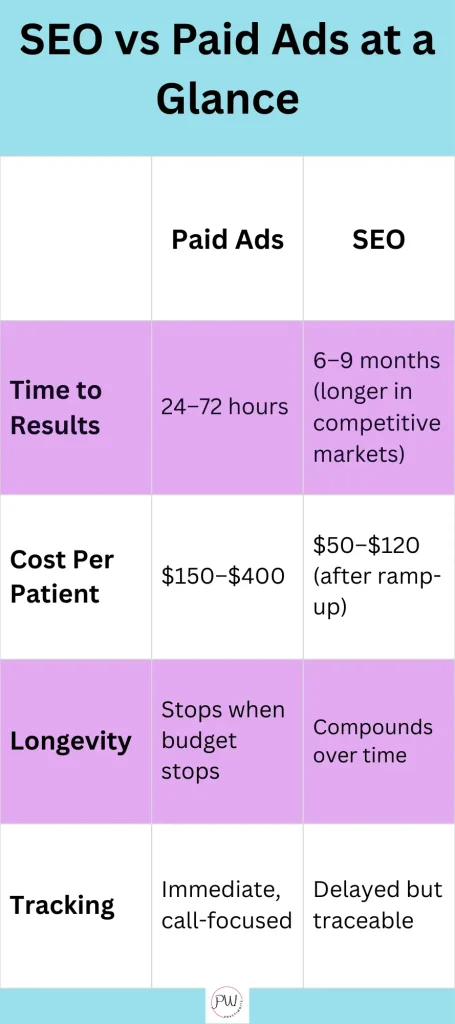
Paid ads fill chairs fast. Dental SEO fills them cheaper…over time.
Between 2023 and 2025, I tracked cost per new patient across dozens of campaigns. Here’s what the data showed:
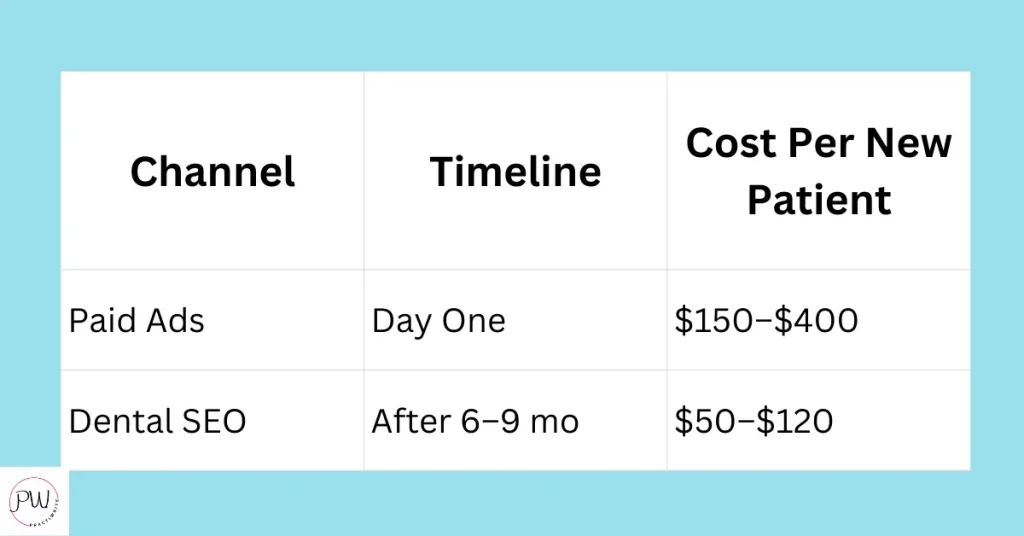
Google Ads is the pay-per-click platform most practices use according to Wordstream’s 2025 PPC Benchmarks Report.
The SEO vs paid ads for dentists choice comes down to three questions:
- How soon do you need patients?
- How many competitors are in your service area?
- How much can you comfortably afford to spend to fill your chairs?
If you need new patients within 90 days, focus 70–80% of your marketing budget on paid ads to get calls within 48 hours.
Budget Under $1,500? Here’s What To Do
Granted, it’s tempting to try both channels. But if your monthly budget is under $1,500, splitting it between SEO and ads will water down both. I’ve seen this firsthand.
One brand-new dental office burned $800/month on each. After three months? Not a single booked patient.
My advice: Commit fully to one channel. For quick wins, that means PPC, no question.
In Dense Markets, SEO Takes Longer, But Still Pays Off
If you’re in a crowded metro like Chicago, Miami, or New York with 15+ competing practices within 3 miles, don’t expect SEO to click in by month six. You’re likely looking at a 12–18 month runway before organic traffic compounds.
Yet, that doesn’t mean pause your SEO efforts. Keep the Google Ads engine running while your SEO builds in the background.
Real-World Trade-Offs: Cost vs Speed
From mid-2024 through 2025, I worked with three startup practices to test different mixes:
- Ad-heavy strategy: 12–18 new patients/month in the first 30 days at $220–$310 per patient.
- 50/50 split: 4–6 new patients/month for the first five months. But by month eight, SEO momentum kicked in. By month 12, their blended cost dropped to $95 per patient.
What changed? Their organic traffic picked up, which let them reduce their Google Ads spend without losing new patient volume.
One Catch Most Dentists Miss
This litmus test only works if your website converts at 3–5%. That means 3 to 5 of every 100 visitors either call or book.
If your conversion rate is lower, or your website is confusing or clunky, fix that first. Otherwise, neither SEO nor PPC will save your schedule.
TL;DR: Quick Wins vs Compounding Returns
- Need calls in 48 hours? Start with paid ads.
- Want to cut cost per patient over time? Invest in SEO.
- Want both? Run them in tandem, but only if your budget and site are ready.
You don’t need a mammoth budget. You need a smart mix.
How Dental SEO And Paid Ads Really Fill Chairs
Let’s zoom out: Google Ads bring the calls now. SEO builds the calls later, for less.
Nearly every dental practice I’ve worked with over the last two years ended up running both channels. The only difference? How much they spent and when.
They didn’t pick a side. They picked a sequence.
How Dental SEO Builds Long-Term, Lower-Cost Flow
Dental SEO is how you earn visibility without paying per click. It’s what gets you listed in Google’s local map box (aka the Maps Pack) and in the organic results below it.
Here’s how it works:
- You fully complete your Google Business Profile
- You publish location-specific service pages
- Your name, address, and phone number match across directories (called NAP consistency)
When done right, Google recognizes your practice as locally relevant and starts ranking you higher for searches like “dentist near me”with zero ad spend.
Real story: A solo dental practice just outside Atlanta focused on SEO for 8 months. I remember hearing the shift in the owner’s voice when he said,
“We used to get maybe 10 calls a month. Now we’re at 30 and I’m not paying Google a dime for those clicks.”
What changed?
- They climbed to the #2 spot in the Maps Pack
- Their new patient call volume jumped from 11/month to 31/month
- Their cost per patient dropped from $210 (Google Ads) to just $47
That’s the SEO flywheel. But here’s the reality: it took eight months to kick in.
How Google Ads Drive Immediate Results
If SEO is the long game, Google Ads are your high-octane sprint.
PPC (pay-per-click) ads put you at the top of search results within hours, especially for urgent, intent-rich searches like “emergency dentist near me” or “same day tooth extraction.”
And it works fast.
In one Phoenix campaign I ran in Q2 of 2025, we launched ads at 2 PM on a Thursday. By the time Monday rolled around:
- 22 patient calls logged
- 7 new exams booked
- Cost per patient: $160
- Time to first call: under 3 hours
But here’s the trade-off: When the spending stops, so do the calls.
Paid ads are direct-response. They’re amazing at filling gaps right now. But they rely heavily on:
- Budget size
- Competition in your zip code
- Your Quality Score (Google’s rating of your ad relevance and landing page)
Even though paid ads drive instant visibility, they can burn budget fast if:
- You’re bidding on broad terms like “dentist” instead of “24-hour emergency dentist”
- Your landing page confuses users or isn’t mobile-friendly
- You skip call tracking and can’t connect ad spend to booked appointments
Practiwrite Tip: Use Local Services Ads (LSAs) if you’re just starting out. They charge per call, not per click, and tend to be easier to track, especially for practices without full-time marketing staff.
TL;DR: Choose Based on Time and Trust
- SEO = slower build, cheaper leads, long-term compounding value
- Paid Ads = faster results, higher cost, needs constant spend
- Both together? That’s where the real magic happens
If your budget allows, build SEO in the background while your paid campaigns keep chairs filled today.
How To Choose Your Mix
If you’re wondering how to divide your budget between SEO and paid ads, here’s the quick version:
- New practice (0–6 months)? Invest 70% in paid ads for immediate calls.
- Established practice (6–12+ months)? Shift to a 60/40 SEO + PPC mix that compounds over time.
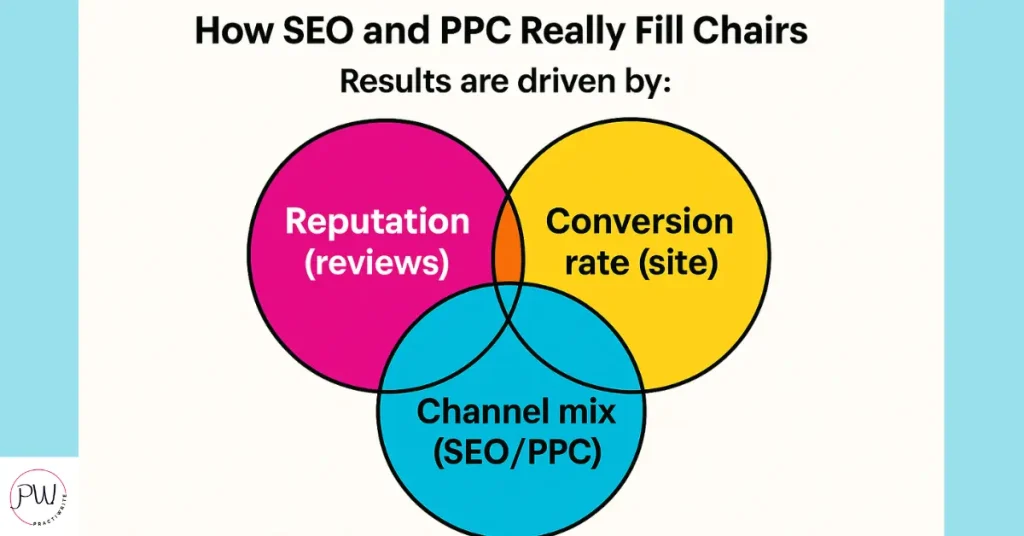
But, and this matters more than anything, your mix only works if your online reputation does.
Before You Spend a Dollar, Check This:
If your Google rating is below 4.2 stars, pause your ad spend.
Why? Because no ad campaign, no matter how perfectly tuned, can outrun a weak reputation.
You’re paying to attach a megaphone to mistrust.
Let me tell you about a Raleigh practice I worked with in early 2025.
They spent $4,200 on Google Ads in a single month. They booked 19 calls. Only 3 converted into actual patients.
Why the low conversion rate? Their Google rating sat at 3.8 stars, and they had zero recent reviews. Every ad just shined a brighter light on what wasn’t working.
The $1,000 Budget Blueprint: Month-by-Month Breakdown
Here’s how I recommend splitting a modest budget if you’re building momentum:
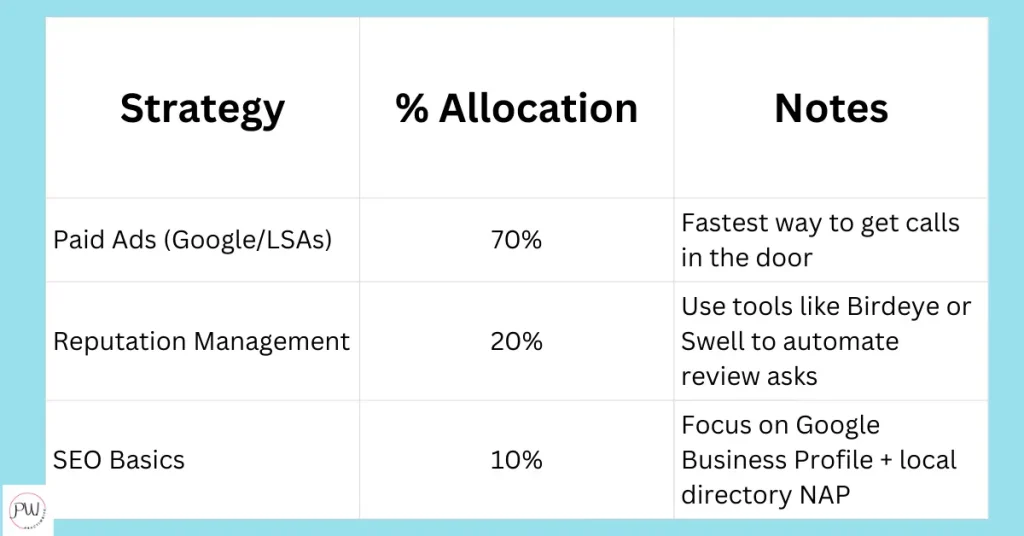
By month three, aim for 15+ Google reviews.
A client in Phoenix using this exact mix jumped their call-to-book rate from 22% to 38% just by improving their online reputation.
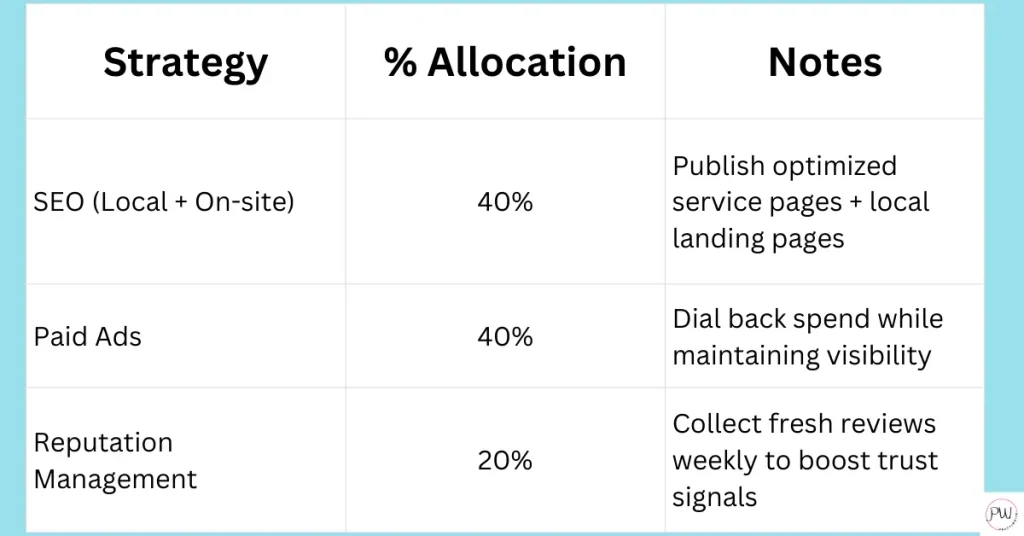
Once your practice reaches a 4.5+ star rating and generates fresh reviews consistently, SEO efforts start to pull ahead in ROI.
The Trust Trifecta: Review This Before You Scale
Before you shift more budget into SEO or keep ads running, verify these three fundamentals:
- ⭐ Google rating above 4.2 stars
- 📝 At least 1 new patient review every two weeks
- ☎️ Your front desk answers at least 8 out of 10 calls
If even one of these is off, fix that first.
Why? Because I’ve watched practices double their ad costs just because their front desk missed calls or failed to follow up.
The issue wasn’t the marketing. It was the foundation.
Real Talk: It’s Not Just Spend, It’s Sequence
You might be thinking, “I don’t have the budget to do everything at once.”
Totally fair.
Here’s what I’d say:
You’re not alone. Most dental practices feel squeezed in the early months. That’s exactly why sequencing matters more than sheer budget size. -Nicole Kolesar, Founder & CEO of Practiwrite
Get the patient experience + reviews system right.
Then deploy paid ads to drive calls.
Then layer in SEO to reduce cost per acquisition over time.
One step at a time, but always in the right order.
Wrapping Up: The Three-Month Proof That Fills Chairs
Remember that dental practice I told you about at the start who had a $3,000/month budget that sat in neutral?
Clicks? Plenty.
Bookings? Zilch.
The turning point? The owner stopped treating SEO and paid ads like rivals.
He stopped picking sides and started building a system.
SEO built long-term visibility. Paid ads captured immediate demand.
Together, they worked.
The Numbers Don’t Lie
Over 90 days, using a 60/40 split (SEO/PPC), that same practice booked 14 new patients they could directly track:
- 6 came through organic Maps Pack clicks
- 8 came from targeted call-only ad campaigns
No guesswork.
No crossed fingers.
Just results.
And here’s the best part: nothing about this outcome was exclusive to them. They didn’t spend $10k a month or hire a dozen specialists.
They just stopped relying on one channel and started running both, strategically.
You Don’t Need a Massive Budget. You Need the Right Roadmap.
You can replicate this blueprint. Starting right now.
Begin with whatever you’re already spending.
Split it intentionally.
Track every new patient source.
Adjust based on proof, not hope.
Because the real metric isn’t your click-through rate.
It’s your schedule.
Ready to See Your Mix?
If you’re not sure where to start (or how to scale what’s already working) book a Strategy Session with me today.
I’ll walk through your numbers, your market, and your current setup in your Dental Practice Roadmap, custom-built to help you:
- Fill more chairs
- Waste less budget
- And stay competitive, no matter how crowded your zip code gets
Book your Strategy Session here to get your personalized plan.
Let’s make every dollar count and every chair filled.

10+ year content strategist, writer, author, and SEO consultant. I work exclusively with dental practices that want to grow and dominate their local areas.