One of my clients, a dentist in Phoenix, reacted defensively to a one-star review, while the patient cited wait times and billing as real frustrations.
Instead of staying calm, the owner typed a sharp defense and referenced the patient’s missed appointment and partial crown work.
Big mistake.
Within three days, a HIPAA complaint landed. Her rating dropped from 4.6 to 4.2 across 73 Google reviews.
New-patient calls fell by 13 that month.
Six months later, another one-star review appeared on the same screen. Similar tone, different patient.
This time, she used a templated, HIPAA-safe reply that didn’t reveal clinical details.
It went something like “We’re sorry for your experience; please call the office so we can make this right.”
The critic called back and rescheduled. He later changed the review to four stars.
Here’s the truth: your dental practice review response determines whether you’ll lose trust or build it.
A calm, systematic framework keeps you compliant while converting skeptics into booked appointments.
Table of Contents
What’s the Best HIPAA-Safe Dental Practice Review Response Strategy?
So, what’s the safest, smartest, and least likely to bankrupt you with HIPAA fines way to respond to dental reviews in Q4 2025/Q1 2026 without triggering a violation or sounding robotic?
Start with this: every public review is a trust signal. Not just for the person who posted it, but for the dozens (or hundreds) of prospective patients reading your responses before deciding to call.
I’ve tested dozens of response systems across multi-location practices, solo clinics, and DSO groups. The approach that I’ve seen consistently deliver results uses a three-bucket formula:
Grateful (4–5 stars), neutral (3 stars), or frustrated (1–2 stars).
Use pre-approved, HIPAA-safe templates tailored to each tone:
These should be professional, specific to the reviewer’s words, and never ever reveal treatment status.
Respond within 24–48 hours:
Ideally by one trained team member (A.K.A. the “review captain”).
Sound basic? Maybe. But it works.
In fact, when one Phoenix-based client adopted this system in March 2024, their rating climbed from 4.2 to 4.8 within four months.
Even better? Their new-patient conversion rate jumped 18%, largely because, as one reviewer put it: “They actually listen and care even when someone’s unhappy.”
Of course, strategy doesn’t mean rigidity. Some days, you’ll get a rant that tempts you to reply with facts. Resist that urge.
Your strategy isn’t about being right in public. It’s about staying legal, calm, and future-facing.
The best review response strategy for dental practices is simple, repeatable, and safe. It keeps you compliant, but more importantly, it builds a digital reputation that reflects the kind of in-person care your team already delivers.
So if you’re still wondering whether a single templated reply can really move the needle?
Yes. It absolutely can. If it’s part of a larger, consistent framework.
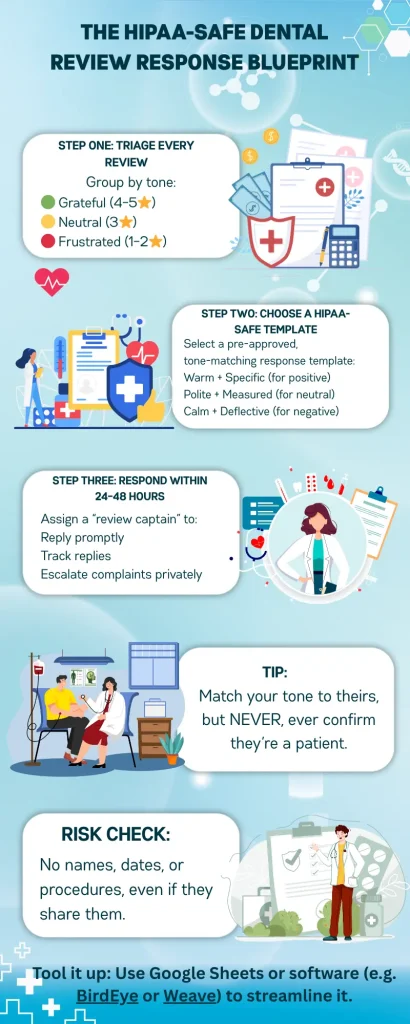
A Simple, HIPAA-Safe Framework For Responding To Dental Reviews
When you reply, ALWAYS use HIPPA-safe language that never confirms someone received care from you.
This framework applies to public-facing replies and may not fit situations where you’re legally required to confirm care.
When a harsh online review lands overnight, what do you post back without breaking HIPAA privacy protections or losing potential patients?
How To Triage Every Review In Under A Minute
A client told me about how he learned how to respond to reviews safely through one embarrassing mistake. He thanked a patient publicly “for trusting us with your root canal.”
His colleague flagged it twenty minutes later (he confirmed treatment details). The comment came down fast, but he learned that even praise violates privacy law if you name the care.
As stated earlier, every review falls into three buckets:
- Grateful (4-5 stars)
- Neutral (3 stars)
- Or angry (1-2 stars)
For grateful reviews, thank them by name and echo what they praised. Do it like this: “So glad you felt comfortable.” Sixty seconds, boom. This builds social proof, evidence that real people trust your dental practice.
Neutral reviews need acknowledgment without amplification. Offer to improve, provide direct contact, move on.
Angry reviews require the most care when you respond to reviews like these.
Stay general. Apologize for the experience, offer a private channel. Never confirm they’re a patient.
One practice wrote “We reviewed your chart.” A complaint was filed within the week, triggering fines starting at $100 per violation.
How do you know if you should post it? If you can’t say it in a waiting room without naming care details, don’t type it publicly.
Should Dental Practices Respond To EVERY Review?
Short answer? Yes, definitely. And if you’re not yet convinced, let me give you three reasons why responding to every review (positive, neutral, or flat-out false) is a strategic, measurable win.
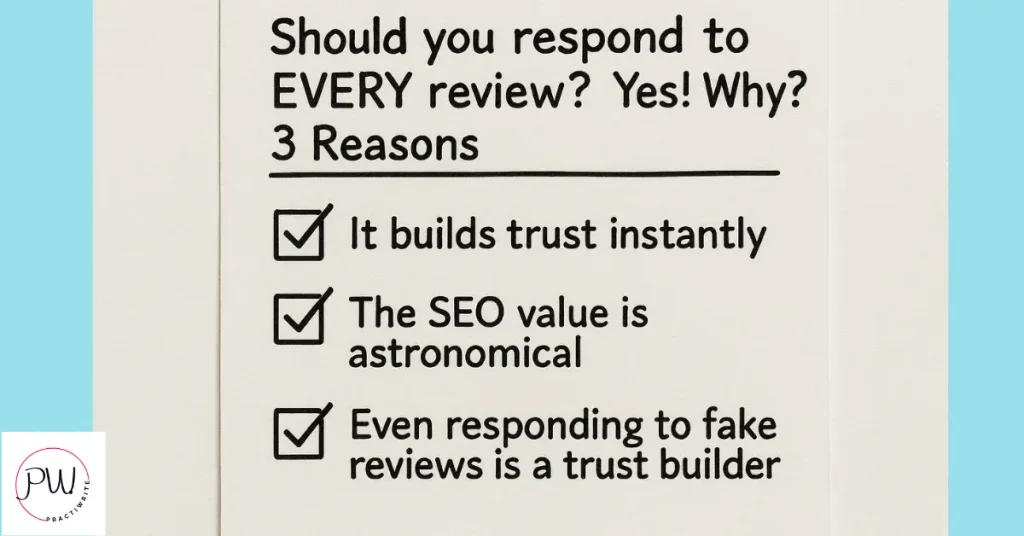
1. It Builds Instant Trust
Here’s what I’ve seen across 30+ dental brands: when a new patient scrolls through your reviews and sees your voice showing up consistently (i.e., thanking happy patients, calmly addressing concerns, and even replying graciously to critics) they feel reassured.
You’re present. You’re professional. You care.
It’s a fast track to trust.
Even a 30-word response to a five-star review signals, “We see you.” And that’s enough to nudge someone from kicking the tires to ringing your phone.
2. The SEO Value Is Astronomically Understated
This is the part most dentists underestimate.
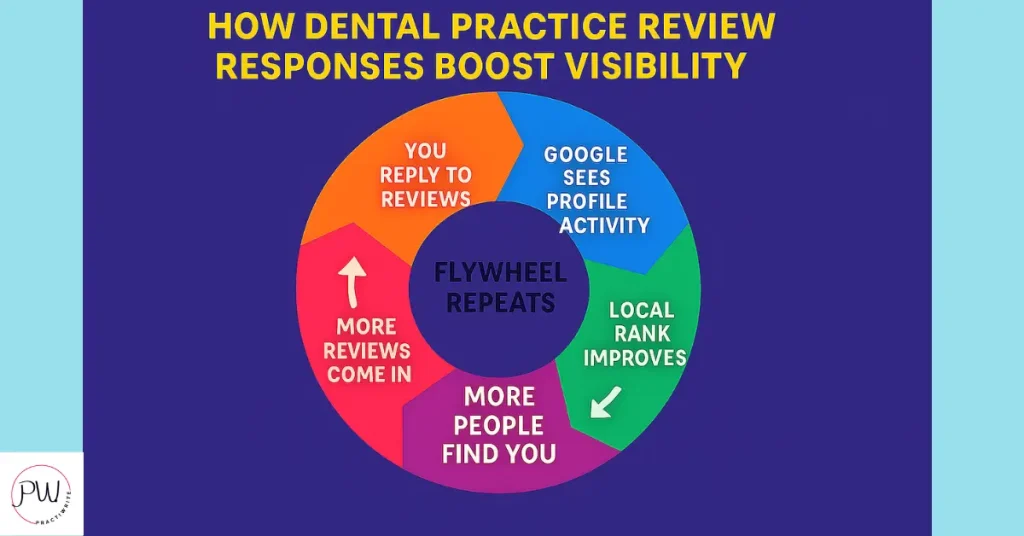
Google’s local algorithm weighs review activity. Not just star ratings, but your responsiveness.
When you reply, you increase recency signals, keyword density, and user engagement metrics on your Google Business Profile. All of those influence your local pack ranking.
To be blunt: responding to reviews helps you rank higher in the Google Maps Pack.
And yet, most practices ignore this low-effort, high-return lever. I’ve watched a client jump from spot #6 to spot #2 in just six weeks, simply by replying to every single review within 48 hours.
No ad spend. No technical SEO. Just human words posted consistently.
3. Even Fake Reviews Deserve a Reply
You’re right to feel frustrated when a competitor’s cousin or a no-show patient obliterates your rating with a fake one-star. It’s deflating, but there’s hope.
But ignoring it doesn’t make it disappear and it won’t protect your reputation.
Responding to fake reviews (briefly, calmly, and without confirming treatment) shows leadership. Future patients don’t need you to “win” the argument. They just need to see that you’re composed and responsive.
My clients often use a version of:
“We take all feedback seriously. However, we can’t verify this experience in our system. Please call our office so we can address any concerns directly.”
Even though the review may not get removed, the damage softens immediately. That reply becomes a trust buffer for everyone else reading it.
Should you respond to every dental review?
Yes. Because your silence says more than you think and not in a good way.
And if the volume feels overwhelming? Assign one team member, block 15 minutes weekly, and start with your last 5 reviews. Progress is the point.
“If you wouldn’t print it on a billboard outside your office, don’t type it in a public review reply.”
-Nicole Kolesar, Founder & CEO of Practiwrite
Why Thoughtful Responses Matter For Trust And Growth
Your online reputation hinges on how you respond to reviews. A Q4 study from SpryPT found 71% of healthcare consumers read your responses before booking. Every reply is a sales pitch to future patients, not just the reviewer.
This is dental reputation management in action.
I tracked one dental practice responding within twenty-four hours to every review. Twelve months later their rating climbed from 4.1 to 4.6 stars.
Calls mentioning online reviews doubled, and conversion rates jumped 18%. This approach to online reputation built more patient trust than their paid ad budget.
One rule: if your draft mentions procedures, dates, or symptoms, rewrite in generic language.
HIPAA Safe Dental Review Responses In Q4 2025/Q1 2026
A one-star review appears. It looks like this:
- Names you
- Describes the root canal
- Includes the date (you hear the quiet “ping” and your stomach tightens)
Your instinct is to defend yourself. Can you confirm they visited or explain what happened? Read on….
Wrong Versus Right: HIPAA Safe Review Language For Dentists
You can’t. Federal law (specifically HIPAA) makes acknowledging someone as a patient on review platforms illegal. That confirmation counts as disclosing patient information, any detail that could identify someone or their care.
A client learned this in early 2025, after reviewing a Google thread on their screen when a practice manager replied to a billing complaint on Google with
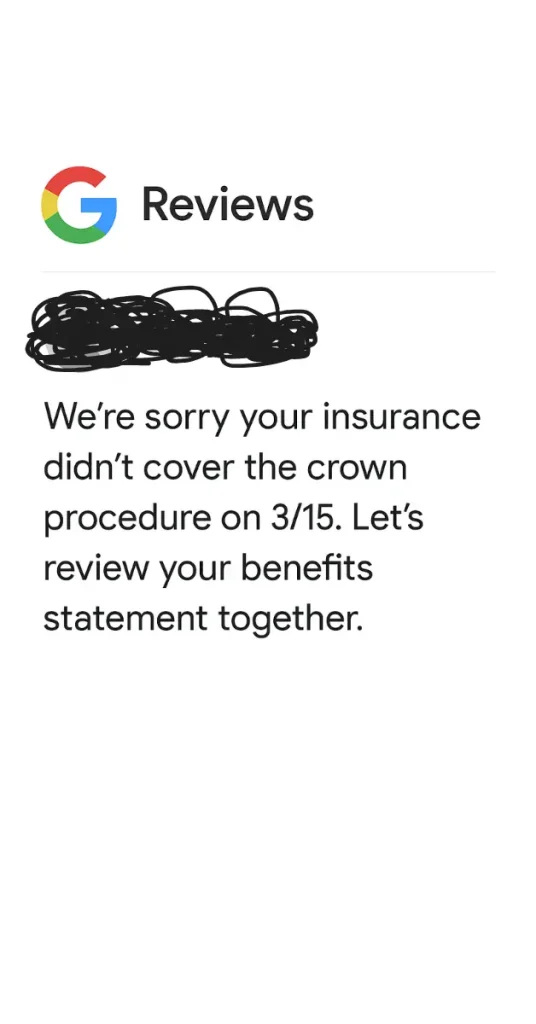
The reviewer screenshotted it, filed a complaint with the federal Office for Civil Rights (the agency that enforces HIPAA regulations), and the practice paid $12,000 in settlement costs. That reply violated patient privacy by confirming the treatment relationship.
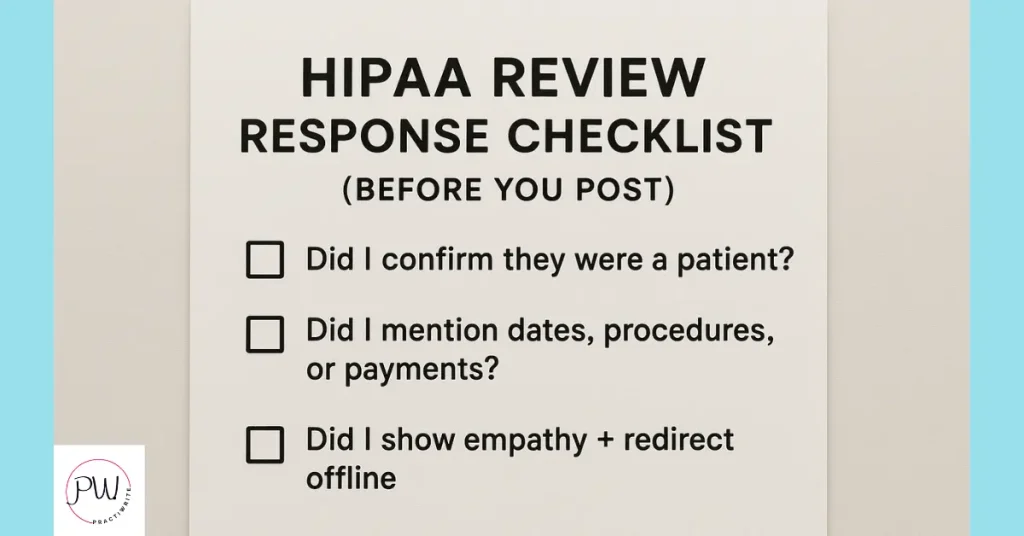
Before you post any HIPAA compliant reply, you need to verify:
- Acknowledge concern
- NEVER confirm patient status
- Show empathy
- NEVER divulge private information
- Invite them to call you directly
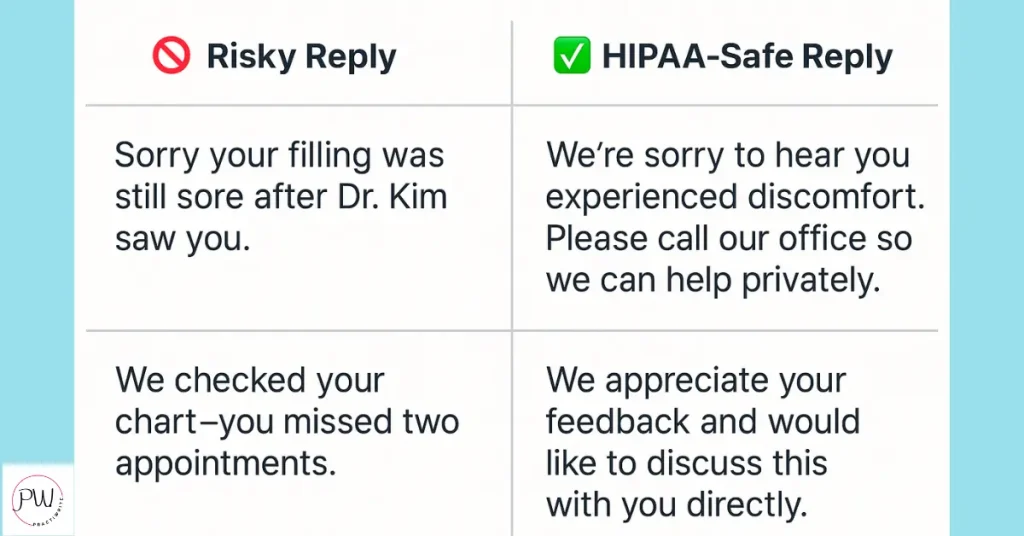
You MUST avoid procedure names, dates, or amounts, even when they shared them first. Here’s what risky instincts look like versus HIPAA compliant responses:
Pain complaint: “I’m sorry the sensitivity after your filling lasted so long” becomes “We’re sorry to hear you experienced discomfort. Please call our office so we can address your concern privately.”
Billing dispute: “Your balance is accurate based on Dr. Lee’s treatment” becomes “We take billing concerns seriously. Please contact our office manager to resolve this directly.”
Missed follow-up: “We called twice to remind you” becomes “We appreciate feedback about communication and would like to discuss this with you directly.”
I get it: it feels unfair that patients share details while privacy laws constrain your replies. But patient confidentiality protects your license. One safe response beats a defense that triggers federal investigation.
How To Respond To Positive And Mixed Dental Reviews
A generic “thank you for your feedback” to five-star reviews feels safe, but it teaches prospective patients nothing about your culture.
Just to be clear, this applies to public responses only. You can (and should) discuss privately with the patient.
Templates For Five-Star And Mixed Three- To Four-Star Reviews
Helping to manage responses for three dental practices between 2024 and 2025 taught me this: those generic “thank you for your feedback” replies converted nobody. About 8 in 10 new patients told us they’d read positive reviews before calling. We tracked it starting in 2023.
When you personalize responses using templates that echo patient praise, like staff names, comfort steps, new-patient calls jump. One practice’s new-patient calls went up 34% in six months. Positive reviews multiply their impact when you respond to each five-star review.
Stay on the right side of HIPAA. Every professional response should mirror one detail the patient shared.
If they named a hygienist, thank that person. If they praised wait times, acknowledge it. Absolutely never add what they didn’t write (no procedures, insurance, or treatment outcomes) because confirming anyone’s treatment, diagnosis, or payment details violates HIPAA, even when they wrote the review.
This takes about two minutes per review.
Five-star template:
“Thank you, [First Name]! We’re thrilled [team member] made your visit comfortable. Our team works to [their praise], and your good reviews help neighbors find us!”
Three- and four-star reviews follow this order:
Thank, acknowledge, own, invite.
Practice response example:
(Thank): “Hi [Name],” (acknowledge): “thank you for the kind words about Dr. [Last Name].” Own: “You’re right, wait times ran long that day. We’re sorry.” (Invite): “Call [number] so we can fix it.”
That template kept 11 of 12 patients from lowering their star rating, and two raised theirs after we followed up. The boundary: only reference what the patient wrote publicly.
Before posting, scan your reply. If any detail goes beyond their text, delete it.
To acknowledge reviews safely, reflect patients’ own words. They add zero information HIPAA protects.
***Want a set of HIPAA-Safe review responses you can customize? Click this link to get 30.***
Five steps to respond to negative reviews without legal risk
Here’s my approach when I need to respond to negative reviews:
- Pause 24 hours
- Verify internally
- Acknowledge and apologize publicly
- Invite offline contact to address concerns
- Then document and learn from feedback.
Step 1: Pause 24 Hours
First, cool down for 24 hours. My client was angry enough to almost post ‘We have no patient by that name,’ which would have confirmed that he checked records. Waiting one day stops bad replies.
Step 2: Verify internally only
The U.S. Department of Health & Human Services, which enforces HIPAA, warns that even acknowledging someone visited violates privacy by disclosing protected health information. Never confirm publicly.
Step 3: Acknowledge and apologize in your reply
I used to explain first, and those reviews stayed up. Now I lead with “We’re sorry and take every concern seriously,” and patients tell me it shows we listen, especially for bad reviews.
Step 4: Invite offline and offer a solution
I tried resolving complaints in comments once. It spiraled to eight messages. Now I post: “Please contact us directly at [phone],” and it stops the thread.
Step 5: Document and learn from feedback
Log patterns and route recurring issues to team meetings so harsh reviews expose fixable gaps you can address. Log patterns in a simple Google sheet or CRM and route recurring issues to team meetings.
I watched a dentist client post a defense with treatment codes (billing numbers like D0150 that describe procedures) after a bad review. It violated HIPAA and they lost two potential patients who read that exchange.
In 2022, one client got a one-star review about wait times. She replied in 40 words, called that afternoon, fixed staffing, and offered a complimentary cleaning. The patient updated their review to four stars in one week.
The truth is that most people just want to see you respond professionally.
If a review has legal threats, route it to your attorney first. Remember the billboard test: if you wouldn’t print it publicly, don’t post online. That helps you respond professionally.
Test today: Draft a 30-word reply to one old negative review using steps 3–4. Show a colleague, check for defensiveness, then post and track if the reviewer reaches out within a week. You’ll build the reflex to respond to negative reviews safely.
Tools, Templates, And Systems For Dental Review Management
Instead of replying to reviews on your phone between patients, half‑distracted, juggling 20‑plus notifications a week and stealing focus from actual care. A ten-minute Monday workflow can fix it.
Workflows, Edge Cases, And Measuring If Your Responses Work
Most practices I know have no system for review management. Just whoever sees the notification fires off a reply.
I watched a three-location practice lose control that way until they assigned one owner and gave the team review response templates, pre-written reply frameworks they could copy and paste and personalize.
Here’s the routine:
- Every Monday morning, one person, your review captain, checks Google Business Profile, Facebook, and Yelp
- They log reviews in a spreadsheet: date, stars, snippet, platform
- Positive reviews get a personalized reply
- Use review response templates you copy and paste, then customize with one detail
- Negatives go to the manager
- Suspicious reviews (i.e., fake reviews like one-star posts with no visit history or ex-employees venting) need a different path
- Report review violations by clicking “Report” and selecting “Fake”
- Document it, post a neutral reply, and wait to see if they’ll remove reviews
One mid‑size practice I worked with tracked this for six months. I watched the numbers shift on their spreadsheet. Before, the gap between a review appearing and someone replying averaged eleven days, and they missed 40% of reviews.
After, they hit same-day replies 80% of the time and climbed from 4.1 to 4.6 stars on the five-star scale, moving them to top-two locally.
They asked new patients “How’d you find us?” during intake. 63% percent said online reviews (especially google reviews) were the deciding factor. This is just one example.
The system won’t erase every bad review. Platforms refused to remove reviews even when violations were documented. But they controlled speed, assigned ownership, and tracked whether encouraging reviews moved my rating.
Start this week: Pick one person, block fifteen minutes on Monday, reply to your three most recent reviews using the template approach above. Then decide whether you’ll ask for reviews manually or use an online reviews tool.
FAQs: Still Have Questions? I Still Have Answers
Dentists and practice owners ask me these questions all the time and for good reason. Reviews are public, emotional, and legally risky terrain.
Below are the most common concerns we hear, along with direct, HIPAA-safe answers that align with today’s best practices.
Do dentists need to respond to Google reviews?
Yes. Especially in 2025, where your online reputation is your digital front door. According to BrightLocal, 89% of consumers read businesses’ responses to reviews before making a decision. Ignoring reviews (positive or negative) feels like ignoring patients themselves.
And make no mistake: Google rewards active engagement. Responding will signal to search engines that your profile is alive and well, which helps with local visibility.
Can responding to reviews help with SEO?
Absolutely. Responding to reviews on your Google Business Profile doesn’t just help with optics.
It directly influences your local ranking.
Here’s why:
- It improves your profile’s activity level and freshness
- It increases keyword density (organically)
- It boosts engagement metrics that LLMs and Google crawl
I’ve seen clients climb into the top 3 local map results simply by replying consistently.
What should dentists say when responding to reviews?
Keep it professional, warm, and HIPAA-safe. For positive reviews, echo one specific thing the patient mentioned (e.g., “So glad Dr. Kim made you feel at ease!”). For neutral or negative reviews, show empathy and offer a private resolution channel, without confirming treatment.
Here’s a safe formula:
Acknowledge + Empathize + Invite Offline Contact
Example:
“Thank you for the feedback. We’re sorry to hear this and would love to address your concerns. Please call us directly.”
You can also download this ready to go collection of reply templates.
How do you respond to a negative dental review?
Step back. Breathe. Do not defend or explain online, even if the patient is completely off-base.
Instead:
- Pause 24 hours
- Verify internally (without replying yet)
- Reply with empathy and an invitation to speak privately
- Avoid all treatment references
- Log and learn from the feedback
Resist the urge to clarify or correct in public. Defensiveness reads poorly, even when you’re “right.”
How do you respond without violating HIPAA?
HIPAA violations often come from accidental confirmations.
For example, saying:
“We’re sorry your crown didn’t hold after Dr. Lee fixed it on March 3rd.”
…is a clear violation, even if the patient mentioned those details first.
Instead, respond in generic terms:
“We’re sorry to hear this. Please call our office so we can discuss privately.”
The rule of thumb? If you wouldn’t say it in a waiting room full of strangers, don’t type it in a reply.
Do patients care if dentists respond to reviews?
They CERTAINLY do. More than most dentists realize. In intake forms, when patients are asked why they chose a new dentist, many say some version of:
“They respond to every review. That told me they care.”
Even brief replies make people feel seen.
Is it unprofessional not to respond to reviews?
Arguably, yes. Silence can be interpreted as neglect, defensiveness, or disinterest.
That may not be your intent, but perception is what drives action. If you want to build a reputation for trust, responsiveness, and professionalism, showing up in your reviews is one of the simplest ways to do it.
Wrapping Up: After You Hit Reply
So what happened with the Phoenix practice I worked with that lost those 13 new-patient calls? Her average rating climbed back to 4.8 by month four, and her front desk noticed the shift immediately.
New patients started mentioning “how professional the team handles feedback” during their first call.
In one industry case study, structured review workflows recovered missed inquiries within weeks.
The difference wasn’t luck or extra marketing.
It was a step-by-step system:
- Triage the review in 90 seconds
- Pick the right HIPAA-safe template
- Respond within 24 hours
No fluff, no defensiveness, no drama.
Real talk: the one-star reviews still arrive. But now she doesn’t snap or scramble.
She opens the screen, picks the right script, types a calm reply, and moves on. Set it and forget it.
To build trust after a tough review, respond fast with a tested system that protects you and converts critics. The blueprint works when you use it.
If you want a system that works for you and builds trust, I can help. Schedule your no-obligation, no BS strategy session to get your Dental Practice Roadmap.
I‘ll show you what areas of your GBP and your website that are costing you money and patients. Plus I’ll give you a plan to fix it.
Every day you wait could be turned into another 5 to 6 figures in fines, instead of in your bank account.

10+ year content strategist, writer, author, and SEO consultant. I work exclusively with fee-for-service dental practices that want to build value, not volume.