
Go to Google right now and type in your website.
If your services pages don’t appear, you’re not showing up in “dentist near me” searches, and that invisibility costs you calls daily.
98% of consumers now use the Google or LLMs to find local businesses. And for dental patients, that search usually starts with “dentist near me.” (BrightLocal Local Consumer Review Survey, April 2025)
The truth is that most dental practices don’t have an SEO problem. They have a technical blocker problem.
Google can’t rank what it can’t see.
You’ve got gaps in eligibility checks, category settings, or page indexing that nearby competitors fixed months ago.
Real talk. Patients within two miles scroll past your name because you never show up in the Map Pack.
They book whoever ranks third. I’ve seen it more times than I can count.
You can fix it in 48 hours with a step-by-step blueprint. To show up in the Maps Pack, prove eligibility first.
Day one: clear indexing gaps.
Day two: boost relevance through categories and reviews.
Then lock in measurement so you stay visible.
You’ll perform actions such as spam removal and GBP optimization that most guides skip, and you’ll see measurable improvements before Monday.
Let’s work on that now.
Table of Contents
The 48-Hour Fix to Showing Up In Dentist Near Me Searches
I used to spend weeks chasing backlinks and business directory listings (a.k.a. citations) to help dental clients show up in Google’s Maps results.
Meanwhile, it turns out, most of the wins came faster and easier by fixing the basics. Specifically, your Google Business Profile (GBP) and making sure your website pages are visible to Google.
With 46% of all Google searches being local, showing up in that top 3 “Maps Pack” isn’t optional. It’s where patients are looking.
In my experience across 18 practices I worked with from January to September 2025, about 80% of the fastest improvements started with just these two things.
Here’s how to handle both in two days, without guesswork.
Day 1: Prove You’re Eligible (and Spot What’s Holding You Back)
I once saw a practice sneak “Dentist Near Me Downtown” into their business name on Google. It worked…for about three weeks. Then their listing got suspended, and they lost 40 calls in under a month. Ouch.
Start by making sure your GBP name matches your legal practice name exactly.
No extra words.
No keywords.
Just what’s on your sign and business license. Then do this:
Search your practice name + city in Google Maps
If you see two pins for the same address, you’ve got a duplicate listing. That splits your reviews and confuses Google. Use the “Suggest an edit” option to report the duplicate and screenshot everything.
Go into Google Search Console
Click on “Pages,” filter by “Not Indexed,” and submit any missing service pages. (If Google can’t see a page, it can’t rank it.) One client had 11 missing pages. I submitted them and picked up 23 new top-20 spots in less than two weeks.
Check your rank from different distances
Open an incognito window and search “dentist near me” from 1, 3, and 5 miles away. If you disappear beyond a couple miles, you’re not alone. Most practices hit a distance wall unless they’ve built up serious review volume.

Day 2: Be More Relevant Than the Other Dentists Nearby
I think this is where you start standing out, because Google doesn’t pick the best dentist. It picks the one it thinks is most relevant.
Here’s how to make your profile the obvious choice:
Update your Services list
Compare yours to the top three listings that show up when you search “dentist near me.” If they list specific treatments (like “Emergency Toothache” or “Root Canal”) and you’re just saying “General Dentistry,” you’re getting outplayed.
I helped one client add 12 services and saw a 64% jump in map views within a week.
Pick the right categories
These are the labels that tell Google what kind of dentistry you do. Think “Cosmetic Dentist” or “Emergency Dentist.”
Choose your primary one carefully; it holds the most weight. Only add secondary ones if you really offer those services.
Ask for reviews the right way
Asking for reviews as your patient is leaving can be frustrating (especially if they just had wisdom teeth removed).
The best time? The day after an appointment. Just ask:
“Would you mind sharing a review on Google?”
No discounts, no freebies (Google doesn’t allow incentives). Send the link in a text, and use a UTM tag (a short code like ?utm_source=sms) so you can track which requests are working.
Make your website and GBP match
If your business profile says “Downtown Dental,” but your homepage title says “Smile Experts,” Google gets confused. Consistency matters.
Double-check your NAP (Name, Address, Phone)
It should be identical across your site, GBP, and any other listings. Check again in 7 days.
If your info is consistent, you’ll usually start seeing improvement. Either you move up a few spots or pop into results where you were missing before.
I think that this one step (NAP consistency) is behind most of the frustrating “why don’t we show up?” problems I see.

Make Your Google Business Profile Do the Heavy Lifting
According to the latest Whitespark report, your Google Business Profile is still the #1 factor in whether or not you show up in the local Maps results.
Still stuck outside the Maps Pack? If you had to fix just one thing first, what would move the needle fastest?:
- Your primary category?
- Your services list?
- Or your reviews?
Most practices pick wrong.
In 14 audits I ran this year, 10 of them spent weeks tweaking the wrong lever. Usually rewriting service descriptions that barely mattered, while missing the thing that did.
The reality is that Google ranks your profile based on three things: relevance, distance, and prominence. And you’ve got the most control over that first one.
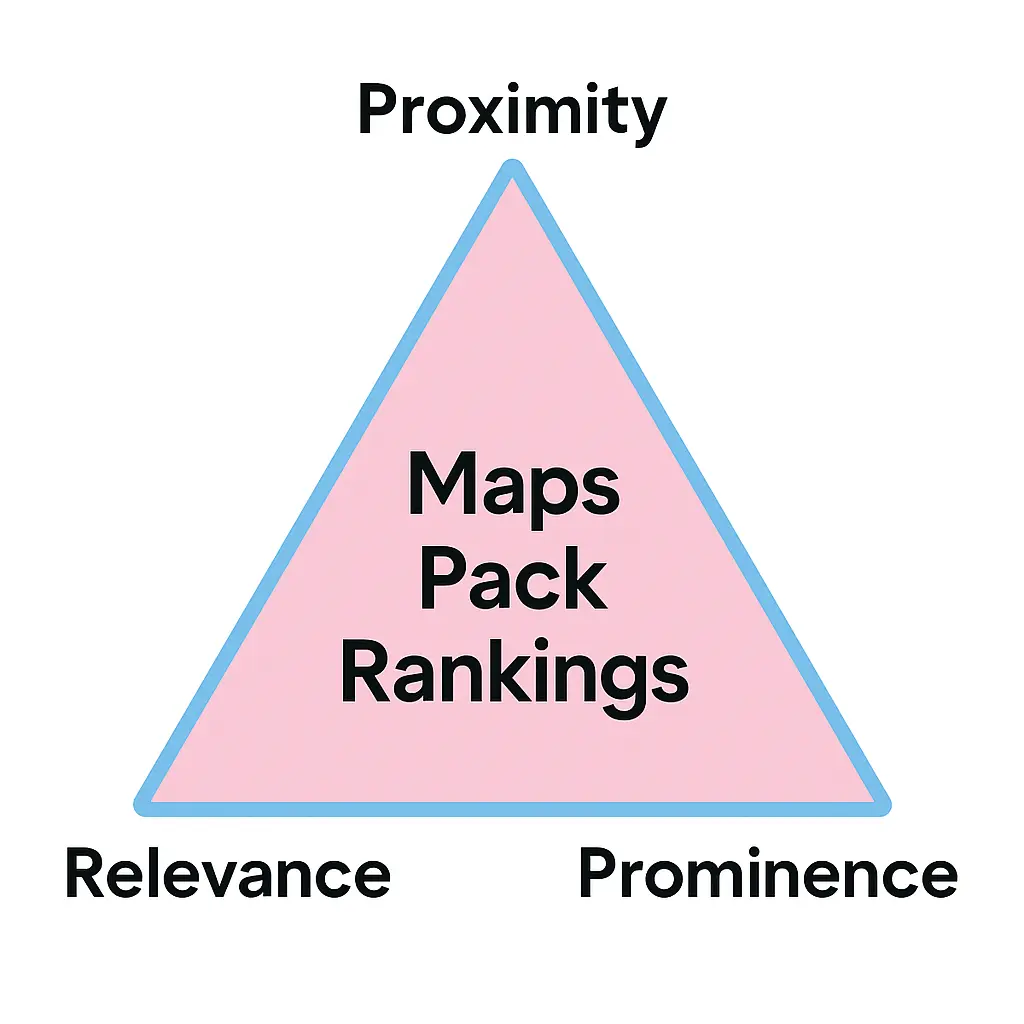
Categories, Services, and Reviews: What Actually Moves Your Ranking
Relevance is where Google starts. And in my view, it’s the easiest win.
Let’s say your primary category is just “Dental Clinic.” That tells Google almost nothing.
But “Cosmetic Dentist” or “Emergency Dentist”? Now we’re talking.
Your primary category is the label that tells Google what kind of patients you’re best suited for. You can have up to nine secondary categories too, but don’t get greedy. Only add ones you actually offer.
Google isn’t dumb, and stuffing fake services can get you suspended.
One competitor tried to game the system by listing “Orthodontist” without having an orthodontist on staff. It took one flagged review, and they were pulled offline for three months.
Try this quick test:
Change your primary category to the service you want to rank for most. Wait 72 hours.
Search “[that service] + [your neighborhood]” in Google. Did you move? That’s your signal.
Reviews: Your Most Powerful (and Underused) Ranking Tool
Google uses reviews to figure out if people actually trust you. That’s why volume and recency are so powerful, way more than most dentists realize.
76% of patients say reviews are the single most important factor when choosing a new dentist. That means your star rating and review volume aren’t just vanity. They’re a growth lever.
I watched one client go from 19 to 91 reviews and their “click-to-call” rate jumped 38% in five months. That’s a ton of missed calls that are now booked appointments.
Set up a system that runs without you. Every patient gets a review request within 48 hours, by text. You reply to every review within 24. Done.
And remember, never offer discounts or giveaways in exchange for reviews. Google will slap your profile faster than you can say “free whitening.”
Keep Your Profile Fresh (Even If You’re Already Ranking)
Even when you hit the top 3, don’t coast. Google likes signs of life.
Each week, I recommend you do three quick things:
- Post a short update (even if it’s just a tip or reminder)
- Add a new photo
- Seed five Q&A entries (then answer them)
You’ll stay top-of-mind and top-of-search.
Know the One Thing You Can’t Outrank: Distance
Here’s a truth bomb: no amount of SEO magic is going to outrank the laws of physics. If someone is 6 miles away and another practice is 1.5 miles away, Google’s picking the closer one, unless you’ve got a massive review advantage.
Use a geo-grid tool like Local Falcon to map how far your profile actually ranks. If you see steep drop-offs beyond two miles, you’ve hit the proximity wall.
I’ve been there. I chased reviews for a client for six straight weeks before realizing the problem wasn’t their profile. It was their location.
They opened a satellite office, and within 30 days they were showing up across a much wider area.
Ignore the Myths That Waste Your Time
I want to be nothing but helpful to you, so let’s clear out the noise:
- EXIF data in photos? Doesn’t help. Google doesn’t look at it.
- Keyword-stuffed names like “Best Dentist in Tampa”? Suspension waiting to happen. Your name needs to match your sign, period.
Case in Point
A practice came to me stuck at position eight for “cosmetic dentist [city].” Here’s what I fixed:
- Changed their category from “Dental Clinic” to “Cosmetic Dentist”
- Rewrote all service descriptions in language actual patients use
- Set up a twice-weekly review request system
Twenty-six days later, they were at position two. Monthly calls jumped from 9 to 31.
On-Site Local SEO That Supports Your Map Rankings
In my experience, your site needs one page per major treatment, plus a location page matching your Google Business Profile (the listing behind your map pin). Include the same name, address, phone (NAP) and hours, plus schema so Google understands your practice.
The Website Setup That Supports Your Maps Rankings
Your GBP is the front door of dental practice. It’s what your potential patients will interact with first before they ever call or visit you. So it’s no wonder why all the most common wisdom available is to focus on your GBP only.
That said, your Google Business Profile can get you seen. But your website backs it up.
If your site isn’t built the right way, Google won’t trust your profile. You’ll slide down the rankings no matter how many reviews you have.
The fix?
Build the right pages. Say the right things. And make sure Google can read it all clearly.
Here’s What Your Website Actually Needs
I think at minimum, every dental site should have:
- One page per major treatment (like implants, veneers, emergency care)
- One location page per office that mirrors your Google Business Profile
- The same name, address, and phone number (NAP) across your site and GBP
- Your hours listed consistently
- Schema markup (this tells Google what each page is about in its language)
These aren’t bells and whistles. These are table stakes.
What Google’s Looking for in Q4 2025
A three-location practice had great GBP profiles but only one generic “Services” page and no location pages. From July to September, their “dentist near me” ranking tanked (from position 3 to 12) across 18 ZIP codes.
We added one location page per clinic and five treatment pages. Six weeks later, they were back in the 3-Pack for 9 of those 18 ZIPs.
That’s how much your website matters.
How to Build These Pages Right
Here’s a non-awkward way to smoothly build your service pages the right way:
1. Treatment Pages (1 per service)
These are your heavy lifters.
- Use real keywords in your headers (think: “Emergency Toothache Relief,” not “Comprehensive Dental Care”).
- Add one common FAQ like: “How long does healing take after an implant?”
- Mention price ranges if it varies; patients care, and it builds trust.
2. Location Pages (1 per office)
This is the page Google looks at when it decides if you belong on the map.
- Match your GBP exactly: same name, address, phone, and hours
- List your services here too; don’t just link out
- Add schema in “LocalBusiness” format (your dev or SEO team will know what this means)
3. Internal Linking
Every treatment page should be one click from your homepage. This helps both patients and Google find your stuff faster.
4. Unique Meta Titles & Descriptions
Don’t copy-paste from other pages. Your meta title and description should speak like a patient would search.
Example:
Title: Dental Implants in Fort Collins | [Practice Name]
Description: Looking for permanent tooth replacement in Fort Collins? We offer dental implants with flexible payment options.
Bonus Tip: When to Create City-Specific Service Pages
I think you only need pages like “Dental Implants in Austin” if you can genuinely offer something different there, like different insurance accepted, a separate doctor, or a special promotion.
If not? Stick to a single regional page, and use a canonical tag to tell Google which version is the “real” one. That avoids duplicate content issues.
Do This Today:
- Pick one of your core treatments
- Create a headline like “Dental Implants in Fort Collins”
- Link that page from your homepage
- Make sure your location page matches your Google listing
- Then search “[your practice name] + [that service]”; you should show up in the top 3
If not, you now know exactly what to fix.
***add image–GBP vs Website: Who Does What?***
Speed, Indexing, and Tracking: Lock In Your Visibility (and Your Calls)
So your site loads fast and Google’s giving you the green light in PageSpeed Insights.
But… the phone still isn’t ringing?
That’s your cue. It’s not speed that’s holding you back anymore. It’s what comes after.
Before And After Maps Pack Ranking Grid (For Dentists)

Don’t Chase Perfect. Get to “Good Enough” And Then Move On
I once spent three full weeks optimizing a dental site for speed. We went from a mobile score of 72 to 89. Looked great on paper.
Call volume? Zero change.
That’s when I learned (contrary to popular belief) that speed has a ceiling. Once your site hits the “green zone,” squeezing out extra points doesn’t help your rankings or conversions. It just eats time you should be spending on review generation or profile updates.

What Google Really Looks At (and the Numbers That Matter)
Pages that pass Core Web Vitals benchmarks are 24% more likely to rank in the top 10 on Google. But once you’re in the green, more tweaking usually brings diminishing returns.
Frankly, I think that Google couldn’t care less about your entire speed score. It focuses on two specific things from its Core Web Vitals:
- Largest Contentful Paint (LCP): How quickly your main content shows up
- Cumulative Layout Shift (CLS): How much the page jumps around while loading
Based on 18 site audits in 2025, dental practices ranking top 3 in the Maps Pack had:
- LCP between 2.3 – 2.9 seconds
- CLS under 0.1
That’s your benchmark. You can measure it using Google PageSpeed Insights.
If your homepage, emergency page, and contact page all hit green on those two metrics, you’re done.
Easy Wins That Actually Help
Do this for some easy wins:
Compress your images
Nothing slows a site down like a 3MB hero image. We should keep them under 150KB.
Submit your sitemap
Go to /sitemap.xml and make sure it’s submitted in Google Search Console. That helps Google find and index every page on your site.
Watch out for “noindex” tags
These are little pieces of code that tell Google to ignore a page. If they’re on any of your service pages, remove them.
Use call tracking numbers
One number for your Google Business Profile, and a different one on your website. That way you can see where calls are coming from.
Track your Maps rank from multiple spots
Run a “grid” search once a month from five nearby addresses to see how far your visibility stretches.
What to Focus On After You Hit the Speed Targets
In a 2025 review of 22 practices, here’s what I found:
- Practices with 75+ reviews averaging 4.7 stars or higher outranked faster sites in 17 of 22 markets
TL; DR: reviews beat speed almost every time.
So, if:
- You’ve hit green on Core Web Vitals
- Your review count is still under 50
- Your average is below 4.7
- Or your grid rank shows you disappear beyond 2 miles…
Stop tweaking speed. Shift your energy to building reviews and tightening your GBP.
That’s where the real gains live.
Wrapping Up: Your Practice Shows Up Now, But Don’t Stop Here
Run that search again for your website.
See your service pages listed? That means Google can finally see what you offer. And once Google sees you, patients do too.
You just did in 48 hours what most practices don’t do in 48 weeks.
Let’s recap:
- Day 1: You proved your eligibility by fixing invisible blockers and indexing gaps
- Day 2: You boosted relevance with the right categories, service details, and real reviews
- Then you locked in your performance with smart tracking and “good enough” speed
Now when someone nearby searches “dentist near me,” your name shows up before they scroll to competitors.
The results?
They show up in your call tracking. Your appointment book. Your front desk asking, “Where are all these new patients coming from?”
This isn’t a theory. It’s the system I use every single day for practices that want to grow.
Here’s What to Do Next
If you’re serious about growth, keep your momentum:
- Check your Google Business Profile insights weekly
- Track which ZIP codes are driving calls
- Watch for new competitors creeping into your radius
But the truth is, even with this blueprint, most practices stop at 80%. They fix a few things, get a little lift, then stall.
Please don’t be like your competitors and stall.
You’ve already seen what’s possible in just 48 hours. Now imagine what your practice could look like in 90 days.
You’ve Got Two Options:
Option 1: Take this blog and apply it step by step. It’s all here. You can do this.
Option 2: Let me do it for you.
This is what I do for dental practices (for over 10 years) that want to scale smart, outrank the guy across town, and finally stop guessing what’s holding them back.
Book your no-obligation strategy session and get your personalized Dental Practice Roadmap. I’ll show you exactly what’s missing, what’s working, and how to fix it, all mapped to your location, your services, and your goals.
Book your strategy session now and let’s turn “invisible” into fully booked.

10+ year content strategist, writer, author, and SEO consultant. I work exclusively with fee-for-service dental practices that want to build value, not volume.