
You hired the agency.
They checked every box.
Built the website, ran the ads, polished your Google profile, and sent a tidy monthly report with green arrows pointing up.
And your schedule still isn’t full of the patients you actually want.
So you start questioning yourself.
Maybe your fees are too high. Maybe your market won’t pay. Maybe it’s you.
It’s none of those.
Here’s the real reason, and it’s the whole point of this post: most agencies aren’t built for you.
Dental marketing agencies fail fee-for-service practices because generic agencies are built for volume practices, and you don’t run on volume. You run on case value.
That one mismatch explains nearly every dollar you’ve wasted. The keywords they chase, the copy they write, the metrics they celebrate, all of it is tuned to pull in as many patients as possible.
But you don’t need as many patients as possible. You need the right ones. And marketing built to maximize volume doesn’t just miss the right patient. It actively repels them.
This post breaks down why generic agencies fail fee-for-service practices, how to spot the mismatch in your own marketing, and what an agency built for your model does differently.
No agency-bashing. Just the mechanism, so you can see it clearly before your next discovery call.
Table of Contents
Why Do Generic Dental Marketing Agencies Fail Fee-For-Service Practices?
It fails because it’s engineered for a different business model, one that profits from patient volume instead of case value.
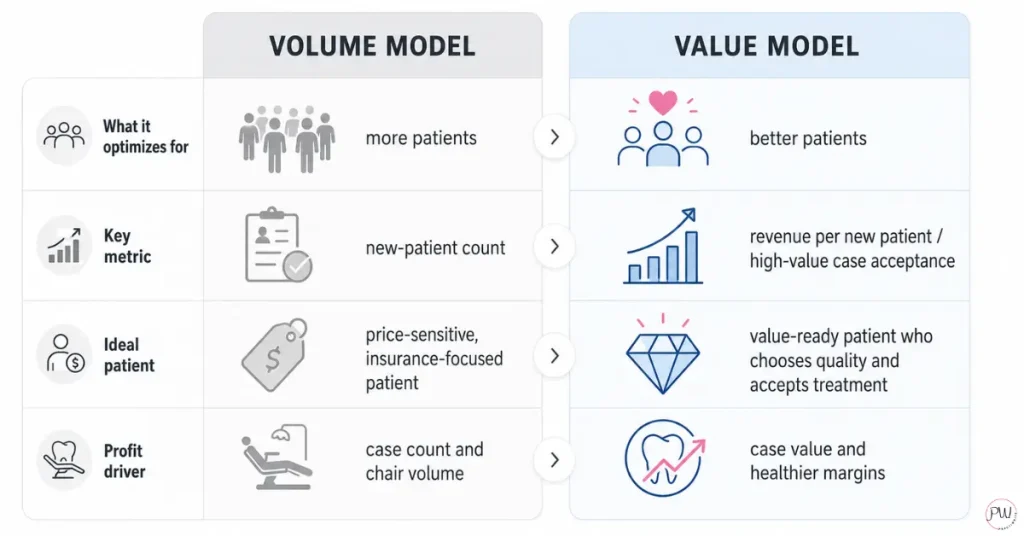
A PPO-driven practice makes money by filling chairs. The insurer sets the fee, the margin per visit is thin, so the math only works at scale. More patients, more procedures, more volume. That’s the whole engine.
A fee-for-service practice runs on the opposite math. You’re not trying to fill every chair. You’re trying to fill the right chairs, with patients who value the care and happily pay for it.
Your profit comes from case value, not case count.
(That’s the same reason leaving the PPO model works in the first place: fewer patients, higher value, healthier margins. *hint, hint)
So when an agency runs a volume system on your practice, it’s not just a little off. It’s solving the wrong equation. It chases more when you need better.
And the tactics that win at more, (the discounts, the insurance keywords, the bargain messaging), are the exact tactics that drive your best patients away. Would you hire a contractor who only builds tract homes to design a custom house? That’s the mismatch in one sentence.
Why Do Most Agencies Run a Volume Playbook on Your Practice?
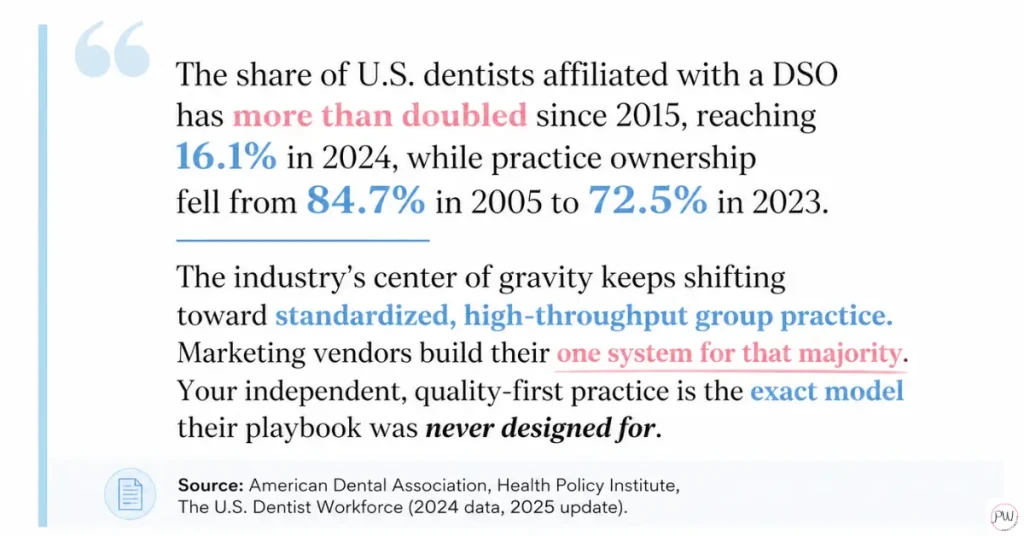
Most agencies run a volume playbook because their entire client base runs on volume, so the only system they own is built to maximize patient count. This isn’t malice. It’s misalignment.
An agency’s playbook is shaped by its book of business, and if almost every client is an insurance-driven, high-throughput practice, they’ve built one system, refined it for years, and they’re going to run it on you too.
It helps to see where the whole industry is heading, because it explains why volume is the default setting.
So the agency isn’t lying when they say the playbook works. It does work, for the clients it was built for.
The problem is that you’re the outlier in their portfolio, and outliers get the standard treatment anyway.
When the only tool you sell is a volume machine, every practice starts to look like it needs more patients. Why would a vendor build a separate system for the smallest slice of their client list?
Are You Measuring New Patients, or the Right Patients?
Volume marketing measures how many patients arrive. Fee-for-service marketing measures whether the right ones do. That difference sounds small on a report and it’s everything in your bank account.
Picture two months. In month one, the agency delivers 40 new patients. The report glows. But most of them:
- Came for a new-patient special
- Balk the second they hear your fees
- And they never schedule the treatment they actually need
In month two, you get 8 new patients, and 5 of them accept four-figure treatment plans without blinking. Month two crushes month one. The volume metric says the opposite.
This is the idea at the heart of fee-for-service marketing: patient sort. Volume marketing sorts for price-sensitivity, because that’s what its messaging attracts.
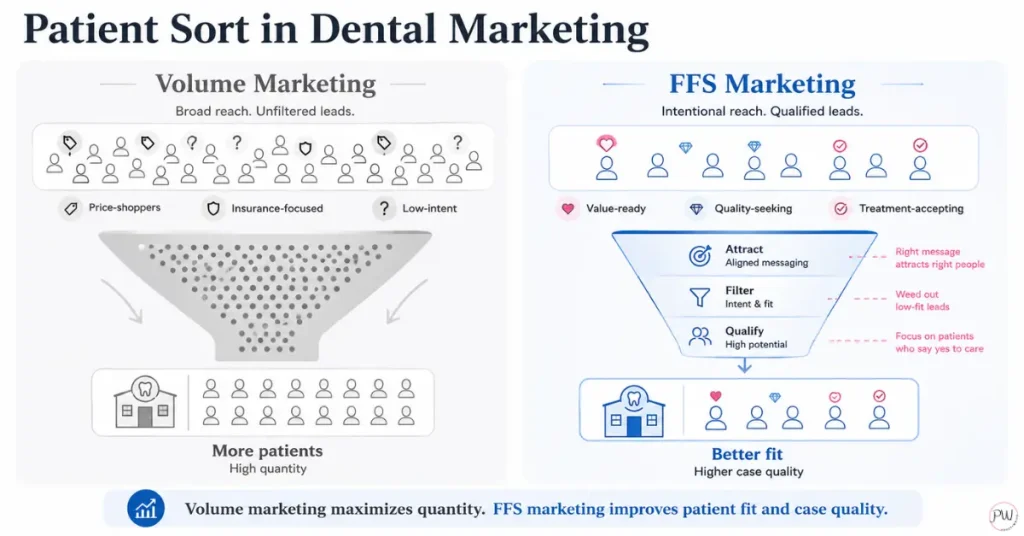
FFS marketing has to sort for value-readiness, the patients who choose a practice on trust and quality, not on the lowest sticker. New-patient count is a PPO metric. It rewards filling the schedule with whoever shows up.
If your agency still leads its report with raw new-patient numbers, ask yourself: are they counting patients, or counting the right ones?
Is Your Marketing Copy Attracting Bargain Hunters or Your Best Patients?
Copy built for volume leans on affordability and insurance language, which pulls in price-sensitive patients and repels the high-value ones a fee-for-service practice depends on. Words sort people. The language on your site and ads is a filter, and it’s either filtering for the patient you want or the patient you don’t.
Look at the phrases a volume playbook reaches for by default:
- Affordable family dentistry
- We accept most insurance plans
- New patient special, $99 cleaning and exam
- Lowest prices in town
Every one of those is a magnet for the patient who shops on price and a repellent for the patient who’d gladly pay for excellence. Lead with a discount and you’ve told the high-value patient they’re in the wrong place before they ever call.
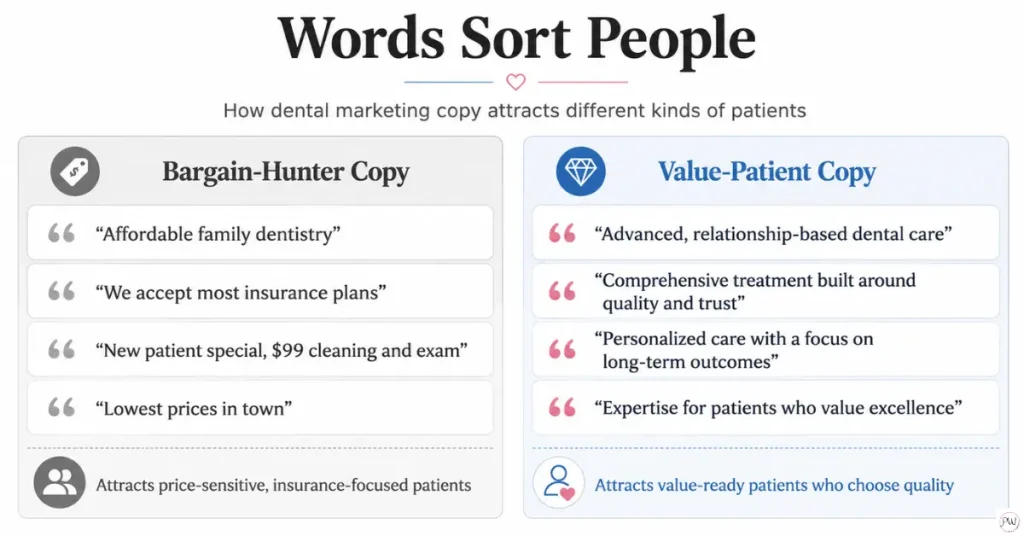
The fix isn’t fancier words. It’s copy that signals quality, expertise, and outcomes, so the right patient feels found and the bargain hunter keeps scrolling.
If your homepage could belong to any practice in town, whose patient is it really sorting for?
Are Volume Marketing Tactics Quietly Damaging Your Premium Positioning?
Short and long answer? Yes. Tactics like insurance-keyword SEO, discount ads, and coupon offers drive short-term volume while eroding the premium positioning a fee-for-service practice sells.
They can even look successful for a quarter, which is what makes them dangerous.
Here’s the slow damage. Every discount you advertise teaches your local market what kind of practice you are. Run enough coupons and you train patients to wait for the next one, to see you as a price, not a standard of care.
Premium positioning is a promise that your work is worth more, and a discount is a public admission that it’s worth less. You can’t coupon your way to a premium brand. The two messages cancel each other out.
A volume agency reaches for discounts because discounts move volume. That’s their job as they understand it. But for you, each one is a small withdrawal from the exact reputation that lets you charge what you’re worth.
What’s the point of winning a patient this month if you devalue your practice in the eyes of every patient next month?
Why Do Agency Reports Look Great While Your Schedule Doesn’t?
Many agencies report vanity metrics like impressions, clicks, and call volume, which signal activity without mapping to fee-for-service profit. The report measures motion. Your schedule measures money.
The two can point in completely opposite directions, and usually do.
You’ve felt this. The dashboard is a wall of green. Impressions up, clicks up, calls up. And yet the high-value chairs sit open.
That’s not a coincidence or a reporting glitch. It’s what happens when an agency optimizes for the numbers that are easy to grow instead of the numbers that pay your mortgage.
Impressions are cheap. Implant cases are not.
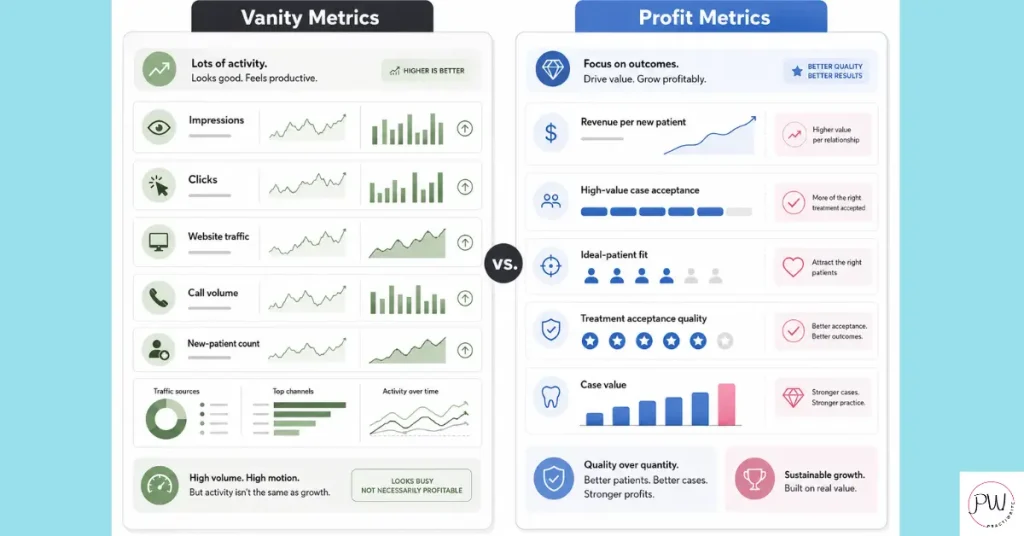
Marketing built for your model reports on different things entirely: revenue per new patient, high-value case acceptance, and the share of new patients who fit your ideal profile. Those numbers are harder to inflate, which is exactly why they’re worth tracking.
If you can’t find a single revenue or case-value metric in your monthly report, what is that report actually measuring?
What Should a Dental Marketing Agency For Fee-For-Service Practices Do Differently?
An agency built for fee-for-service markets for positioning and patient sort instead of patient volume, and it measures success by case value rather than headcount. Everything flows from that one shift in goal. Here’s what it looks like in practice:
- Position for the value-ready patient. Lead with quality, expertise, and outcomes, so the practice reads as premium to the patient who’ll pay for it.
- Write copy that sorts. Use language that draws the right patient in and lets the bargain hunter self-select out, on purpose.
- Build the GBP and website to attract and pre-qualify. Your Google Business Profile and site should set expectations before the call, so the people who book are already the right fit.
- Measure revenue, not reach. Report on case value and high-value acceptance, not impressions and raw patient counts.
That third point is where most of the money hides, and it’s not a guess. It comes from primary research.
In my analysis of 2,000 dental Google Business Profiles across all 50 states, one pattern held up again and again: what separated the practices that showed up from the ones that stayed invisible wasn’t location, specialty, or market size. It was execution.
Two practices in the same city, offering the same services, routinely landed in completely different performance tiers based on nothing but how their profiles were managed. The things dentists blame (the market, the competition, the fees) weren’t the deciding factor. What they did with the profile was.
The same study found the review response gap is one of the clearest places this shows up.
A large share of practices, including ones with strong ratings and plenty of reviews, never respond to a single one. And reviews don’t just sit there as a star rating. They work as a decision filter.
When patients compare a few similar practices, the ones with thin, stale, or unanswered reviews get filtered out before the phone ever rings. That’s patient sort happening in public, and it’s exactly the kind of trust signal a volume agency chasing call counts never bothers to manage.

None of this is exotic. It’s just aimed at the right target. The volume agency points a good engine at the wrong goal.
An FFS-built agency points it at yours.
How Can You Tell If Your Agency is Running the Wrong Playbook?
You can tell when an agency’s goals, language, and reports center on quantity of patients rather than quality of cases. You don’t need an audit to spot it. You need to know the symptoms.
Here are the ones to watch for tonight:
- Their pitch and reports lead with new-patient counts, not revenue or case value.
- Their first instinct for slow months is a discount, a coupon, or a new-patient special.
- Your ad copy and landing pages lean on affordability and insurance language.
- They optimize for insurance-related keywords that pull in price-shoppers.
- They can’t name a metric that ties their work to your actual profit.
- Most of their case studies and other clients are high-volume or insurance-driven practices.
One or two of these might be a coaching conversation. A clean sweep is a structural mismatch, and structural mismatches rarely get fixed, because the system isn’t broken, it’s just built for someone else.
If this list reads like your last three reports, the problem was never your fees. It was the playbook. (When you’re ready to pressure-test a specific agency, the questions to ask them are a topic of their own, and they deserve their own checklist.)
Wrapping Up: The Real Problem Was Never Your Marketing Effort
Your practice never had a marketing problem. It had a marketing-mismatch problem. A better volume agency won’t fix it, because the issue was never effort or talent.
It was alignment.
They ran the wrong equation with real skill, and skill aimed at the wrong target still misses. Once you see it, you can’t unsee it, and you’ll never read an agency report the same way again.
The fastest way to see the mismatch in your own practice is to look at the front door, (your Google Business Profile and website) and ask one question: are they built to sort for high-value patients, or to attract whoever’s cheapest? Right now, one of those is true.
Schedule your 100% free Dental Practice Roadmap.
Your Dental Practice Roadmap is a GBP and website audit that shows you exactly where you stand, what keywords you’re ranking for now, what you should be ranking for, and a step-by-step plan to close those gaps.
No vague recommendations. No fluff. Just a clear picture of what’s broken and what to do about it.
Book your Dental Practice Roadmap and get yours today now.

10+ year content strategist, writer, author, and SEO consultant. I work exclusively with fee-for-service dental practices that want to build value, not volume.