
You decided to drop your PPO plans. Smart move.
Your margins are about to stop bleeding.
But there’s a fear sitting in the back of your mind, and it’s loud: the second patients hear you’re out of network, they’ll walk.
Here’s the truth, and it’s the whole point of this guide on dental membership plans vs financing. Patients don’t leave because you left a network. They leave because paying for care suddenly feels like a gamble.
Take away the gamble, and most of them stay.
So how do you take it away? You give patients a structured way to afford you.
There are exactly two tools for the job, and they aren’t interchangeable.
In-house membership plans keep your preventive base loyal and paying you directly.
Third-party financing kills sticker shock on the big cases, so a $6,000 treatment plan doesn’t get a polite I’ll think about it.
The strongest fee-for-service practices use both, on purpose, for different patients at different moments.
Use the wrong one at the wrong time and you’ll either torch your margins or confuse people right out the door. Use them right and affordability stops being the reason patients leave and starts being the reason they stay.
This isn’t about picking a winner. It’s about knowing which lever to pull, and when. Let’s break it down, tool by tool, no fluff.
Table of Contents
Will Your Patients Really Leave When You Drop PPOs?
No. Patients leave a dental practice over cost and hassle, not over whether your name sits on an insurance list. What scares them off is the feeling that care has become unpredictable or out of reach, and that feeling shows up around money long before it shows up around network status.
The data backs this up hard. Cost is the number one barrier to dental care in this country, and it isn’t close.
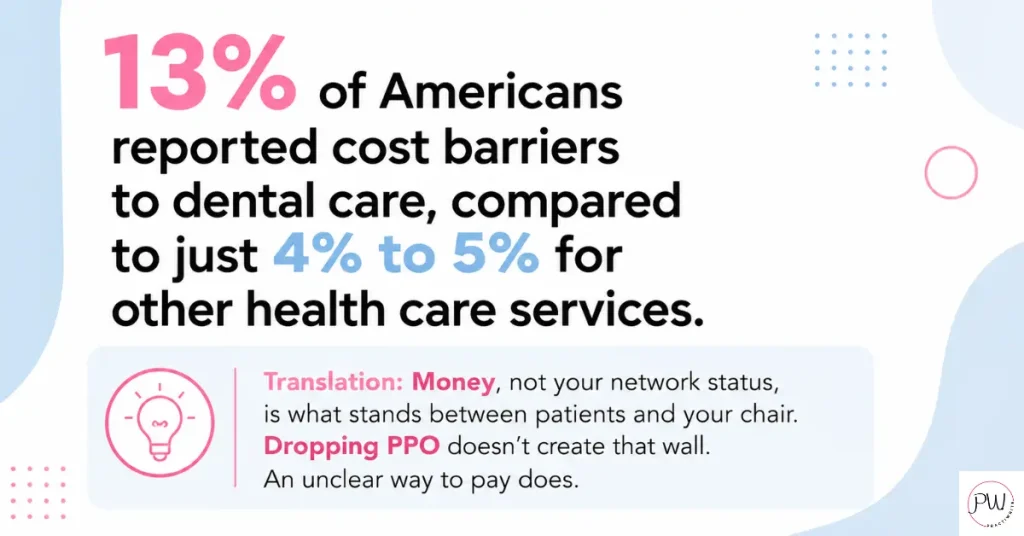
So when a patient hears we’re out of network, what they’re really asking is, can I still afford to come here? If your answer is a shrug or a discount, you just confirmed their fear. If your answer is a clear, structured way to pay, you removed it.
That’s the entire game. Affordability is something you design on purpose, with two tools: a membership plan and a financing option. Would you rather have patients guessing what care costs, or handing them a plan they already understand?
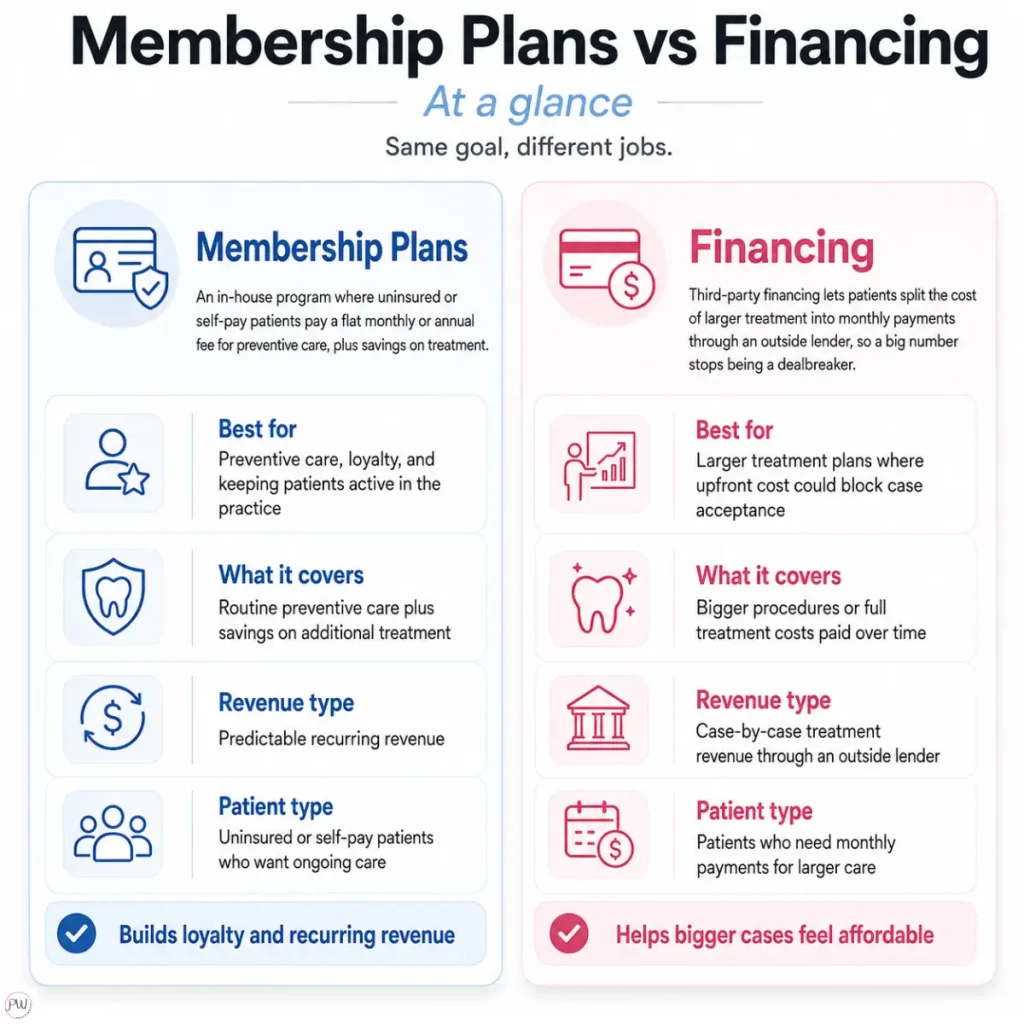
Here’s the one-line difference between the two:
- A dental membership plan is an in-house program where uninsured or self-pay patients pay you a flat monthly or annual fee for preventive care, plus savings on treatment. It builds loyalty and predictable recurring revenue.
- Third-party financing lets patients split the cost of larger treatment into monthly payments through an outside lender, so a big number stops being a dealbreaker.
Same goal, different jobs. Membership keeps people coming back. Financing gets the yes on the expensive plan.
What Is A Dental Membership Plan, And Why Isn’t It A Discount Club?
A dental membership plan is a product, not a coupon. It’s an in-house program where patients pay you a recurring fee in exchange for preventive care and treatment savings, which makes it a revenue stream you control instead of a discount that quietly drains you.
Too many dentists get spooked about going out of network and slap together a 10% off everything plan like it’s a panic button. That’s not a strategy. That’s desperation with a price tag.
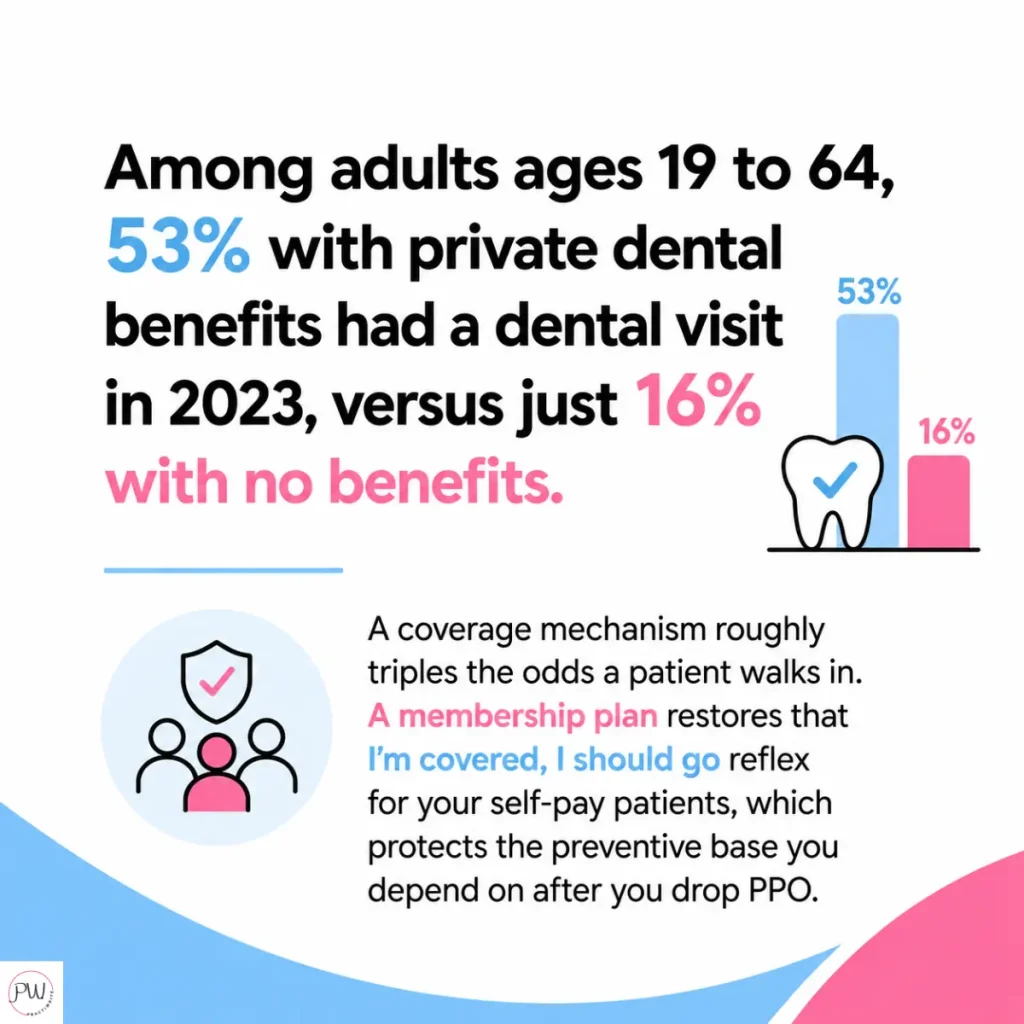
Built right, a membership plan can outperform your old PPO reimbursements, because there’s no claim to chase and no insurer skimming the middle. (If you want the full math on what PPO was actually costing you, that’s a whole separate conversation.) And it does something a discount never will: it gives self-pay patients a reason to keep showing up.
Are You Building A Discount Plan Or A Revenue Stream?
Design the plan like a real product. That means three things:
- No race-to-the-bottom pricing. You’re not here to undercut insurance. You’re here to deliver care without the handcuffs.
- Benefits that actually matter. Cleanings, exams, and x-rays, yes. Add-ons for perio patients or families, even better.
- Predictable, recurring revenue. Paid monthly or annually, with renewals built in. No claims, no waiting on reimbursements.
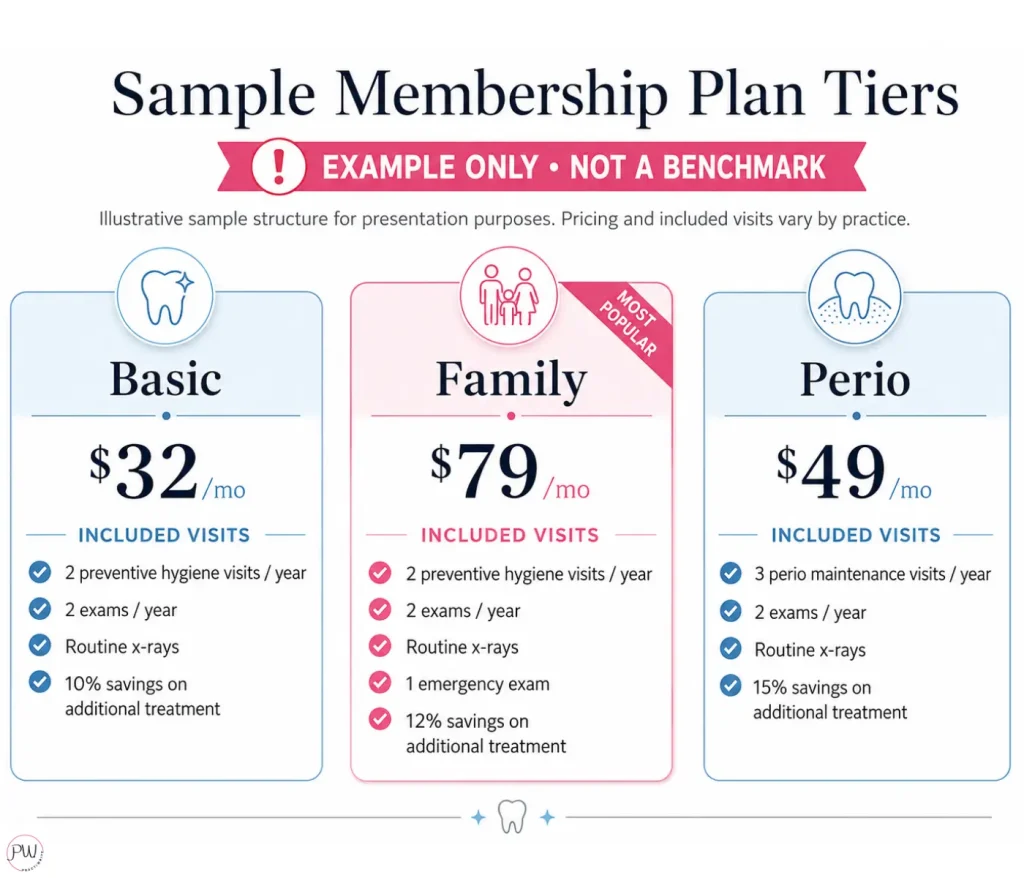
How Do You Tier And Price It Without Killing Your Margins?
One size never fits all. A smart plan has tiers that match real patient needs and still protect profit. Want to sweeten it without tanking your margins? Add simple perks like whitening touch-ups, priority booking, or a small thank-you for auto-renewals.
The moment your plan becomes unlimited dentistry for $39 a month, you’ve built a dental Netflix with zero profit. Don’t do that.
Is Your Membership Plan Legally Sound?
This is where practices get blindsided. Your membership plan is a legal product, and depending on how you build and market it, it can accidentally look like you’re acting as an insurance company. That opens a compliance mess.
State rules vary, some require registration or a third-party administrator, and your plan must clearly state that it is not insurance.
Practiwrite does NOT provide legal advice. What is written here should NOT be considered financial or legal advice. You’ll need to consult a qualified attorney familiar with healthcare contracts and dental membership laws in your state before launching any in-house plan.
Should Your Front Desk Be Managing This By Hand?
No. If you’re asking your front desk to track renewals, bill manually, and chase every patient, you’re building burnout. Use a platform built for dental that handles recurring billing, renewals, compliance, analytics, and member communication.
You shouldn’t be managing your plan. You should be marketing it.
When Should You Use Third-Party Financing In Your FFS Practice?
Use financing for the big, elective, or unexpected cases, where the price tag alone scares patients off. Financing turns a $6,000 “let me think about it” into an affordable monthly number, so sticker shock stops costing you accepted cases.
Is Sticker Shock Killing Your Case Acceptance?
You know the look. You present a $6,500 plan and the patient goes cross-eyed, nods politely, and needs to check their calendar. Translation: they’re out.
Now imagine they hear, instead, “we can split that into affordable monthly payments, no credit card, no stress.” That’s what financing does.
And it isn’t just for full arches. A $1,200 crown can be a dealbreaker too if you expect payment in full today.
In the practices I work with, the case-acceptance jump from simply presenting a monthly number first is the single most underrated lever in the whole fee-for-service playbook. Patients rarely reject the treatment. They reject the lump sum.
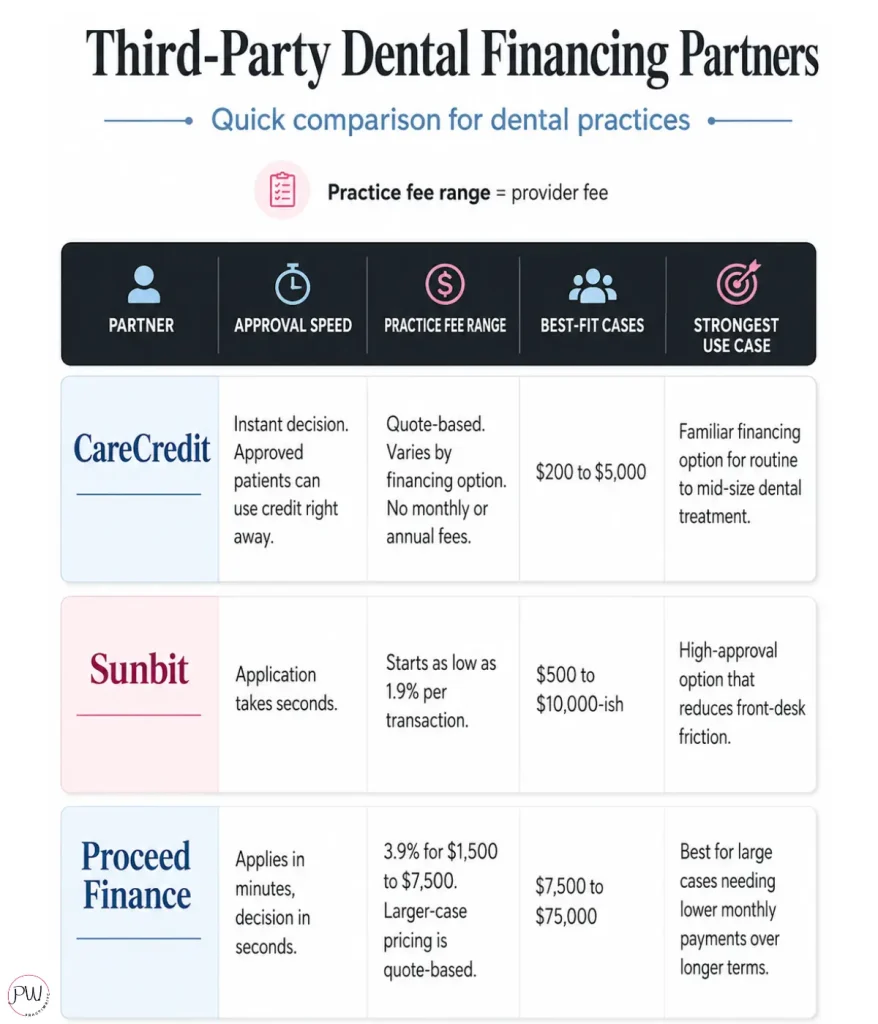
Which Financing Partners Won’t Eat Your Margins?
Not all financing is created equal, and the wrong partner chews through your margins with fees and fine print.
Pick one or two options that match your patient demographic. Don’t offer a buffet. Your team will never keep it straight, and confused patients don’t say yes.
How Do You Present Financing Without Feeling Slimy?
Most dentists fumble financing because they either avoid it until the patient says no, or hand over a brochure and hope. Frame it like a pro instead:
Most of our patients choose to pay monthly for this kind of treatment. We work with a trusted partner that can get you approved today with no upfront cost.
The total is $4,200. With our monthly option, it can be as low as $120 a month, and we can get an answer in about two minutes.
Let your treatment coordinator, not your front desk, walk them through it. Keep it seamless.
And don’t call it a loan. Call it a payment option or a monthly plan. Language matters.
Should You Present Financing Before Or After The Objection?
Before. Always before. If you present the monthly option before the “I can’t afford that” shows up, you normalize it, lower anxiety, and lift acceptance on the spot.
You don’t wait for a no. You build the payment option into the offer, because it is part of the offer. Why hand the patient a reason to stall when you can hand them a reason to start?
Should You Offer Both Membership Plans and Financing?
Yes. The strongest fee-for-service practices don’t choose. They run both, so patients self-select the path that fits them instead of getting a lecture. A hybrid setup builds loyalty and lifts case acceptance without discounting your work.
For the dentists still on the fence about going all in on FFS, having a hybrid option brings the best of both worlds.
–Nicole Kolesar, Founder & CEO of Practiwrite
Why Does The Lexus Or Toyota Model Win?
Ever been to a dealership that says you can only lease, never buy? Of course not, that would be ridiculous.
Same with your financial options. Some patients want predictability. Some need flexibility. Some want both. So give them both:
- Membership plans for routine, preventive care. Ideal for trust and retention.
- Financing for treatment plans. Perfect for the bigger, emotionally charged decisions.
A patient walks in with no insurance? Great, here’s a clean membership option.
They need two implants? Awesome, let’s break that into payments.
They want both? Even better, now they have a system.
You’re not confusing patients. You’re empowering them.
Want Higher Case Acceptance? Let Patients Mix And Match.
Here’s where it gets fun. Let patients combine the two when it makes sense.
Someone joins your membership plan for cleanings and x-rays, then needs $3,600 in treatment later that year. You finance the treatment portion only. They feel taken care of, you keep their loyalty, and you get paid in full.
Options are not discounts. You’re not cutting your fees. You’re structuring affordability in a way that protects your margins and respects your value.
Which Payment Tool Mistakes Quietly Drain FFS Profit?
The five that hurt most are underpricing your plan, treating financing as a last resort, an untrained front desk, offering financing to everyone, and ignoring renewals. Each one looks small and bleeds you slowly. Here’s how to plug them.
Mistake 1: Underpricing Your Membership Plan
This is the most common and most painful one, setting fees out of guilt or guesswork. If your plan doesn’t cover your real costs plus a healthy margin, it isn’t helping your practice. It’s draining it.
Say a cleaning costs you $100, an exam $75, and x-rays $40. That’s $215 in direct cost before you’ve touched a handpiece. Price the plan at $199 a year to sound affordable and congratulations, you’re losing money on every member.
Set fees on value and margin, not on beating insurance rates.
Mistake 2: Treating Financing Like a Last Resort
Presenting treatment, waiting for the patient to panic about price, then mentioning financing as a lifeline is backward. Build it into the case presentation from the start:
“This treatment is $4,600. Most of our patients break that into monthly payments. Want me to show you what that looks like?”
Zero shame. Just clarity.
Mistake 3: Letting Your Front Desk Fumble The Conversation
Your front desk may be great at scheduling, but if they can’t explain your plans confidently, you’re leaving money on the table and confusing patients. Train like it’s a product launch.
Give them one-sheets with plan benefits and pricing, scripts for different case types, and regular role-play with your treatment coordinator. They should talk about financial options as confidently as your assistants talk about flossing.
Mistake 4: Offering Financing To Everyone, All The Time
Use financing like a catch-all and you start eating provider fees on everything, even on patients who could’ve paid in full or used the membership plan.
Use it strategically. Big case, offer financing. Routine work, offer the membership plan. Cash-pay patient, ask before assuming.
For good-fit patients, a short in-house payment plan can dodge provider fees entirely. Just get it in writing.
Mistake 5: Forgetting To Track Renewals And Drop-Offs
Membership plans live or die on renewals. If you’re not tracking who’s expiring, who dropped, and who never signed up, you’re losing more than you think.
Use software with auto-renewals and alerts, run a monthly membership audit, and give patients a reason to stay on board. If you’re replacing expired members every month just to stay flat, you’re spinning your wheels.
Do dental membership plans count as insurance?
No. A dental membership plan is not insurance. It is an in-house program in which a patient pays the practice a recurring fee for a defined set of services, such as cleanings, exams, and x-rays, along with discounts on other treatment.
Unlike insurance, there is no third-party payer, no claims process, and no annual maximum. Because membership plans can be mistaken for insurance products, most states require clear disclosure that the plan is not insurance, and some require registration or use of a third-party administrator.
Will I lose patients if I drop my PPO plans?
Most practices do not lose their core patients when they drop PPO plans, provided they offer a clear way to afford care. Research consistently shows that cost, not network status, is the leading barrier to dental care for adults. When a practice replaces insurance with a structured membership plan and a financing option, patients retain a predictable way to pay, which removes the primary reason they would otherwise leave.
How much should a dental membership plan cost?
A dental membership plan should be priced to cover the practice’s direct cost of the included services plus a sustainable profit margin, rather than to undercut insurance rates. Typical plans are paid monthly or annually and are structured in tiers, such as a basic preventive tier and expanded tiers for periodontal maintenance or families. Pricing below the practice’s cost of delivering the included care causes the plan to lose money on every member.
Are third-party financing fees worth it for an FFS practice?
For larger treatment plans, third-party financing fees are generally worth the cost because they increase case acceptance and ensure the practice is paid in full at the time of treatment. Financing is most cost-effective when applied selectively to high-value or elective cases rather than to every patient, since provider fees apply to each financed transaction. Routine care is usually better served by a membership plan or full payment.
Can a patient use a membership plan and financing together?
Yes. A patient can belong to a membership plan for routine preventive care and use third-party financing for a separate, larger treatment plan. This hybrid approach is common in fee-for-service practices because it lets patients keep predictable preventive coverage while spreading the cost of major treatment over time. The membership plan supports retention, and the financing option supports acceptance of high-value cases.
Wrapping Up: Dental Membership Plans vs Financing: Which Should Your FFS Practice Choose?
Neither, by itself. The right answer is a system that uses both: membership plans to lock in your preventive base, financing to close the big cases, and a trained team that presents both without flinching.
Most dentists have tools. The successful ones have systems.
Here’s what you came in afraid of: that going out of network would empty your chairs. Now you know better.
You were never going to lose patients over a network logo. You were going to lose them over a clumsy or missing way to pay, and that’s fixable inside a week.
But fixing affordability only protects the patients you already have. It does nothing to bring in the right new ones.
A rock-solid membership plan can’t help a patient who never finds you in the first place.
Right now, the highest-value patients in your area, the ones happy to pay out of network for great care, are searching Google and choosing whoever shows up. If that’s not you, your payment strategy never gets a chance to work.
That’s the real leak in most fee-for-service practices.
Not affordability. Visibility.
Schedule your 100% free Dental Practice Roadmap.
Your Dental Practice Roadmap is a GBP and website audit that shows you exactly where you stand, what keywords you’re ranking for now, what you should be ranking for, and a step-by-step plan to close those gaps.
No vague recommendations. No fluff. Just a clear picture of what’s broken and what to do about it. Book your Dental Practice Roadmap and get yours today now.

10+ year content strategist, writer, author, and SEO consultant. I work exclusively with fee-for-service dental practices that want to build value, not volume.