
Your schedule has a slow week, so you run a special. New patient exam, X-rays, and cleaning for $59.
The phone rings. Problem solved, right? Not even close.
Here’s the uncomfortable truth. That discount didn’t fill your chairs with the patients you want. It filled them with the patients who came for the $59 and will leave the second someone down the street offers $49.
If you want to attract high-value dental patients, the kind who accept treatment, stay for years, and refer their friends, a discount is the fastest way to repel them.
High-value dental patients choose a practice for its care and its reputation, not its coupons. They’re not price-shopping. They’re trust-shopping.
And when they see a deep discount, they don’t think ‘wow, what a bargain.’ They think ‘what’s wrong with this place that they have to compete on price?’
Your special didn’t just attract the wrong patient. It quietly pushed away the right one.
So here’s the answer I’ll spend this post proving. You attract high-value dental patients by making the right ones self-select through positioning, reputation, and a website-and-GBP system that signals value at every touchpoint.
You don’t lower your price. You raise your signal.
You make it obvious, before anyone calls, that your practice is the one worth paying full fee for.
That sounds harder than slashing a price. It’s not. It’s just different work, aimed at a different patient.
And unlike a discount, it compounds instead of training your market to wait for the next sale. Let’s get into it.
Table of Contents
What Does It Mean To Attract High-Value Dental Patients?
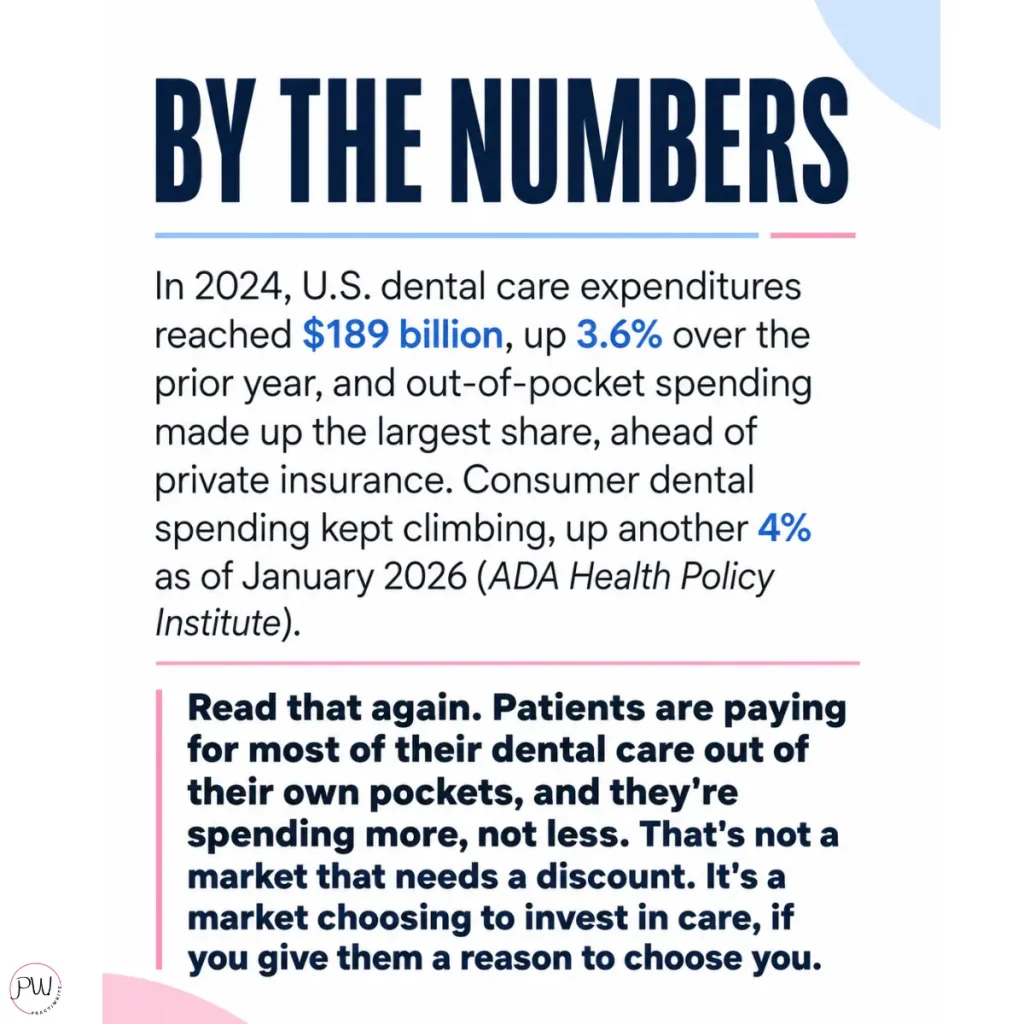
To attract high-value dental patients means to draw in the patients whose worth to your practice comes from case value, loyalty, and referrals, not from sheer visit count. A high-value patient isn’t just someone with an expensive treatment plan. It’s someone who trusts your judgment, says yes to the care they need, comes back, and sends people like them.
Let’s define the opposite so the contrast is clear. A high-volume patient is driven by price and convenience. They shop the exam fee, question every recommendation, disappear after the cleaning, and reappear only when there’s another deal.
There’s nothing wrong with them as people of course. They’re just the wrong economic fit for a fee-for-service practice that runs on quality, not quantity.
Here’s what actually makes a patient high-value. First, case value. They accept comprehensive treatment, not just the bare minimum insurance would cover.
Second, low price sensitivity. They care more about the outcome than the invoice.
Third, loyalty. They stay for years, which means their lifetime value dwarfs any single visit.
Fourth, referral behavior. They send friends and family who look and spend like they do.
So ask yourself this. If one loyal implant patient who refers three friends is worth more than fifty coupon-driven cleanings, why would you build your marketing to attract the fifty?
Why Does Discounting Attract The Wrong Patients?
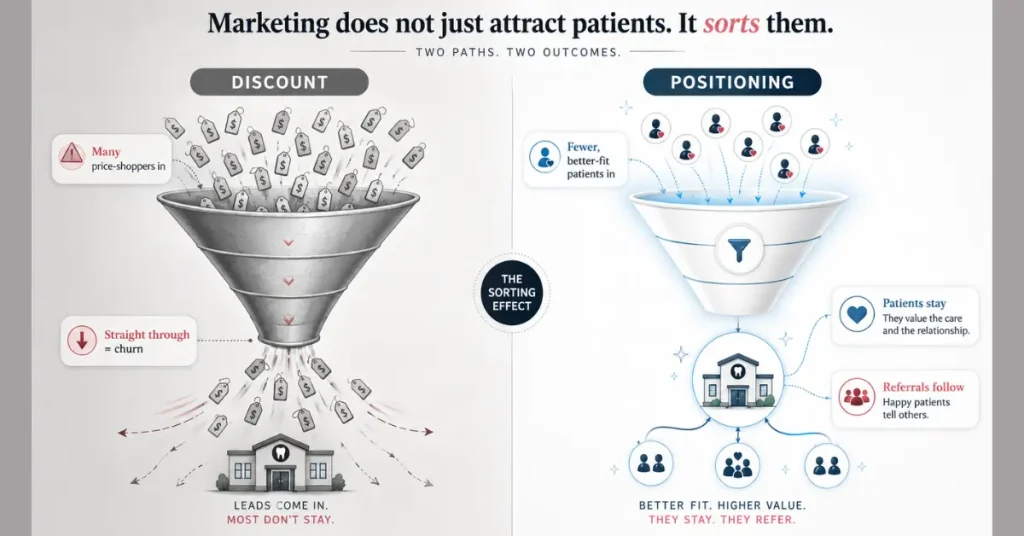
Discounting is a sorting mechanism. Whether you mean it to or not, the price you advertise selects the type of patient who responds to it. Lead with a low number, and you sort your incoming patients for the trait that number rewards: price sensitivity.
Think of it like a filter you can’t see. When your ad says ‘$59 new patient special,’ the people who raise their hand are, by definition, the people motivated by $59. You’ve pre-selected for the exact trait that makes a patient hard to keep and easy to lose. The patient who’d have happily paid your full fee for the same care? They scrolled right past, because your discount signaled that you’re a commodity, and commodities don’t earn trust with high-stakes treatment.
There’s a second cost that’s easy to miss. Discounts train your existing market. Run enough specials and you teach your community that your prices are negotiable and your real value is whatever you last marked down to.
Basically, you’ve capped your own ceiling. Now even your good patients wonder if they overpaid.
And here’s the part that stings. The busier a discount makes you, the worse it can feel, because you’re now running harder to serve patients who produce less and churn faster. A full schedule of the wrong patients isn’t a win. It’s a treadmill.
So if discounting sorts for the wrong patient, what sorts for the right one? Positioning.
How Do You Attract High-Value Patients Without Lowering Your Price?
Attracting high-value patients without discounting means using positioning instead of price to make the right patients self-select. Positioning is everything that signals who your practice is for and why it’s worth full fee, before a patient ever picks up the phone. Get it right and the sorting works in your favor: the right patients lean in, the wrong ones filter themselves out.
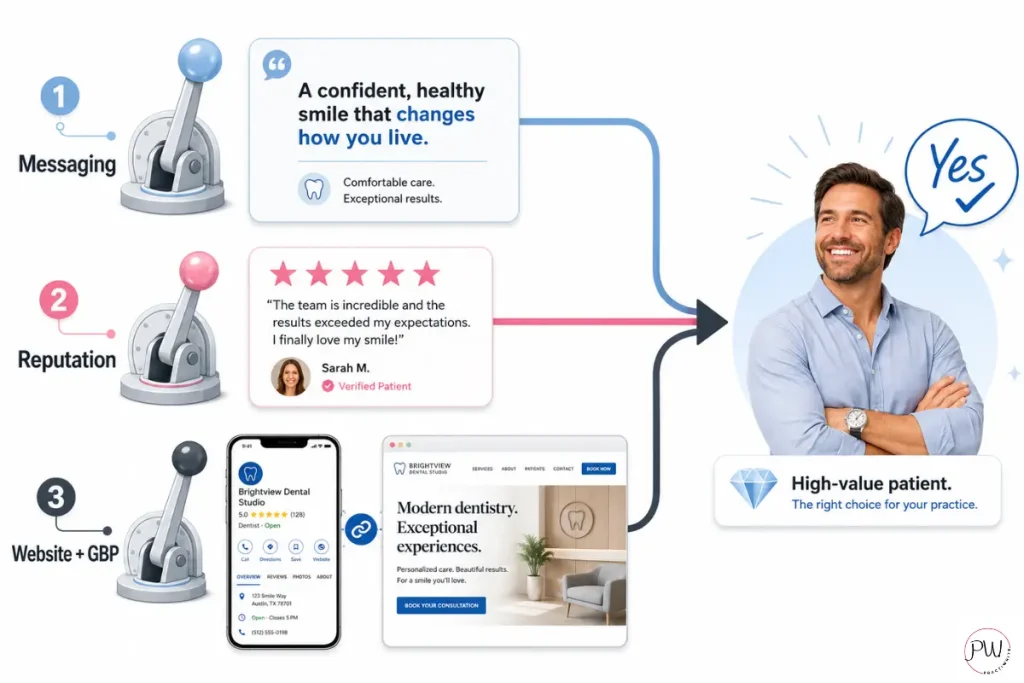
There are three levers that do this work. Your messaging, your reputation, and your website-and-GBP system.
Pull all three in the same direction and you build a practice that’s obviously worth paying for.
How Does Your Messaging Signal Value Instead Of Price?
Your messaging signals value when it speaks to outcomes, expertise, and experience rather than cost. Every word on your site, your profile, and your ads either raises your perceived value or lowers it. There’s no neutral.
Stop leading with what you do and start leading with what patients get. ‘Comprehensive dental services’ says nothing. ‘The last dentist you’ll ever be nervous to visit’ says something.
Speak to the specific patient you want, the one weighing a full-mouth reconstruction or finally fixing the smile they’ve hidden for years, and speak to the result they’re after, not the procedure code. When your message sounds like it was written for a discerning patient, discerning patients recognize themselves in it.
How Do Reviews And Reputation Attract High-Value Patients?
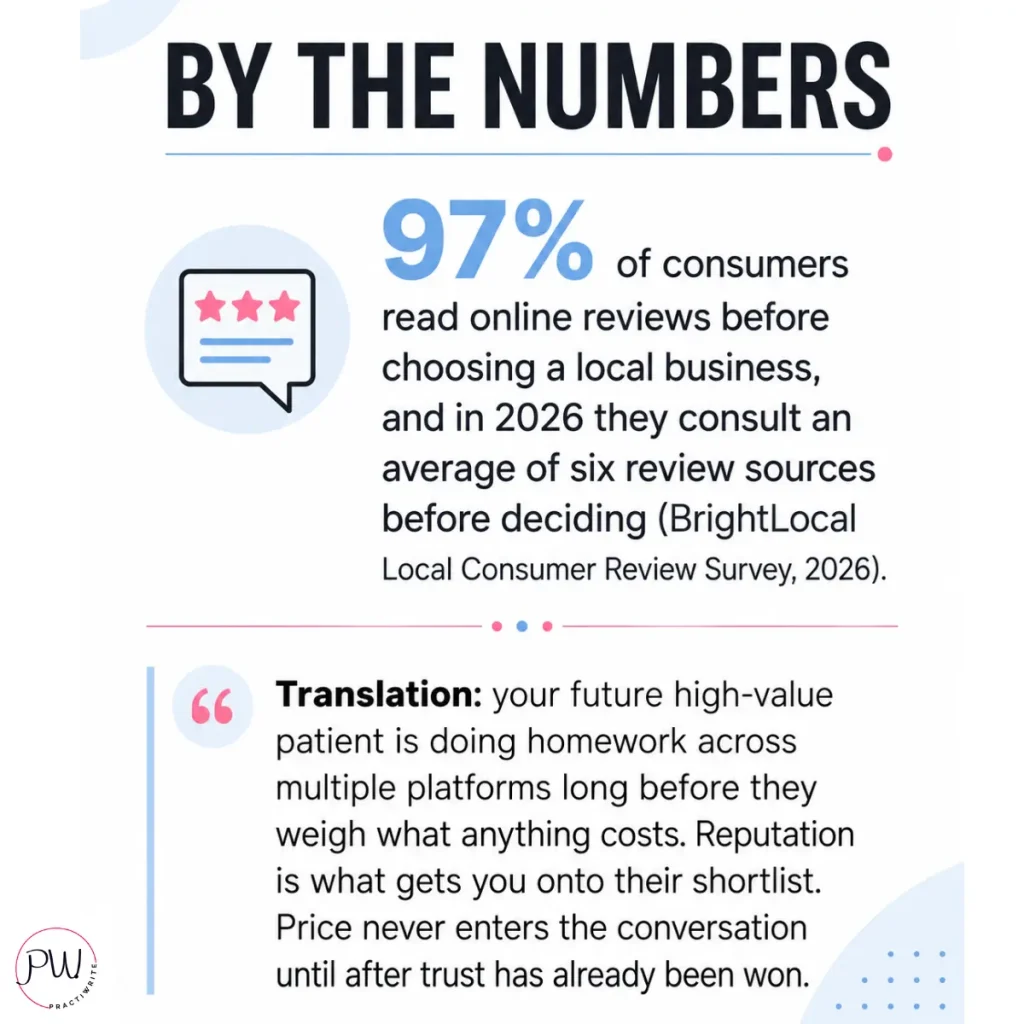
Reviews and reputation attract high-value patients because trust is the currency they actually shop in. Before a high-value patient spends five figures on their mouth, they read what other people like them experienced. Your star rating and your recent reviews are the single most persuasive asset you own, and they cost nothing to accumulate except attention.
High-value patients don’t just count stars. They read. They look for reviews that mention the exact outcome they want, the calm demeanor, the painless implant, the transformation.
So a reputation system that consistently generates specific, recent, story-driven reviews does more to attract premium cases than any discount ever could. Would you trust your smile to a practice with eleven reviews from two years ago, or the one with two hundred recent ones describing patients just like you?
How Do Your Website And GBP Filter For The Right Patients?
Your website and Google Business Profile filter for the right patients when they work as one system that signals premium care at every step. A high-value patient’s journey isn’t your website or your profile. It’s both, in sequence: they find you on Google, judge you by your profile and reviews, then click to your site to confirm you’re the caliber they’re looking for.
A break anywhere in that chain leaks the exact patient you want.
This is why optimizing them in isolation fails. A polished website behind a neglected, photo-less GBP still loses the patient at the first impression. A strong profile that clicks through to a dated, generic website loses them at the second.
Funded and built as a unified system, your GBP and website become a filter that quietly qualifies premium patients in and price-shoppers out, without you ever advertising a price at all.
What Should You Offer Instead Of A Discount?
The alternative to a discount is a value offer: something that lowers the patient’s risk or friction without lowering your price. You’re not giving away margin. You’re removing the reasons a high-value patient hesitates, which are almost never about finding the cheapest option.
Offer certainty instead of a price cut. A complimentary consultation for implants or cosmetic cases isn’t a discount, it’s a low-risk first step that lets a serious patient decide with confidence. Offer a clear plan, a warm experience, and a straight answer about what treatment will cost and why it’s worth it.
Position financing as access, not as a markdown. Payment options let a patient say yes to the care they actually want instead of the cheaper compromise. That protects your fee and your case value at the same time.
And if you run a membership plan, frame it as a relationship for the uninsured patient who’s choosing you on purpose, not as a race-to-the-bottom coupon. Same tool, completely different signal.
Here’s the test for any offer you’re considering. Does it make the right patient feel safe saying yes, or does it just make you cheaper? If it’s the second one, you’re back to discounting.
Isn’t it worth building offers that attract patients instead of training them to wait for a sale?
How Do You Talk About Price Without Flinching?
Talking about price without flinching means presenting your fees as a confident statement of value rather than an apology you rush to soften. The moment your team hesitates or reaches for a discount to smooth over a number, you’ve told the patient the price isn’t real. High-value patients read that instantly.
Confidence starts before the price conversation. By the time a well-positioned patient hears the number, your reputation and messaging have already done the persuading, so the fee lands as confirmation, not sticker shock.
Train your team to state the investment plainly, connect it to the outcome, and then stop talking. Silence after a fair number is a sign of conviction. A nervous discount is a sign of doubt.
This is where positioning pays off in the operatory, not just the ad. A practice that discounts to win the case teaches patients to negotiate. A practice that stands behind its fees, backed by genuine value, teaches patients that the number is the number, and the number is worth it. Which of those practices do you want to be known as?
How Do You Know Your Value Positioning Is Working?
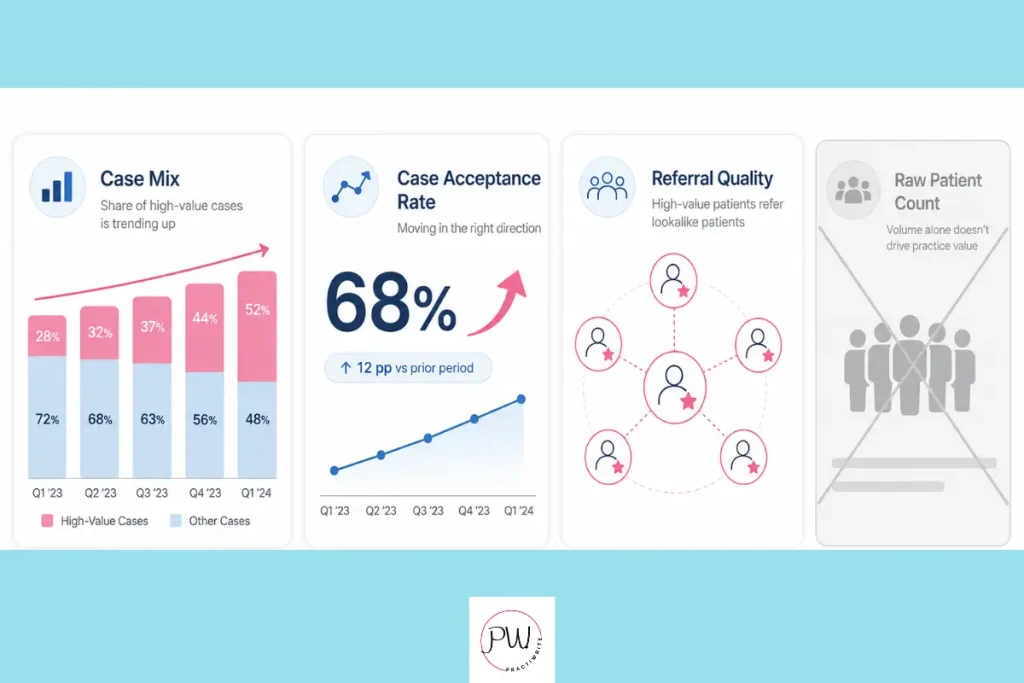
You know your value positioning is working when your patient mix, not your patient count, starts to shift. The scoreboard for a discount is raw volume. The scoreboard for positioning is quality, and it shows up in three numbers worth watching.
Track your case mix first. Are you attracting more of the implant, cosmetic, and comprehensive cases you built the strategy around, or still fielding calls that open with ‘do you take my insurance and what’s your cheapest cleaning’? A rising share of high-value cases is the clearest sign the sort is working.
Watch your case acceptance rate next. When patients arrive already trusting you, they say yes more often and haggle less. Acceptance climbing without you dropping fees means your positioning is doing the convincing before the treatment plan hits the table.
Finally, look at referral quality. High-value patients refer people like themselves. When your new patients increasingly arrive pre-sold through word of mouth from your best cases, you’ve built the compounding engine a discount can never produce.
So are you measuring the patients you’re keeping, or just counting the ones who showed up for a coupon?
What is a high-value dental patient?
A high-value dental patient is one whose worth to a practice comes from case value, loyalty, and referrals rather than from frequency of visits alone. These patients tend to accept comprehensive treatment, show low price sensitivity, remain with a practice for years, and refer others with similar needs. For fee-for-service practices, a single high-value patient can be worth more than dozens of price-driven, one-time visitors.
Does discounting hurt a dental practice?
Discounting can hurt a fee-for-service practice by attracting price-sensitive patients who are less likely to accept treatment or stay long term, while signaling lower value to the premium patients the practice wants. Repeated discounting can also condition a local market to expect lower prices, which erodes the perceived value of the practice over time.
How do you attract dental patients without lowering prices?
Practices attract patients without lowering prices by using positioning rather than price. This includes value-focused messaging that speaks to outcomes, a strong and recent review base that builds trust, and a Google Business Profile and website that function as a unified system signaling premium care. These elements lead the right patients to self-select based on trust instead of cost.
Are dental membership plans just a form of discounting?
Membership plans are not inherently discounting, though they can be framed either way. Positioned as an ongoing relationship for uninsured patients who choose a practice deliberately, a membership plan supports value-based positioning. Positioned as a race-to-the-bottom price offer, it functions as a discount. The framing, and the patient it attracts, determine which it becomes.
How long does it take to attract higher-value patients?
Shifting toward higher-value patients is a gradual process measured over months rather than weeks, because reputation and positioning compound over time. Reviews accumulate, messaging gains traction in search, and referrals build. Practices typically evaluate progress through changes in case mix, case acceptance, and referral quality on a rolling basis rather than through immediate spikes in patient count.
Wrapping Up: Stop Competing On Price The Right Patients Never Cared About
Here’s the whole argument in one breath. Discounting doesn’t fill your practice with the wrong patients by accident, it does it by design, because price is a filter and a low price filters for people who leave.
You attract high-value dental patients the opposite way: by raising your signal instead of lowering your fee, so the right patients recognize you’re worth full price before they ever call. Sharpen your messaging, build a reputation that does the selling, and run your website and GBP as one system that qualifies the right patients in. Do that and you stop competing on price entirely, because the patients you want were never shopping on price to begin with.
But you can’t out-position a foundation that’s leaking. If your Google Business Profile is thin or your website reads like every other practice in town, even the best patients slip away before they see your value.
Schedule your 100% free Dental Practice Roadmap. Your Dental Practice Roadmap is a GBP and website audit that shows you exactly where you stand, what keywords you’re ranking for now, what you should be ranking for, and a step-by-step plan to close those gaps. No vague recommendations.
No fluff. Just a clear picture of what’s broken and what to do about it.
Book your Dental Practice Roadmap and get yours today now.

10+ year content strategist, writer, author, and SEO consultant. I work exclusively with fee-for-service dental practices that want to build value, not volume.