
You’ve seen them. Those listings sitting at the very top of Google, above the regular ads, above the map, with the green Google Screened checkmark next to a smiling dentist. And you’ve wondered whether that spot is worth buying for your practice.
Here’s the problem with almost everything written about local service ads for dentists: it’s written for volume practices. You know, where any lead is a good lead.
You don’t run on any lead. You run on the right leads, and a pay-per-lead product charges you the same whether the caller wants an implant consult or a coupon.
So here’s the straight answer, no hedging. Yes, local service ads work for fee-for-service practices, and they can work very well. But only under conditions.
LSAs put you in the most visible spot in local search and deliver high-intent leads, and they do zero sorting.
The ad can’t tell a value-ready patient from a price-shopper. Your foundation does that, because LSAs pull your reviews, your rating, and your responsiveness straight from your existing presence and put them on display at the top of the page.
Which means LSAs aren’t really a shortcut. They’re an amplifier.
Run them on a strong foundation and you’re buying premium real estate with a filter already installed. Run them on a weak one and you’re paying retail to broadcast your weakest signals.
This post covers how LSAs actually work, where pay-per-lead helps and hurts a fee-for-service practice, the conditions that decide your outcome, and how to tell if you’re ready. Let’s get into it.
Table of Contents
What Are Local Service Ads For Dentists, And How Do They Work?
Local Service Ads are Google’s pay-per-lead ad format that places verified, Google Screened businesses at the very top of local search results. These results sit above traditional pay-per-click ads and the maps pack, and charges per lead instead of per click.
A lead is a call or message sent through your ad by a patient asking about a service you offer. No call, no charge.
Dentistry earned its spot in the program as the first HIPAA-regulated industry Google let in, which tells you how carefully the product is gated. To run LSAs, a practice has to pass Google’s screening first:
- An active dental license for each dentist on the account, plus NPI verification.
- Business registration, and a background check processed through Google’s screening partner.
- In many markets, a minimum Google review count and rating before you’re eligible.
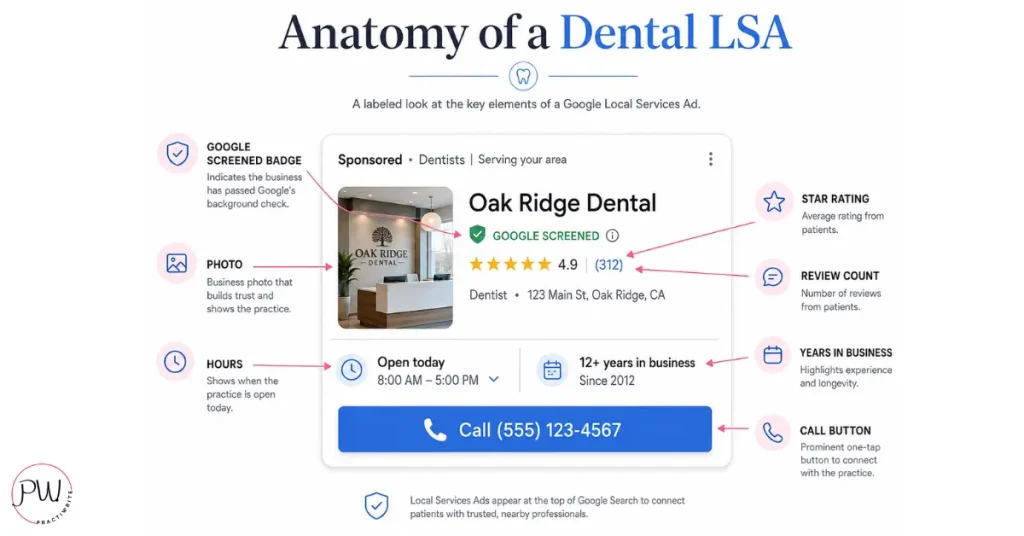
Pass all that and you get the green Google Screened badge, which is the trust signal that makes these ads convert. Each ad unit shows your practice name, photo, star rating, review count, hours, and years in business. Patients tap to call or message you directly.
Only a few positions exist, roughly three on desktop and two on mobile, so this is scarce real estate, not an open auction.
And here’s the detail that matters most for everything that follows: the ad’s ranking and appeal run on your existing signals. Your Google reviews, your rating, your proximity to the searcher, and how fast you answer leads all feed the algorithm. The ad doesn’t create trust. It borrows yours and puts it at the top of the page.
Do Local Service Ads Work For Fee-For-Service Practices?
Yes, conditionally. Local service ads work for fee-for-service practices when the foundation underneath them sorts patients, and they burn money when it doesn’t. That’s the whole answer, and the rest of this post is the mechanics behind it.
Here’s the honest tension. LSAs deliver two things an FFS practice genuinely wants: the highest placement on the page, and high-intent leads from patients ready to contact a dentist right now.
But they deliver one thing an FFS practice can’t ignore: no built-in sorting. Pay-per-lead means the implant consult and the bargain-hunting call cost you the same money.
In a volume practice, that’s fine, every lead has roughly the same value. In your practice, lead quality is the entire ballgame, and the platform doesn’t care about quality. It counts contacts.
That’s not a reason to avoid LSAs. It’s the reason to do them in the right order. The practices that win with LSAs are the ones whose website and Google Business Profile already sort for the right patients, because the ad inherits everything those assets signal.
Why would you buy the most visible spot in town before deciding who it should be visible to?
Why Is Pay-Per-Lead Both The Best And Worst Thing About LSAs?
Pay-per-lead means you only pay when a patient actually contacts you, which caps waste, and it also means you pay full price for wrong-fit patients, which is where fee-for-service practices bleed. Both halves are true at once, so let’s take them one at a time.
The Best Half: You Pay For Contact, Not Curiosity
With traditional pay-per-click, you pay every time someone clicks, whether they call you or wander off to check their fantasy league. With LSAs, browsers cost you nothing. A patient who taps your ad, reads your reviews, and leaves without calling is free brand exposure.
You’re only charged when someone reaches out about a service you actually offer, and if a lead is spam, fraudulent, or clearly outside what you do, you can dispute it through your dashboard for a credit. That’s a real waste cap that PPC never gives you.
The Worst Half: The Platform Can’t Tell Your Patients Apart
The lead that books a full-arch case and the lead that asks if you take their discount plan hit your invoice at the same rate. Google’s dispute process credits invalid leads, not wrong-fit ones.
A price-shopper asking about a cleaning is a valid lead by Google’s definition, and you’ll pay for it. That’s why raw cost per lead is a misleading number for an FFS practice, and why the volume crowd’s LSA advice mostly doesn’t apply to you.
The Math That Actually Matters For An FFS Practice
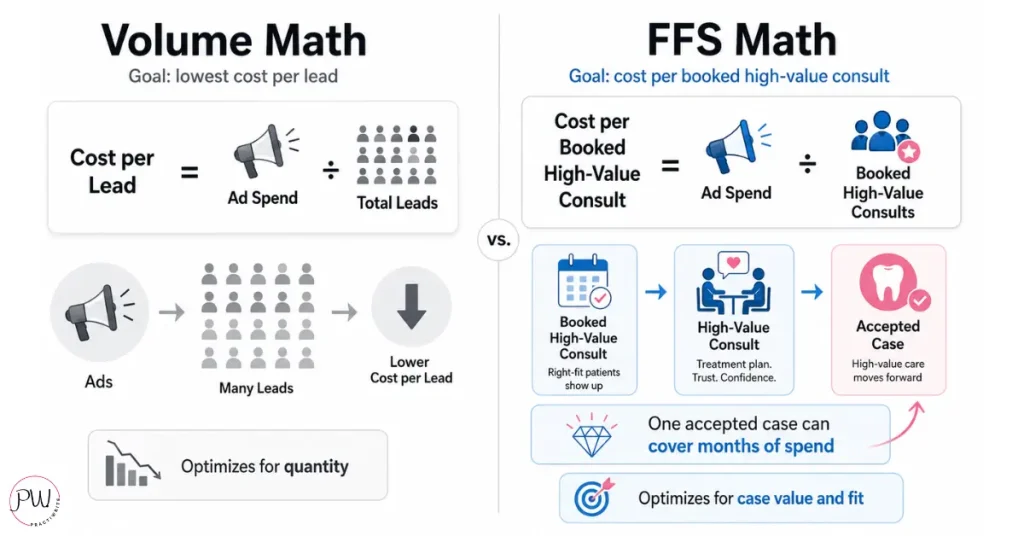
Here’s the flip side that the volume crowd misses. Because your revenue runs on case value, you don’t need many right leads for LSAs to pay for themselves.
In the practices I work with, a single accepted high-value case typically covers months of LSA spend, which completely changes the arithmetic. A volume practice needs the cost per lead low. You need the cost per booked high-value consult low, and those are different games.
One more reason your effective cost stays down: answer speed. Google factors responsiveness into ranking, and missed calls are still billed leads, so every unanswered ring quietly raises your true cost per patient.
What Has To Be True Before LSAs Make Sense For Your Practice?
LSAs reward practices that already have a strong Google Business Profile, healthy review volume with responses, fast call handling, and clear positioning, because the ad borrows all of those from your existing presence. This is the section that decides whether LSAs make you money or make you noise, so slow down here.
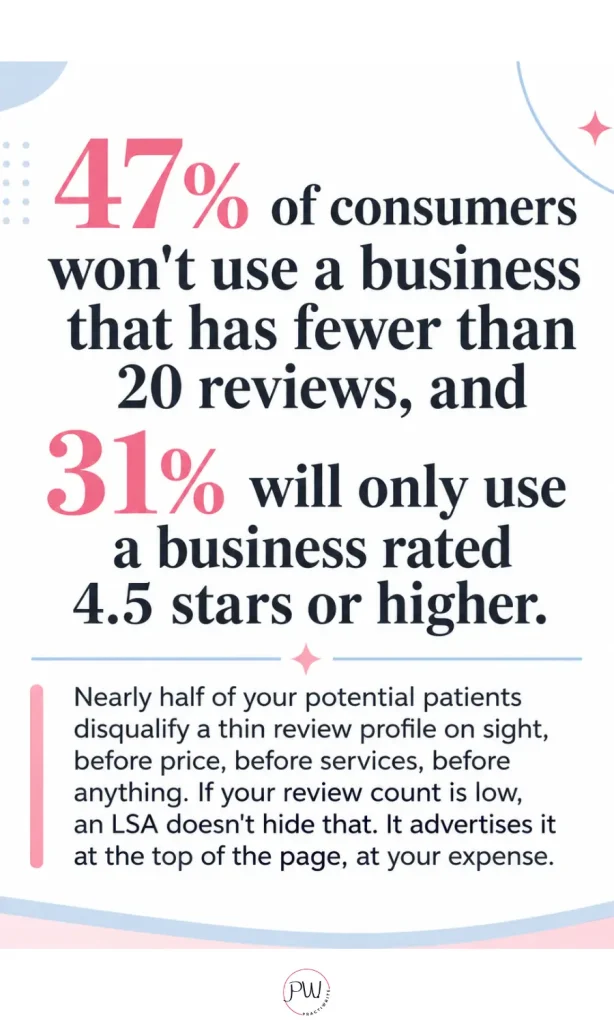
Remember what displays in the ad unit: your star rating and your review count, right there at the top of the page next to your competitors’. That display isn’t decoration. It’s the first filter patients apply, and the thresholds keep rising.
Now put that next to what I found in my own research. In my analysis of 2,000 dental Google Business Profiles across all 50 states, the practices that landed in the bottom performance tier were overwhelmingly there because of execution, not location, not specialty, not market size. Thin review volume with no owner responses was one of the most common gaps, even among practices with strong ratings.
In other words, the exact signals LSAs display and rank on are the signals most practices neglect. That’s why two dentists in the same town can run the same LSA budget and get wildly different results. The ad amplified what each already had.
So before you spend a dollar on LSAs, these four things should already be true:
- Your GBP is complete and actively managed. Categories, services, photos, hours, and description all current, because the ad and the algorithm both draw from it.
- Your review engine is running. Volume past the disqualification threshold, a strong rating, fresh reviews coming in, and owner responses on all of them.
- Your phones get answered fast. Responsiveness feeds your ranking, and every missed call is a billed lead with no patient attached.
- Your positioning is set. Your website and profile clearly signal a quality-first practice, so the patients the ad delivers arrive pre-sorted.
Foundation first, then ads. Not because ads are bad, but because ads multiply whatever they’re pointed at.
How Do You Keep LSAs From Filling Your Chairs With The Wrong Patients?
You control LSA lead quality through your service selections, your coverage area, your budget pacing, and disciplined front-desk screening, because the platform won’t filter for you. LSAs give you fewer dials to turn than regular Google Ads, but the dials you get matter. Here’s how to set them like a fee-for-service practice instead of a volume mill.
- Turn off the services you don’t want more of. LSAs let you switch individual dental services on and off. Keep the high-value work on, and turn off the categories that attract the calls you dread. Fewer service types means cleaner leads.
- Draw the coverage area around your real patient base. An overly broad radius dilutes lead quality. Target the neighborhoods your best patients actually come from, not the maximum area Google will allow.
- Pace the budget for quality, not maximum volume. Start with a modest weekly budget, watch what comes in, and scale only after the lead quality proves out.
- Train the front desk to qualify fast and dispute promptly. The first sixty seconds of each call decide whether a lead becomes a consult, and ineligible leads should be disputed the same week, not at month’s end.
- Track the right number. Cost per booked high-value consult, not cost per lead. The second number will always look better and mean less.
What should your numbers look like? Watch for these patterns:
Green flag: A meaningful share of leads book consults, disputes get credited, and your cost per booked high-value case is a fraction of the case’s revenue.
Red flag: High lead volume, low bookings, calls about services you turned off or plans you don’t take, and a cost per lead that looks cheap while your schedule stays empty of the cases you want.
Notice that every lever here is a sorting decision. The platform delivers intent. You supply the filter.
Should You Run LSAs, Google Ads, Or Both?
LSAs and standard Google Ads occupy different real estate and serve different intent, so for most fee-for-service practices the real question is sequencing, not either-or. Here’s the short version, because this deserves its own deep dive.
LSAs own the top of the page and the ready-to-book searcher. They’re simpler to run, charge per lead, and lean entirely on your reputation signals. Standard Google Ads sit below them, charge per click, and give you far more control, which makes them better for targeting specific high-value procedures where LSA service categories are too blunt an instrument.
Many strong FFS practices eventually run both, LSAs catching the high-intent local demand, search ads sniping the implant and cosmetic keywords with precision landing pages.
But neither one comes first. The foundation does. An ad budget can’t fix a weak profile, it can only promote it. If you’re choosing where the next dollar goes and your GBP isn’t airtight, the answer isn’t either ad platform yet.
How Much Do Local Service Ads Cost For Dentists?
Local Service Ads charge per lead rather than per click, and the cost per lead varies by market, competition, and the services selected, so there is no single national price. Practices set a weekly budget based on the number of leads they want, and Google estimates lead volume against that budget. Because pricing is auction-based and local, the most reliable way to gauge cost is to start with a modest weekly budget, measure the cost per booked consultation rather than cost per lead, and scale based on lead quality.
What Is The Difference Between Local Service Ads And Google Ads For Dentists?
Local Service Ads charge per lead, appear at the very top of search results above traditional ads, and display trust signals such as the Google Screened badge, star rating, and review count. Standard Google Ads charge per click, appear below LSAs, and offer far more control over keywords, ad copy, and landing pages. LSAs suit high-intent local searches where trust drives the choice, while standard ads suit precise targeting of specific procedures. Many practices run both once their foundation supports them.
What Does Google Screened Mean For Dental Practices?
Google Screened is a verification badge indicating that a dental practice has passed Google’s screening process, which includes confirmation of dental licenses, National Provider Identifier verification, business registration, and a background check through Google’s screening partner. Some markets also require a minimum review count and rating. The badge appears on the practice’s Local Service Ad as a trust signal, and only screened businesses are eligible to run LSAs.
Can You Dispute Bad Leads From Local Service Ads?
Yes. A practice can dispute a lead through its Local Services Ads dashboard, and if Google agrees the lead was invalid, the charge is credited. Disputes generally cover spam, fraudulent contacts, and inquiries about services the practice does not offer. Disputes do not cover valid leads that are simply a poor fit, such as price-focused patients asking about services the practice does provide, which is why lead qualification at the front desk still matters.
Do Local Service Ads Use Your Google Business Profile Reviews?
Yes. Local Service Ads display the practice’s Google review rating and review count directly in the ad, and those review signals are a significant factor in how prominently the ad appears. A strong, recent, well-managed review profile improves both the ad’s ranking and its appeal to patients, while a thin or stale review profile weakens the ad regardless of budget. This is why review health is a prerequisite for LSA performance rather than an optional extra.
Wrapping Up: LSAs Are An Amplifier, Not A Shortcut
Here’s the whole post in three sentences. Local service ads take whatever your practice already signals, your reviews, your responsiveness, your positioning, and put it at the top of the page at retail prices.
Amplify a practice built to attract high-value patients, and LSAs are some of the best money in local search. Amplify a weak foundation, and you’re paying premium rates to broadcast it to everyone in town.
So the real question was never whether LSAs work. It’s whether your foundation is ready for them. And unlike most marketing questions, that one is checkable right now, today, before you spend a dollar on ads.
Schedule your 100% free Dental Practice Roadmap.
Your Dental Practice Roadmap is a GBP and website audit that shows you exactly where you stand, what keywords you’re ranking for now, what you should be ranking for, and a step-by-step plan to close those gaps.
No vague recommendations. No fluff. Just a clear picture of what’s broken and what to do about it.
Book your Dental Practice Roadmap and get yours today now.

10+ year content strategist, writer, author, and SEO consultant. I work exclusively with fee-for-service dental practices that want to build value, not volume.