Most dentists transitioning from PPO to fee-for-service blame the wrong thing when their phone keeps ringing with insurance questions.
They blame the market.
They blame their patients.
They blame the economy.
The real problem is on their homepage.
If you’re working on (or thinking about) a fee-for-service transition and the patients calling your office still ask about insurance first, your website and Google Business Profile are still set up for PPO patients.
Fee-for-service dental marketing isn’t a redesign. It’s a reposition.
Here’s the short answer to the question this blog is built around: stop leading with insurance acceptance, affordability, and “new patients welcome.”
Start leading with expertise, comprehensive care, and selectivity.
Your homepage headline, service pages, GBP business description, and the way your front desk answers the phone all need to point in the same direction. When they do, the patients who call you change.
The patients calling your practice are the patients your messaging asked for.
If you’re getting PPO calls, your website is still asking for them. The good news? You don’t need a $30,000 website redesign.
You need to fix the words. This guide walks you through exactly what to look for on your website and GBP, what to change, and the mistakes that quietly sink most repositioning efforts.
Why Does Your Dental Website Attract The Wrong Patients?
Your website attracts the wrong patients because every word, image, and call-to-action on it tells search engines and patients what kind of practice you are. If your messaging signals “insurance-friendly, affordable, family practice,” that’s who Google ranks you for and that’s who picks up the phone.
Think of it like a buffet sign. If your restaurant sign says “$9.99 all-you-can-eat,” you don’t get fine dining customers walking in. You get the people who saw the sign. Then if you raise your prices, those people leave and you wonder why nobody new came in.
The sign was the problem.
Your website is the sign. Most dentists don’t realize this until they’ve spent a year trying to transition and watching nothing change.

Here’s what’s happening behind the scenes:
- Google reads your website and GBP content and matches you to the search queries your messaging looks like
- Patients self-select into or out of your practice within seconds of landing on your homepage; it takes 0.05 seconds (50 milliseconds) for a patient to form an opinion on your website
- Insurance-focused messaging trains both Google and patients to see you as an insurance-driven practice
So if your homepage headline says “Quality Family Dentistry, Most Insurance Accepted,” Google ranks you for “dentist that takes my insurance.”
That’s who searches and finds you.
That’s who calls.
Not because they’re bad patients, but because your sign asked for them.
Want fee-for-service patients calling instead? You change the sign.
What Does PPO Messaging Look Like On A Dental Website?
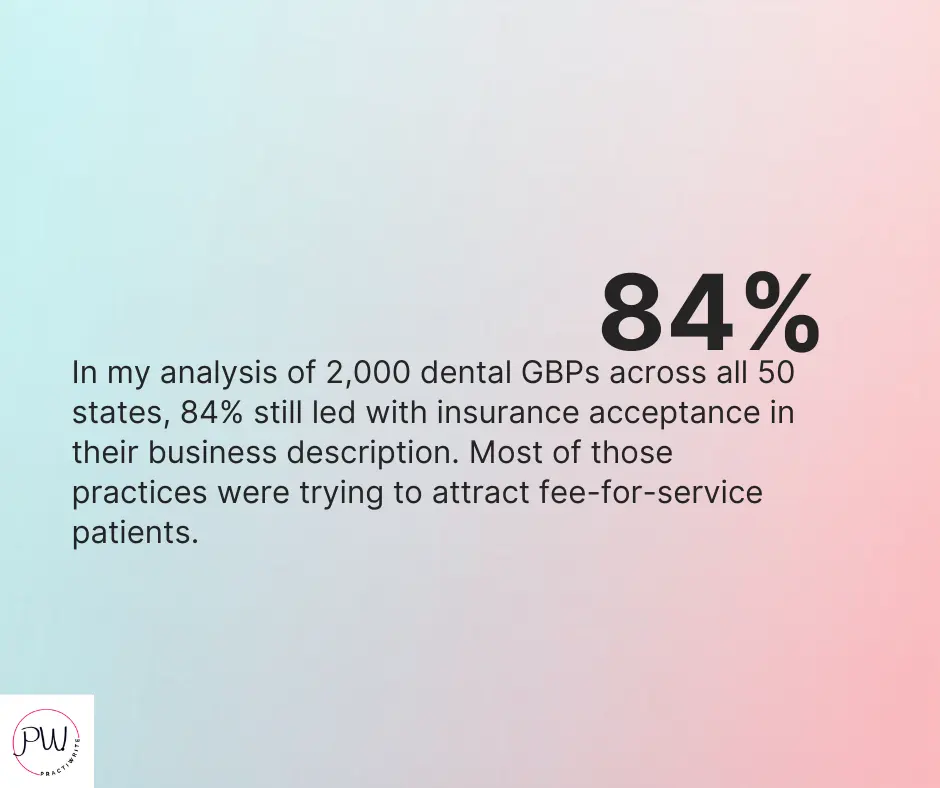
PPO messaging is any language, image, or call-to-action on your website that signals affordability, insurance dependence, or volume over expertise. Most dentists have it everywhere and don’t know it.
Here’s how to spot it on your own site.
What Are The Red Flags On A Dental Practice Homepage?
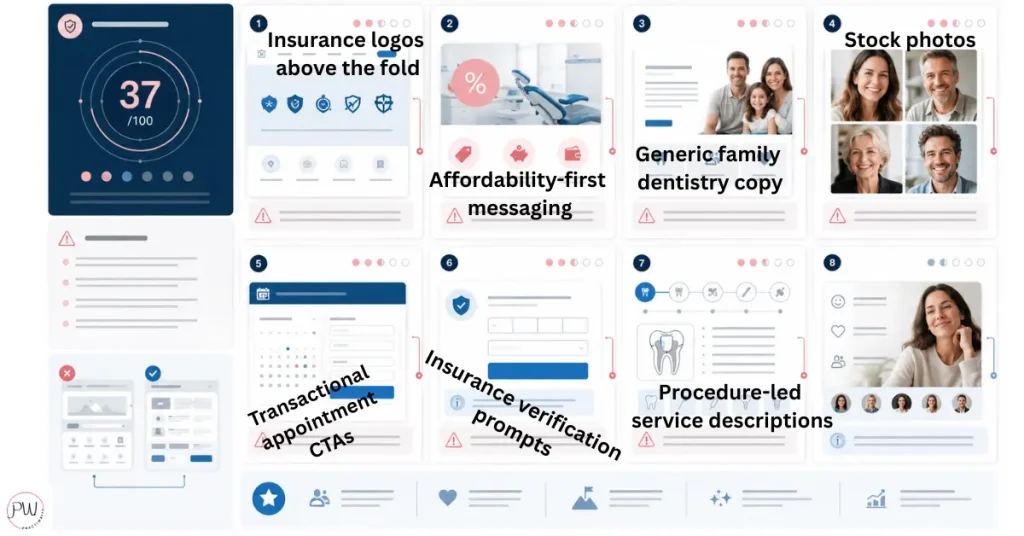
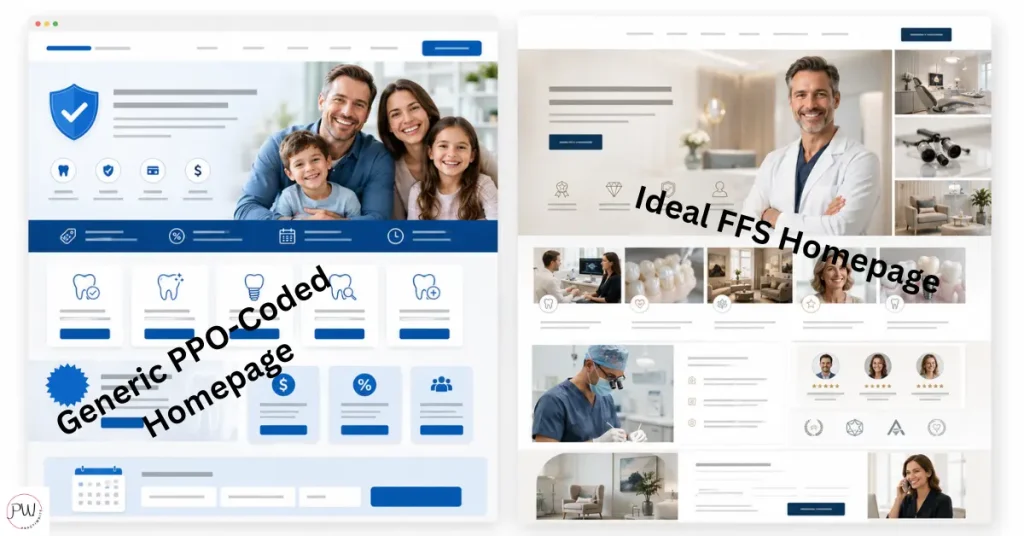
Homepage red flags include insurance logos in the header, “most insurance accepted” in the hero section, headlines built around affordability or family, and stock photos of generic smiling families.
Look at your homepage right now. If your headline is some version of “Quality, Affordable Dental Care for the Whole Family” with insurance logos under it, that’s PPO messaging.
Patients reading it think: insurance-friendly, budget option, volume practice. Even if you’re a Harvard-trained implant specialist, the headline buries you.
What Are The Red Flags On Service Pages?
Service page red flags include:
- Procedure descriptions that lead with what the procedure is instead of what the patient gets
- Missing pricing
- “We’ll work with your insurance” CTAs (and no mention of doctor expertise or technology)
A PPO-positioned implant page describes implants. A fee-for-service-positioned implant page leads with the patient: “Missing teeth affect your confidence, your ability to chew, and the long-term health of your jaw.”
Same procedure. Different sign.
What Are The Red Flags On Your About Page?
About page red flags include:
- Taglines like “affordable family dentistry since 2008,”
- Lists of insurance plans accepted,
- Generic mission statements about “comfortable care,”
- And no discussion of clinical philosophy or treatment approach
Your About page should explain who you are and why a patient should pick you. If yours sounds like every other dentist’s About page in your zip code, you’ve got PPO messaging. What does your About page say about why a patient should pick you over the practice down the street?
What Are The Red Flags In Your CTAs?
CTA red flags include:
- “Verify Your Insurance”
- “Schedule Appointment” (transactional)
- “New Patients Welcome” (desperate)
- And any CTA that prioritizes insurance verification over clinical assessment
A fee-for-service CTA invites a patient to a comprehensive consultation, not a transactional appointment. The verb matters.
“Book,” “Schedule,” and “Reserve” all sound the same.
“Schedule Your Comprehensive Consultation” tells the patient something specific is happening.
How To Reposition Your Google Business Profile For Fee-For-Service Dental Marketing
Repositioning your GBP for fee-for-service dental marketing means:
- Rewriting the business description
- Refining your category
- Controlling the Q&A section
- Posting with intent
- And showing the right photos so Google ranks you for the patients you actually want
Here’s why this matters more than your website.
Most patients don’t visit your homepage first. They see your GBP in Google’s local maps pack and decide whether to click. If your GBP is positioned for PPO patients, you don’t even get the chance to make a website case.
How Should You Rewrite Your GBP Business Description?
Your GBP business description should lead with your clinical philosophy, your areas of expertise, and the patient experience, not insurance acceptance.
A PPO-positioned business description sounds like:
- “Riverside Dental Care provides quality dental care for families”
- “We accept most major insurance plans including Delta Dental, Cigna, MetLife, and more”
- New patients welcome!”
A fee-for-service-positioned business description sounds like:
- “Riverside Dental Care provides comprehensive, patient-centered dentistry for individuals and families who value exceptional care.”
- “Dr. Martinez combines advanced training in cosmetic and restorative dentistry with state-of-the-art technology to deliver beautiful, long-lasting results.”
- “We work with most insurance plans, but never let coverage limitations dictate your treatment options.”
The second version doesn’t reject insurance. It just doesn’t lead with it. That difference is everything.
What’s The Right Primary Category For A Fee-for-Service Dental Practice?
The right primary category depends on what you actually do, but most fee-for-service practices are mispositioned as “Dentist” when they should be “Cosmetic Dentist,” “Dental Implants Provider,” or another more specific category.
“Dentist” is the broadest category and competes with every general practice in your area, including the ones running PPO volume. A more specific category narrows your competitive set and signals expertise.
If 60% of your production comes from cosmetic and restorative work, “Cosmetic Dentist” tells Google to rank you for those searches, where the search intent matches a fee-for-service patient.
How Do You Get Your Practice Into Google’s AI-Powered Answers?
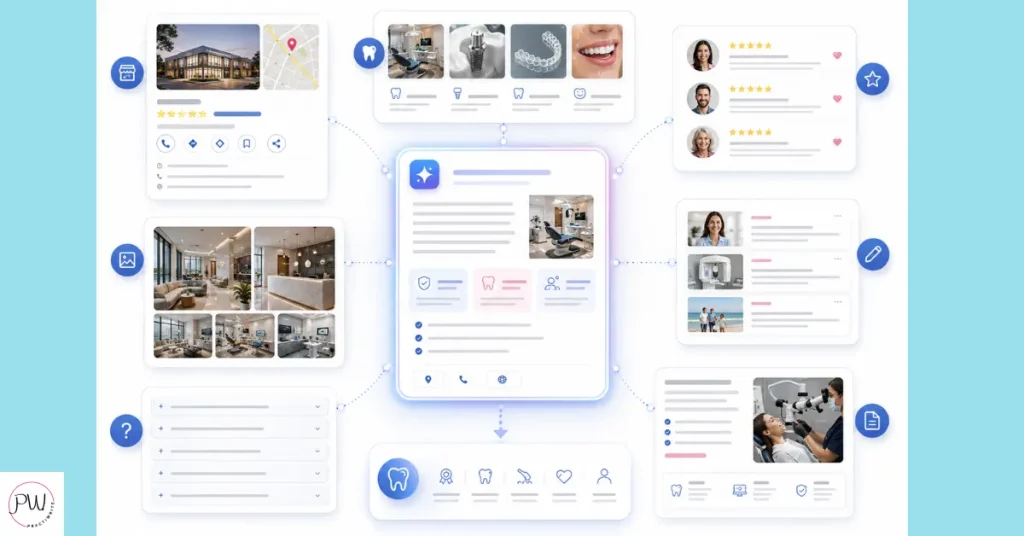
You get your practice into Google’s AI-powered answers by making sure every data source Gemini reads about your practice tells the same fee-for-service story.
The old advice was to seed your GBP Q&A with your own questions and answers. That advice is dead.
Google discontinued the Q&A API on November 3, 2025, and the public Q&A section started disappearing on December 3, 2025. Most dental marketing blogs still haven’t caught up.
If your last marketing audit told you to “post your own Q&A,” your agency is using a playbook from a feature that doesn’t exist anymore.
Here’s what replaced it: a Gemini-powered tool called “Ask Maps.” When a patient asks a question about your practice in Google Maps, the AI generates an answer in real time by pulling from:
- Your GBP business description
- Services, attributes, categories, reviews, photos
- Google Posts
- And your website content
FAQ pages on your website (with proper schema markup) feed the AI directly.
Translation: Google’s AI is now answering for you. Whatever message it gives is built from the data you’ve published.
If your GBP description leads with insurance, your website still says “affordable family dentistry,” and your reviews mention “they take my insurance” more than “best implant work I’ve ever had,” the AI will tell new patients you’re an insurance-driven volume practice.
Even if you’ve decided to become a fee-for-service one.
So instead of seeding Q&As, you feed the AI by:
- Completing every GBP field with fee-for-service positioning language (description, services, attributes, categories)
- Building a robust FAQ page on your website using FAQPage schema markup, with questions you want patients and Gemini to know the answer to
- Encouraging reviews that mention specific outcomes, technology, and expertise (not insurance acceptance)
- Posting consistently on your GBP with educational, positioning-aligned content
- Making sure your website service pages directly answer common patient questions in clear, definition-first language
When Gemini summarizes your practice for a new patient, what story is it telling right now?
What Should You Post On Your GBP?
You should post educational content that signals expertise, patient outcomes, and clinical philosophy, not promotional content that signals discounts and insurance acceptance.
A PPO post says: “We accept your insurance! Schedule today!”
A fee-for-service post says: “Why we use 3D imaging for every implant consultation.”
Same platform. Different signal. Google sees the difference. Patients see the difference.
What Photos Should Be On Your Dental GBP?
Your GBP photos should show your doctor, your team, your technology, and real patient results, not stock images and exterior shots of the building.
If a patient scrolls your photos and can’t tell you apart from any other dental office in town, you’ve got a stock photo problem. Patients pick fee-for-service practices because they trust the doctor. So why are you hiding behind a stock image of a perfect family that doesn’t even live in your state?
How Do You Reposition Your Dental Website For Fee-for-Service Patients?
Repositioning your dental website for fee-for-service patients means rewriting the messaging across every page so it signals expertise, comprehensive care, and selectivity instead of insurance and affordability.
This isn’t a redesign. The site doesn’t need new colors. It needs new words.
Here’s where to start.
How Should You Rewrite Your Homepage Headline?
Your homepage headline should lead with the patient outcome and your expertise, not affordability or insurance acceptance.
PPO version: “Quality Family Dentistry, Most Insurance Accepted!”
Fee-for-service version: “Comprehensive Dental Care Focused on Your Long-Term Health and Confidence”
The first headline targets price-sensitive insurance shoppers. The second targets patients who care about long-term outcomes. Same practice. Different patient mix.
What Should Your Value Proposition Say?
Your value proposition should explain why a patient should choose you beyond the fact that you accept their insurance.
If “we accept most insurance” is the strongest reason on your website to pick you, you’ve got a problem. Insurance acceptance is table stakes. Every dentist accepts some insurance.
Your value proposition has to answer the question: why YOU and not the practice down the street?
Comprehensive consultations.
Advanced training in your specialty.
State-of-the-art technology.
Time spent with the doctor.
Treatment plans that solve the actual problem instead of patching it.
Those are value propositions. “We accept your insurance” is not.
How Do You Rewrite Service Pages For Fee-for-Service Marketing?
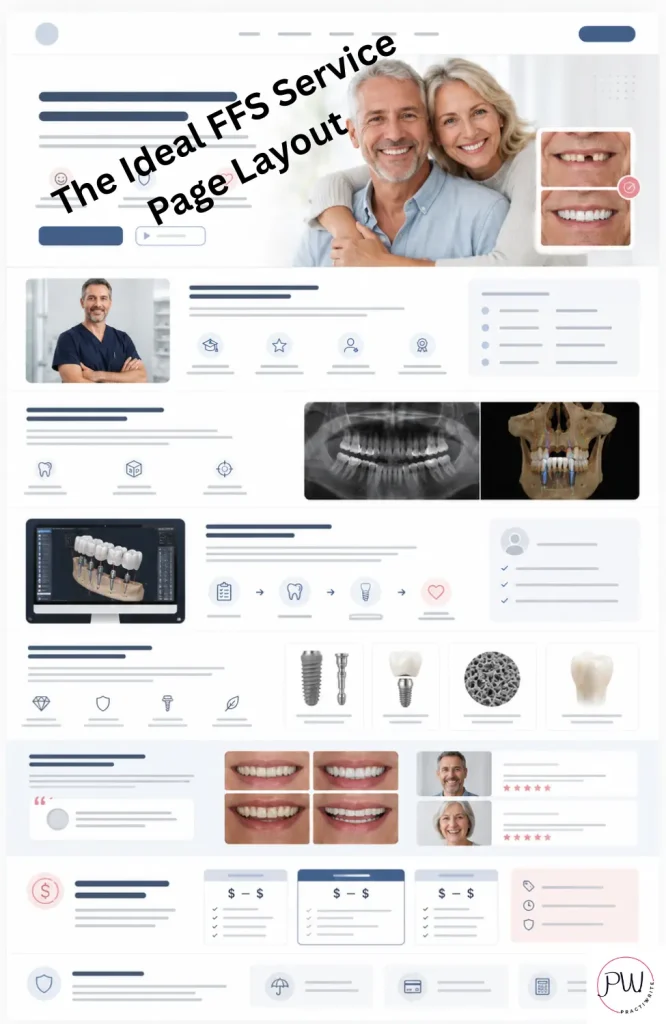
You rewrite service pages by leading with patient outcomes and clinical expertise, then mentioning insurance as a secondary consideration.
The PPO version of an implant page leads with: “We offer dental implants. We work with most insurance plans to maximize your coverage.”
The fee-for-service version leads with: “Missing teeth affect more than your smile. They impact your confidence, your ability to eat comfortably, and your long-term oral health. Dr. Martinez specializes in dental implant placement using advanced 3D imaging and precise surgical techniques.”
The fee-for-service version doesn’t ignore insurance. It just leads with the patient.
Should You Show Pricing On Your Dental Website?
Yes, you should show pricing on your dental website. Transparent pricing builds more trust with fee-for-service patients than “free consultation” CTAs ever will.
This is the contrarian move most dentists won’t make. They’ve been told for years to never show pricing because “patients shop on price.” Patients DO shop on price when price is hidden.
When you show pricing, you filter out the bargain hunters before they ever call your office.
A “Single implant restoration starting at $3,200” line on your service page does more qualifying work than your front desk does in a week.
How Do You Reposition Your Calls-to-Action?
You reposition calls-to-action by replacing transactional language with consultative language and inviting patients into an assessment, not an appointment.
“Schedule Appointment” is transactional. “Schedule Your Comprehensive Consultation” is consultative.
The first one suggests you’ll fit them in. The second one suggests something specific will happen, you’ll evaluate them, and they need to qualify.
Fee-for-service patients respond to “consultation.” PPO patients respond to “appointment.” Which one’s on your homepage right now?
What’s The Front Desk Multiplier (And Why Does Repositioning Fail Without It)?
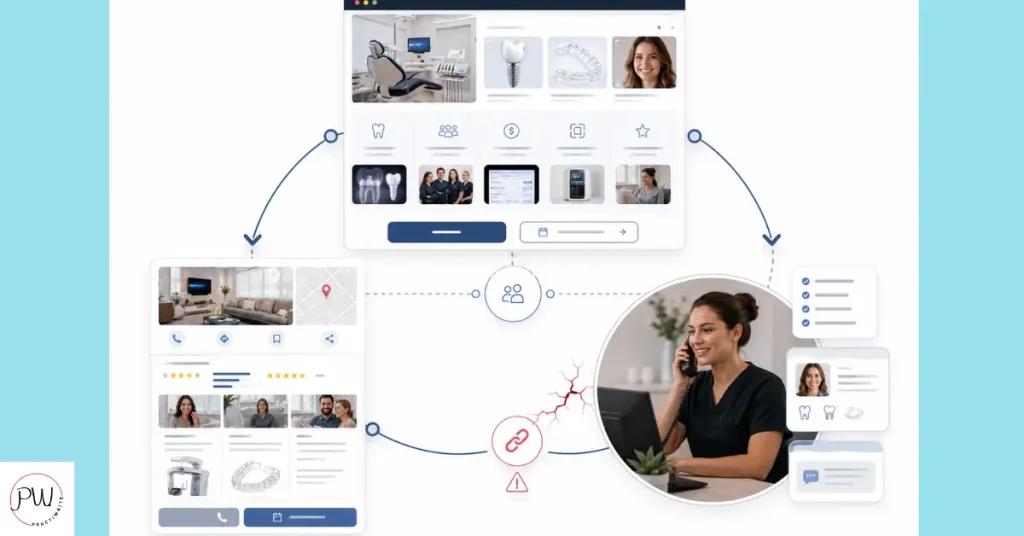
The front desk multiplier is the alignment between your repositioned website, your repositioned GBP, and the way your team answers the phone. Without it, every dollar you spend on website rewriting gets undone in the first 10 seconds of a phone call.
Here’s the scenario: You spent six weeks rewriting your homepage. Your GBP business description is rebuilt. A potential fee-for-service patient finds your practice, reads your repositioned site, and picks up the phone.
They ask, “Do you take Delta Dental?” Your front desk says, “Yes! We’re in-network with Delta. Want to schedule?”
Game over. Your repositioning just lost.
Front desk scripts have to align with your new positioning before the website goes live. The team has to know how to answer insurance questions in a way that reinforces fee-for-service value, not undermines it. That’s a separate piece of work and it lives in our PPO Transition Strategy Service.
The point for this guide I don’t want you to miss: don’t relaunch a repositioned website without a repositioned front desk. How long does a 10-second phone call take to undo six weeks of website work? Exactly that long.
What Are The Most Common Dental Website Repositioning Mistakes?
The most common dental website repositioning mistakes happen when dentists try to overcorrect, do the work piecemeal, or skip the team training that makes the new messaging stick.
Here are the ones that sink the most transitions.
Mistake #1: Going Full Elitist
Going full elitist means stripping every reference to family, affordability, or accessibility from your website to the point that you sound like you only treat millionaires. You don’t.
Fee-for-service doesn’t mean exclusive. It means transparent and value-focused.
The patients you want to attract aren’t only the rich ones. They’re the patients who value good care and are willing to pay for it. There’s a difference.
Sound premium without sounding elitist.
Mistake #2: Stripping Insurance Language Entirely
Stripping insurance language entirely is the opposite mistake. You delete every mention of insurance and existing patients panic. They think you’ve gone fully out of network without warning. You haven’t.
But the website said you did.
The right move is to reposition insurance, not erase it. We work with most insurance plans, but don’t let coverage limitations dictate your treatment” tells patients you still file insurance, you just aren’t run by it.
Mistake #3: Repositioning In Pieces
Repositioning in pieces means rewriting your homepage but leaving your service pages PPO-positioned, or fixing your website but ignoring your GBP. Mixed messaging confuses both Google and patients.
Google sees the inconsistency and doesn’t know how to rank you. Patients land on a fee-for-service homepage, click through to a PPO-positioned service page, and bounce. Half-finished is worse than not started.
Mistake #4: Launching Without Training Staff
Launching without training staff means sending your team into a fee-for-service phone environment with PPO scripts. They sabotage the website without meaning to.
Train the front desk. Role-play the conversations. Don’t go live until they can handle “do you take my insurance?” in a way that doesn’t undo your homepage.
Mistake #5: Copying Another Practice’s Messaging
Copying another practice’s messaging means lifting copy from another fee-for-service website that you found inspiring. It sounds like them, not you. Patients can tell.
Your messaging should sound like the way you actually talk about your practice. Borrow structure, not voice.
Mistake #6: Hiring A Generic Web Agency
Hiring a generic web agency means paying $20,000 for a beautiful website that doesn’t move your patient mix. Most generic agencies are designers, not strategists. They’ll make your site pretty.
They won’t make it convert.
What’s beautiful design worth if your patient mix doesn’t change? Nothing.
FAQs About Dental Website Repositioning
Still have questions? Let’s answer them:
How Long Does It Take To Reposition A Dental Website For Fee-for-Service?
Repositioning a dental website for fee-for-service typically takes 4 to 6 weeks for the messaging audit, content rewrite, and GBP updates. The timeline depends on how many pages need rewriting and whether the front desk training happens in parallel. Most practices see the first shift in caller demographics within 60 to 90 days of relaunch.
Will I Lose Existing Patients If I Change My Website Messaging?
You won’t lose existing patients from a website messaging change alone, because existing patients don’t visit your website. They’ve already decided they like you. The change affects who finds you next, not who already knows you.
If you’re worried about retention, the bigger risk is the day you drop a PPO plan, not the day you change your homepage headline.
Can I Reposition My Dental Website Without A Full Rewrite?
You can reposition your dental website without a full rewrite if your structure is solid and only the messaging is off. Most practices need rewrites of the homepage, About page, top 3 to 5 service pages, and GBP business description. The rest can stay. Repositioning is about words, not redesign.
Should I Remove All Mention Of Insurance From My Dental Website?
You shouldn’t remove all mention of insurance from your dental website. Insurance language should be repositioned to a secondary role, not erased. The right framing is: “We work with most insurance plans and process them as a courtesy, but we don’t let coverage limitations dictate your treatment.”
That keeps existing insurance patients comfortable while signaling fee-for-service to new ones.
What If I’m In A Small Or Rural Market? Does Fee-for-Service Repositioning Still Work?
Yes, fee-for-service repositioning still works in small and rural markets. The myth that fee-for-service only works in wealthy urban areas is one of the most persistent and most wrong ideas in dental marketing. Patients in smaller markets value transparent pricing, comprehensive care, and trust just as much as patients anywhere else.
The messaging is the same. The price points adjust to the market.
How Much Does It Cost To Reposition A Dental Website And GBP?
The cost to reposition a dental website and GBP varies based on the number of pages and the depth of strategic work. A full repositioning project that includes a messaging audit, GBP rewrite, homepage rewrite, service page rewrites, and front desk script development typically runs between $4,500 and $8,500 as a one-time project. Generic redesigns from web agencies often cost more and don’t change your patient mix.
How Do I Know If My Dental Website Is Positioned For PPO Or Fee-for-Service?
You can tell your dental website is positioned for PPO patients if:
- Your homepage leads with insurance acceptance or affordability
- Your service pages mention insurance verification before clinical outcomes
- Your About page focuses on volume or longevity instead of clinical philosophy
- And your CTAs say “schedule appointment” or “verify insurance” instead of “schedule consultation.”
If three or more of those describe your site, you’re positioned for PPO patients no matter who you say you want to attract.
Wrapping Up: Your Website Doesn’t Need A Redesign. It Needs A Reposition.
Every word on your homepage, every line of your GBP description, every photo on your service pages is either pulling in the patients you want or repelling them.
Right now, if your messaging still leads with insurance and affordability, you’re paying for a website that works against the practice you’re trying to build.
Stop blaming the market. Stop blaming the patients. Look at your homepage.
The patients calling you are the patients your sign asked for. Fix the words. Watch who calls.
Too overwhelming? Would you rather spend time on your patients than website and GBP messaging? Let Practiwrite handle it!
Schedule your 100% free Dental Practice Roadmap. Your Dental Practice Roadmap is a GBP and website audit that shows you exactly where you stand, what keywords you’re ranking for now, what you should be ranking for, and a step-by-step plan to close those gaps.
No vague recommendations. No fluff. Just a clear picture of what’s broken and what to do about it. Book your Dental Practice Roadmap and get yours free.

10+ year content strategist, writer, author, and SEO consultant. I work exclusively with fee-for-service dental practices that want to build value, not volume.