
Your fee-for-service dental website copy is doing one of two things right now.
It’s attracting patients who are the right fit for your practice. Or it’s attracting patients who’ll sit in your chair, hear your fees, and never come back.
Most FFS practices I talk to are dealing with the second scenario. And when I dig into their websites, the problem is obvious.
The copy is trying so hard not to scare anyone off that it ends up saying nothing at all.
Generic headlines. Vague value statements. Zero mention of what makes the practice different. The copy reads exactly like every PPO practice in a ten-mile radius.
Your website is qualifying patients before your front desk gets the chance to. If your copy is generic, you’re qualifying in the wrong people just as fast as the right ones.
This is a fee-for-service dental website copy problem.
Not a pricing problem.
Not a market problem.
A copy problem.
Good fee-for-service dental website copy doesn’t hide your model. It doesn’t apologize for it.
And it doesn’t lead with the thing patients fear most before they understand what they would be gaining.
It leads with value. Then it explains the model. Then, and only then, does price enter the room.
Here is what that actually looks like in practice.
Table of Contents
Why Most Fee-for-Service Dental Website Copy Fails Before Patients Even Call
Most FFS practices take one of two approaches with their website copy.
The first approach: say nothing about the model and hope patients figure it out later.
The homepage is full of smiling families and “compassionate care.” No mention of insurance. No mention of the practice philosophy. Just warm fuzzies and a “book now” button.
The second approach: put a quiet disclaimer somewhere in the footer or FAQ.
Something like “We are a fee-for-service practice. We do not participate with dental insurance plans.” Cold. Clinical. Zero context.
Both approaches backfire.
The first one invites the wrong patients in and blindsides them at checkout. Those patients leave frustrated.
Some of them leave a one-star review about not being told upfront. And a frustrated wrong-fit patient is now actively hurting your reputation with the patients who would have been a perfect fit.
The second one scares everyone off equally. It treats your practice model like a warning label instead of a value proposition.
What does getting this wrong actually cost? An FFS practice that keeps attracting and onboarding wrong-fit patients burns through time, chair hours, and staff energy.
You’re not growing. You’re churning.
That cycle is expensive and it’s invisible on a spreadsheet until it is not.
The fix is not more volume. The fix is better copy.
And here’s a stat that will (hopefully) light a fire under you: 71–77% of prospective dental patients research dentists online before booking an appointment.

The Real Reason FFS Practices Are Afraid to Say What They Are
I need to be honest about something here.
Early in my work with FFS practices, I watched even the most confident dentists go completely vague on their websites. Practices with a clear philosophy in person, with a well-defined “why” behind their model, would hand over their website copy and it was suddenly nothing.
No stance. No differentiation. Just noise.
The fear driving this is real. It sounds like: “If I say I don’t take insurance, I’ll lose too many patients before they even give us a chance.”
Volume thinking applied to a value model. It doesn’t work.
Here’s the thing about that fear. The patients you’re afraid of losing were never going to stay.
PPO patients are price-shopping. They’re looking for the deepest in-network discount they can find. No amount of beautiful copy or trust-building language is going to turn a price-sensitive patient into an FFS patient.
That is not how patient psychology works.
FFS patients aren’t looking for the cheapest option. They’re looking for the best one.
They’re researching, reading reviews, evaluating expertise, and looking for a practice that operates at a different level. Those patients exist in your market right now.
Are your words giving them any reason to choose you?
Your copy is either calling those patients in or sending them to a competitor down the street. There’s no neutral position.
What “Positioning Without Scaring” Actually Means in Fee-for-Service Dental Website Copy
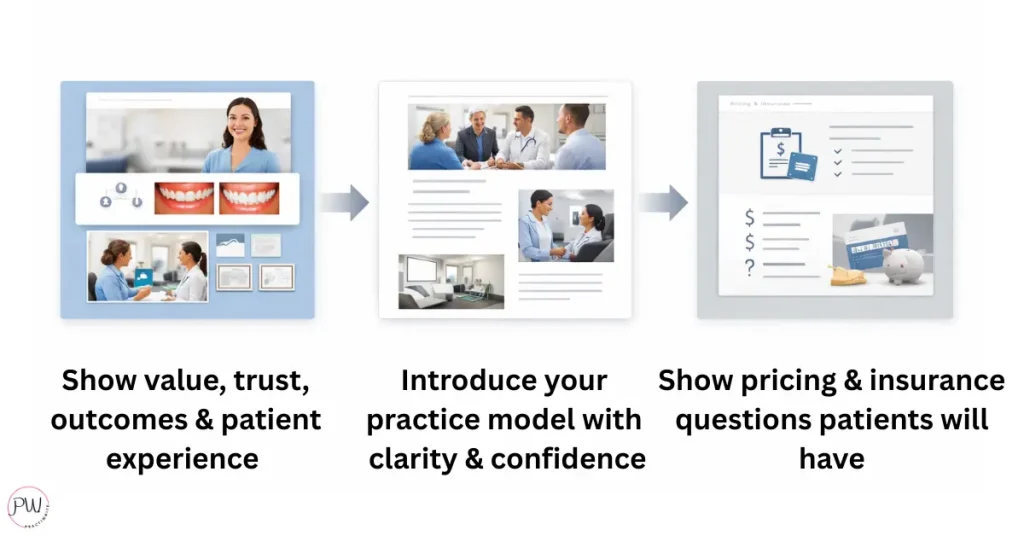
This is where the strategy lives.
Positioning without scaring doesn’t mean hiding your model. It means sequencing your message correctly.
Value first. Model second. Price last.
When a patient lands on your website, their first question isn’t “do you take my insurance?” Their first question is “can this practice help me?”
Answer that question first. With confidence. With specificity. With the outcomes and experience that only an FFS practice can deliver.
Then explain your model. Not defensively. As a feature.
Then let them come to you with pricing questions. By that point, they already understand what they would be getting. The “but do you take insurance” conversation changes completely when a patient already believes in the value.
Think about what that number means for an FFS practice. If your copy leads with the thing patients fear before they understand what they’re gaining, you’re not giving yourself a chance. Copy that sequences value before model keeps patients on the page long enough to make a real decision.
The 5 Website Copy Elements That Do the Heavy Lifting for FFS Practices
Pay close attention to the following five website copy elements for your site pages:
1. Your Homepage Headline
This is not the place to announce your model. Your headline has one job: make the right patient feel immediately seen.
Your healthiest smile starts with a dentist who actually has time for you” does more FFS positioning than “fee-for-service dental care in [City]” ever will.
The first statement speaks directly to a patient who has been through rushed, in-and-out appointments and wants something different. The second one just announces a category.
Lead with the transformation, not the structure.
2. Your About Page
This is where your FFS model earns a home on your site. Not your homepage. Your About page.
The About page is where patients who are already interested come to decide if they trust you. This is where you tell the story of why your practice operates the way it does.
Not as a complaint about the insurance industry. As a belief statement about the kind of dentistry you think patients deserve.
“We chose to practice fee-for-service because we believe your treatment plan should be based on what your mouth needs, not on what an insurance company approves” isn’t scary. It’s clarifying. It tells a value-aligned patient exactly why you are the right practice for them.
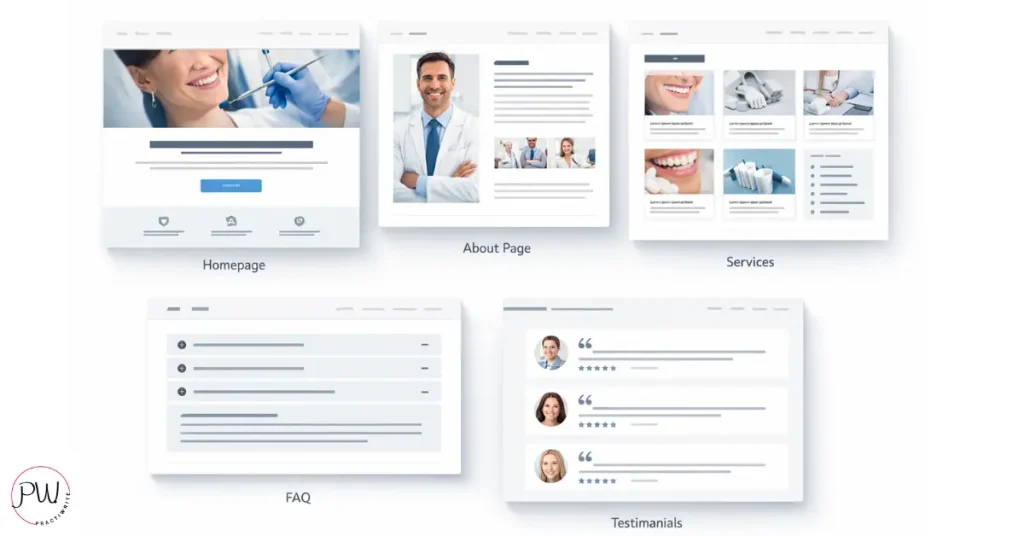
3. Your Services Pages
Most FFS practices write services pages that read identically to every PPO practice in their market.
They describe the procedure. They list what is included. They might mention a before-and-after.
An FFS services page should go further.
- It should describe the experience.
- How much time is spent.
- What a patient can expect from an appointment that is not constrained by insurance time limits.
- What materials are used and why.
These are the details that separate a $200 cleaning from a $350 cleaning in a patient’s mind. If your services page doesn’t explain the difference, patients will default to price comparison.
4. Your FAQ Section
Patients will search for your practice’s insurance policy. It happens. Your FAQ is where you answer that question on your terms, with full context, before they hear it cold from your front desk.
This is not damage control. It is the most transparent thing you can do. An FAQ that says “We are an out-of-network practice. Here is what that means for you and how we help you navigate it” builds infinitely more trust than a front desk call where a patient feels ambushed.
5. Your Patient Testimonials
Social proof for an FFS practice should do a specific job. It should not just describe a pleasant experience. It should describe the value received.
“Dr. [Name] spent 90 minutes with me on my first appointment and caught three things my previous dentist had been missing for years” does more positioning work than “great office, very friendly staff.” One of those testimonials justifies premium pricing. The other one says the practice is nice.
Ask the right patients for testimonials. Prompt them toward the details that matter for your model.
What to Say About Insurance Without Making It the Headline
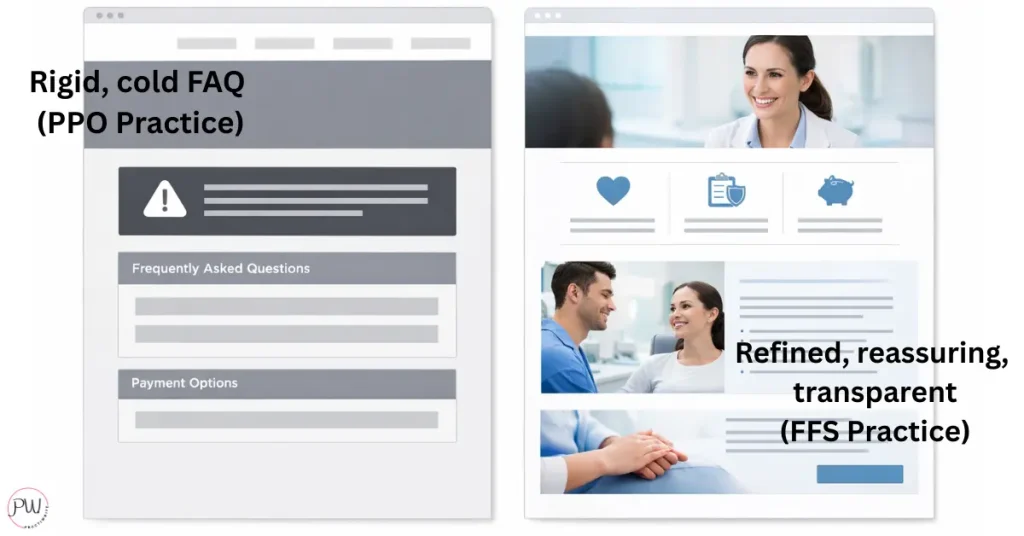
The biggest mistake FFS practices make with the insurance conversation is treating it like a confession. Something that has to be disclosed before the relationship can go any further.
It’s not a confession. It’s a differentiator.
Here is what not to say:
“We do not accept dental insurance.”
Full stop. No context. No value frame. Just a wall.
Here is what to say instead:
“Our practice operates on a fee-for-service model, which means your treatment is never shaped by what an insurance company will or won’t approve. We provide you with a superbill to submit for out-of-network reimbursement, and our team is happy to walk you through that process.“
Those two approaches give the patient the same factual information. But only one of them explains why that information is actually good news for them.
Transparency is not the enemy of FFS positioning. Unexplained transparency is.
When you tell patients you are FFS without explaining what that means for their care, they fill in the blank themselves. And they fill it in with fear. Give them the context before they have a chance to make the wrong assumption.
The Copy Mistakes That Are Quietly Attracting the Wrong Patients
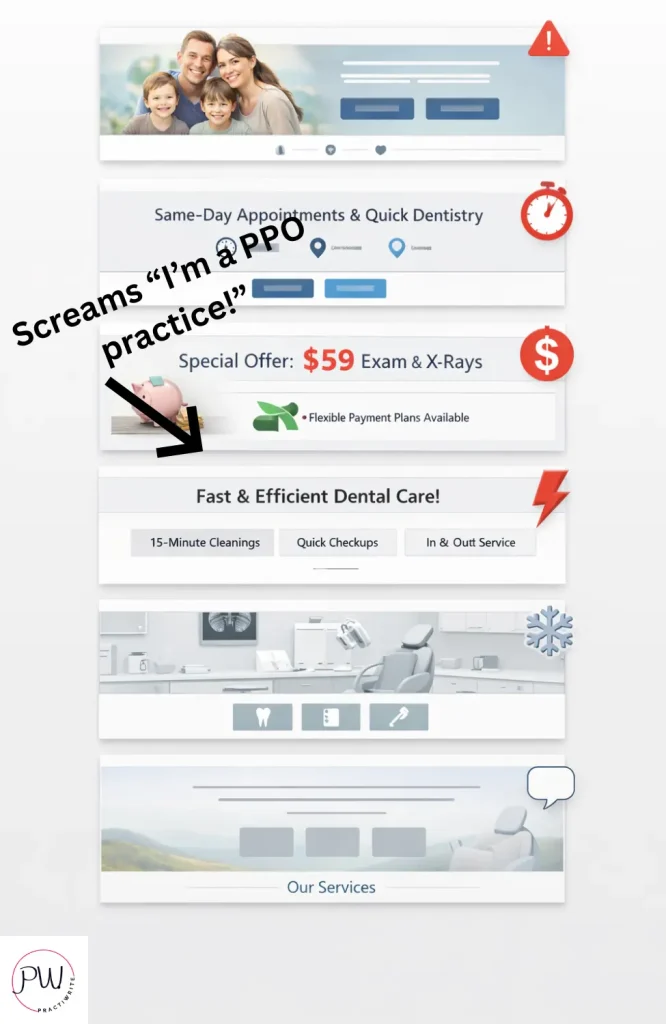
A few things that show up on FFS websites far more often than they should:
“Accepting new patients!” with no qualifier. This signals anyone and everyone is welcome. A PPO practice can run this line. An FFS practice should not.
“Affordable care for the whole family.” Affordable is the signal word of volume dentistry. If that word is anywhere on your site, it is working against your positioning.
“Quick, convenient appointments.” FFS practices are not quick-and-convenient. They are thorough and unhurried. Those are not the same value proposition, and the patients attracted by each are not the same people.
No team photos or visual warmth. An FFS patient is buying a relationship. If your website looks like a medical equipment catalog, you are not giving them a reason to trust you before they ever call.
No story anywhere on the site. Just a list of services and a phone number. FFS patients want to know who they are trusting their health to. A practice with no point of view has not given those patients anything to connect with.
If your website copy reads exactly like every PPO practice in your market, how is a patient supposed to know you’re different?
What should a fee-for-service dental practice put on its homepage?
A fee-for-service dental practice homepage should lead with patient outcomes and the experience the practice delivers, not its insurance model. The homepage headline communicates the transformation the patient wants, such as comprehensive care, unhurried appointments, or long-term oral health, rather than announcing the payment structure. Insurance model information belongs on the About page and in a dedicated FAQ section, where it can be presented with full context and framed as a value proposition rather than a disclaimer.
How do you explain fee-for-service dentistry to patients on a website without losing them?
The most effective approach sequences information from what patients want to hear first, which is outcomes, experience, and expertise, to what they need to understand second, which is the practice’s model and the reasoning behind it. Patients who understand the value of an FFS practice before they encounter the insurance conversation are significantly more likely to remain engaged. Leading with the model before establishing value causes most patients to exit before they have absorbed what they would be gaining.
Is it a mistake to mention insurance on a fee-for-service dental website?
Omitting the topic entirely is a larger mistake than addressing it directly. Patients will seek out insurance information regardless of whether it appears on the site. A fee-for-service practice that addresses this question transparently, including how it assists patients with out-of-network reimbursement where applicable, builds more trust than one that leaves patients to discover the answer during an intake call. Silence does not protect an FFS practice from the insurance conversation. It simply relocates that conversation to the worst possible moment in the patient relationship.
What words or phrases should fee-for-service dental practices avoid in their website copy?
Fee-for-service practices should avoid language that signals volume-based care: “affordable,” “convenient,” “quick appointments,” and any copy that positions the practice as competing on price or speed. These signals attract price-sensitive patients who are not the right fit for an FFS model. Effective FFS copy emphasizes expertise, time investment, relationship continuity, and clinical outcomes, which are the dimensions where FFS practices genuinely outperform in-network alternatives.
How is website copy for a fee-for-service practice different from a PPO practice?
PPO practice copy typically emphasizes insurance acceptance, broad accessibility, and high patient volume. Fee-for-service practice copy should emphasize the quality of each patient experience, the clinical thoroughness of every appointment, and the long-term value of care delivered without insurance-driven time constraints. FFS website copy should also tell the story of why the practice chose this model, particularly on the About page, so patients understand they are choosing a different category of care rather than simply a different price point.
Can a fee-for-service dental practice rank well in local search without using insurance-related keywords?
Yes. Fee-for-service dental practices can rank competitively by optimizing for service-specific and experience-driven keywords rather than insurance-acceptance terms. Keywords such as “dental implants in [city],” “cosmetic dentist [city],” and “holistic dentist near me” attract search intent from patients who are evaluating quality over cost. A well-optimized Google Business Profile, paired with website content that clearly communicates expertise and outcomes, is often more effective for FFS practices than competing on broad, insurance-adjacent search terms where they are disadvantaged.
Wrapping Up: Ready to See What Your Website Is Actually Saying?
Schedule your 100% free Dental Practice Roadmap. Your Dental Practice Roadmap is a GBP and website audit that shows you exactly where you stand, what keywords you’re ranking for now, what you should be ranking for, and a step-by-step plan to close those gaps.
No vague recommendations. No fluff. Just a clear picture of what’s broken and what to do about it. Book your Dental Practice Roadmap and get yours free.

10+ year content strategist, writer, author, and SEO consultant. I work exclusively with fee-for-service dental practices that want to build value, not volume.