Pull up your dental implants service page right now.
Read the first two paragraphs.
Does it mention comfortable care? State-of-the-art technology? Flexible payment options?
Does it note somewhere that you work with most insurance plans?
If it does, you have a problem.
Not because the writing is bad. But because that page was built for a completely different patient than the one you’re trying to attract.
Most fee-for-service dental service pages are written by general web agencies using templates that work for any practice in any market at any price point.
The problem is, a fee-for-service practice is not any practice. Your buyer is not the same person walking into a PPO office down the street.
And when your service page speaks to the wrong buyer, your best prospective patients land on it, read it, and quietly decide you’re not the right fit.
Not because of your fees. Because of your words.
I’ve audited service pages for dozens of dental practices in transition. The single most common mistake isn’t bad SEO or a weak headline.
It’s copy that speaks to the wrong patient entirely. That’s what this piece fixes.
Table of Contents
Two Different Patients. Two Completely Different Decisions.
Before you can write a service page that converts FFS patients, you need to understand exactly who that patient is and how differently they make decisions compared to a PPO patient.
These are not variations of the same buyer. They are operating from entirely different motivations.
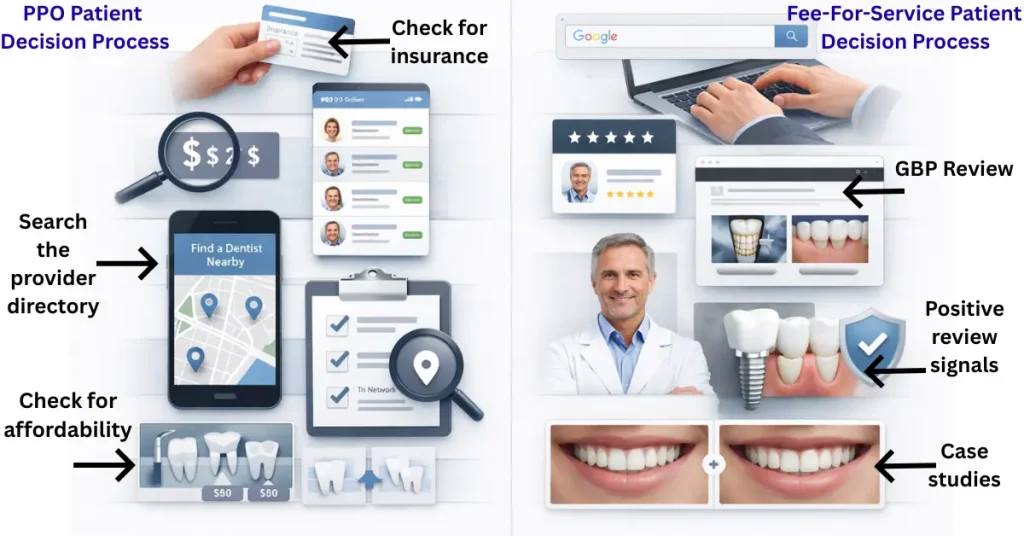
The PPO Patient’s Decision Framework
The PPO patient leads with one question: does this practice take my insurance? If the answer is yes, they’re already 80% of the way to booking.
The directory sent them.
The network confirmed you.
Your service page just needs to not lose them.
What PPO-optimized copy looks like:
- Insurance mentions
- Affordability framing
- Broad accessibility language
- References to payment plans.
This patient is comparison shopping on cost. They want to know their out-of-pocket exposure. Clinical depth is secondary, sometimes irrelevant.
That’s a rational way to choose a dentist when cost is the primary variable. It’s also not your buyer.
The FFS Patient’s Decision Framework
The FFS patient has already accepted they’re paying out of pocket. That decision is made before they land on your page. What they’re evaluating now is whether you’re worth it.
Their core question isn’t “what does this cost.” It’s “can I trust this person with my mouth.”
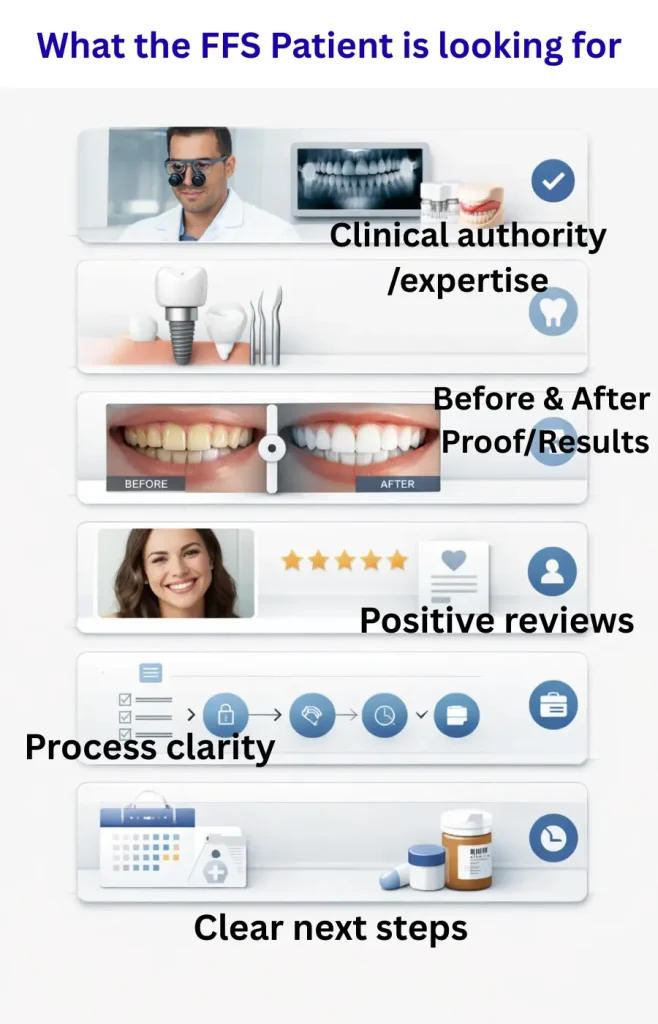
The variables they’re weighing:
- Clinical authority
- Documented outcomes
- Experience with their specific concern
- Social proof from patients who sound like them
- And whether your practice understands what they actually want
They’re comparison shopping on quality and confidence, not price.
This patient reads your service page looking for a reason to trust you. The PPO patient reads it looking for a reason not to leave. Those are not the same job, and you cannot write one page that does both well.
Why Most FFS Practices Are Still Writing PPO Pages
The copy was written once, by a general web agency, using a template that works for any dental practice.
“Flexible payment options.”
“We accept most major insurance plans.”
“Affordable care for the whole family.”
These phrases don’t just fail to attract FFS patients. They actively signal the wrong positioning.
The agency didn’t know the difference. The dentist didn’t know to ask. And the page has been quietly disqualifying high-value patients ever since.
When I started working with practices in transition, I assumed this was a rare problem. It isn’t. It’s the rule, not the exception.
What the FFS Patient Is Actually Looking For on Your Service Page
Now that you understand the distinction, you need to understand the FFS patient’s psychology at the page level.
What are they scanning for?
What builds trust?
What breaks it?
This is where most rewrites go wrong, because practices swap out a few phrases without ever getting inside the head of the buyer they’re trying to reach.
Evidence That You’ve Done This Before, and Done It Well
FFS patients are paying a premium. They need to know the premium is justified. Generic confidence doesn’t cut it here.
They want to see clinical volume. How many of these procedures have you performed? What does success look like for a patient with their specific situation? Before/afters, case descriptions, and procedure-specific experience markers all do this job.
What fails: “we use the latest technology” and “our team is committed to your comfort.” Every practice says that. It proves nothing.
Specificity proves something. Volume proves something. “We have placed over 500 implants, including full-arch cases that other practices declined” proves something.
Specificity That Speaks to Their Exact Situation
FFS patients are high-consideration buyers. They have often been thinking about this treatment for months, sometimes years. They arrive at your page with more knowledge than a casual patient and a sharper filter for vagueness.
Vague copy reads as a red flag. If your implants page could describe literally any implant procedure at any practice anywhere in the country, it tells this patient you don’t understand their case specifically.
What converts: condition-specific language, process transparency, and honest acknowledgment of the concerns they already have before you’ve been asked.
Specificity is the FFS service page’s most underused conversion tool. The more precisely your copy mirrors what a patient is already thinking, the more they trust you’ve seen this situation before.
-Nicole Kolesar, Founder & CEO of Practiwrite
Cost Framing That Doesn’t Apologize
FFS patients don’t need you to hide the cost conversation. They need you to frame it confidently.
The mistake is burying cost information, using hedging language like “starting at” or “varies by patient,” or avoiding cost entirely and forcing them to call just to get a number.
Address cost directly. Frame it around value, longevity, and outcomes rather than comparison to what insurance would cover. Treat the investment conversation as a sign of respect for an informed buyer.
A patient who is shocked by your pricing was never going to become your best patient. Stop writing copy designed to soften that landing.
A Clear Picture of What Choosing You Actually Means
FFS patients are choosing a relationship, not just a procedure. They want to know what the experience is going to look like, who they’ll work with through the process, and what happens after the procedure is done.
Aftercare protocols, follow-up timelines, and warranty language on restorations matter to an out-of-pocket buyer in ways they simply don’t to a patient whose insurance handled the decision.
Your service page should be able to answer: what does being a patient here actually look like from start to finish? If it can’t, you’re leaving a trust gap that a competitor’s more specific page will fill.
The Anatomy of a High-Converting FFS Service Page
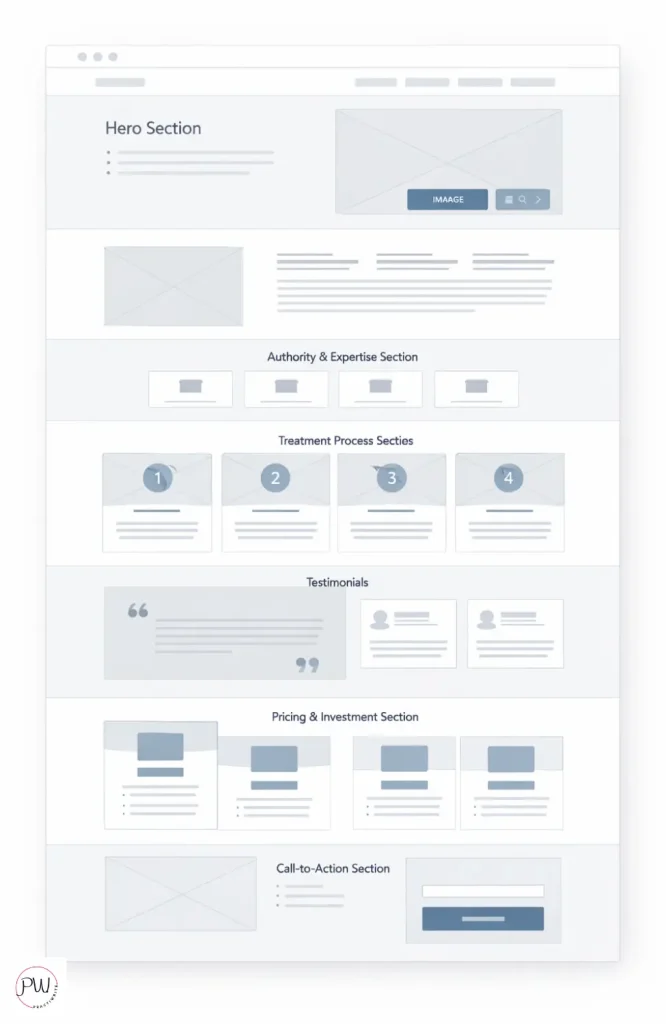
Understanding the buyer is step one. Building the page is step two. Here is the structural blueprint we use at Practiwrite when rebuilding service pages for FFS practices.
Each component has a specific job. Together, they walk the FFS patient from landing on the page to picking up the phone.
The Headline: Outcome First, Procedure Second
PPO headline: “Dental Implants at [Practice Name].”
FFS headline: “Permanent Teeth Replacement That Looks, Feels, and Functions Like the Real Thing.”
The FFS patient is buying a result, not a procedure code. Your headline should lead with the outcome they want, not the service you’re selling.
On the technical side, your URL and title tag should still contain the target keyword for SEO purposes. The H1 visible to the reader is where outcome-first language lives.
The Opening Paragraph: Speak to the Decision They’re Already In
Do not open with a description of the procedure. Open with an acknowledgment of where this patient is right now. For example:
“If you’ve spent years covering your smile in photos, you already know you want this fixed. The question is whether you’ve found the right practice to do it.”
That speaks to a real psychological moment. “A dental implant is a titanium post surgically inserted into the jawbone” does not.
The opening paragraph’s job is to make the patient feel understood before you’ve asked them to trust you. That’s the sequence. Empathy first, authority second, process third.
The Authority Section: Credentials That Actually Convert
This is where most practices get it wrong. A bulleted list of credentials reads like a resume. It doesn’t convert.
What converts is contextualized authority.
Not: “Dr. [Name] is a member of the American Academy of Cosmetic Dentistry.”
Instead: “Dr. [Name] has completed more than 400 cosmetic cases, including patients who came to us after consultations at other practices left them with more questions than answers.”
Volume plus specificity plus outcomes equals trust for an FFS buyer. I’ve seen practices list seventeen credentials and still lose the patient to a competitor who wrote two sentences about their clinical experience in plain English.
Credentials inform. Proof convinces.
The Process Section: Reduce Anxiety, Don’t Ignore It
FFS patients often carry higher treatment anxiety precisely because they’re making a real financial commitment. They need to see the process laid out clearly before they’ll commit to even a consultation.
Step-by-step process sections consistently outperform dense procedure descriptions on high-value service pages.
Include:
- Number of appointments
- What each visit involves
- Realistic recovery language
- And what they need to do to prepare.
Yes, this makes the page longer. For high-consideration procedures, that is the right call. It’s not the FFS buyer who abandons the long page. It’s the price shopper.
Social Proof: Patient Language, Not Practice Language
The testimonial that converts an FFS patient is not “great office, friendly staff, highly recommend.” That’s fine for a low-stakes PPO decision. It does nothing for a patient investing thousands of dollars out of pocket.
FFS-converting social proof is outcome-specific and mirrors the prospective patient’s pre-treatment hesitation: “I’d been putting this off for three years because the cost scared me. Two years later I genuinely can’t imagine having waited any longer. It changed how I carry myself.”
You can guide patients toward this kind of language. Ask them directly:
- What were you worried about before you came in?
- What would you tell someone who’s on the fence?
Those answers are worth more than any polished testimonial you could write yourself.
The Cost Section: Transparency as a Competitive Advantage
FFS patients respect directness. Vague cost copy damages trust before the first appointment ever happens.
Best practice: give a realistic range, explain what drives variation, and connect the investment to outcomes and longevity, not to the procedure in isolation.
Avoid saying: “call for pricing,” “varies by patient,” or no cost information whatsoever.
Practices that address cost transparently on their service pages report fewer consultation dropoffs from sticker shock. The patients who call already know the range. They’re calling because they’re ready.
The CTA: One Ask, Zero Ambiguity
“Schedule a Consultation” outperforms “Contact Us” on FFS service pages. It names the next logical step and signals that the practice understands this is a considered decision, not an impulse booking.
Where applicable, offering a free consultation removes the last friction point for a patient who is close but not yet committed.
One CTA. Not a form and a phone number and a chat widget stacked on top of each other.
The more options you give, the less likely they are to take any of them. Choose one door and point every reader toward it.
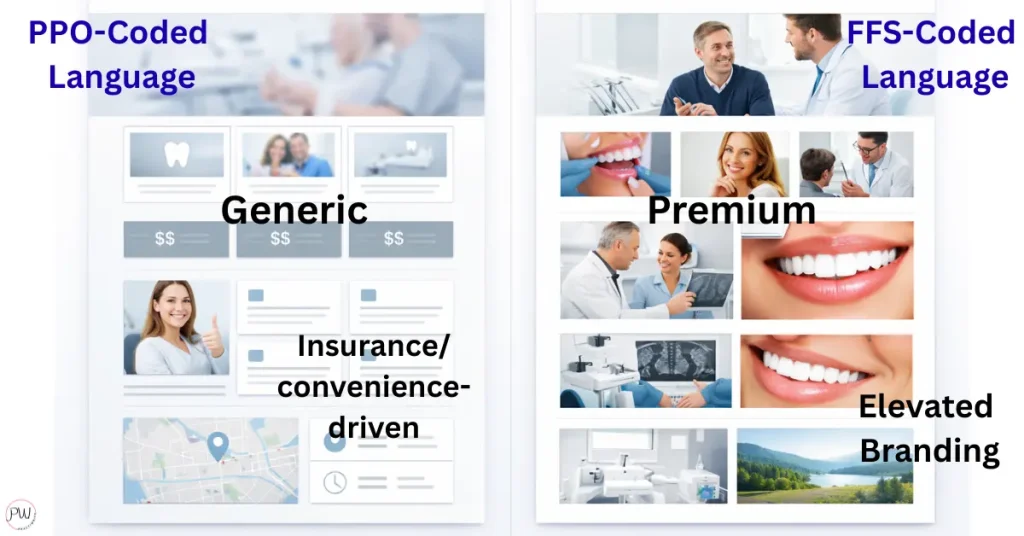
The Language Signals That Tell a Patient Which Kind of Practice You Are
This is where the distinction becomes visceral. Words carry positioning signals that patients absorb before they consciously process them. The FFS patient has a finely tuned BS detector for practices that are calibrated for volume and price sensitivity.
Your copy either reassures that detector or sets it off.
PPO-Coded Language and What It Signals
These are phrases that communicate insurance-first thinking even when insurance isn’t mentioned directly:
- “Affordable”
- “Budget-friendly”
- “Payment plans available”
- “We work with most insurance providers”
- “Flexible financing options”
- “Gentle care for anxious patients”
Every one of these phrases tells the FFS patient something: this practice is built for cost-sensitive buyers. That patient will not self-identify as your target. They’ll keep scrolling.
I worked with a cosmetic practice that had “affordable veneers” in three places on their veneer service page. They couldn’t understand why their consult calls kept coming from patients who balked at pricing.
The copy told those patients exactly what kind of practice to expect. The signals were working perfectly. They were just working against the practice.
FFS-Coded Language and What It Signals
These phrases communicate quality-first positioning:
- “Built to last”
- “Crafted with precision”
- “Investment in your health and confidence”
- “Life-changing results”
- “Patients travel from across the region for this treatment”
- “Cases other practices declined”
- “You’ve waited long enough for this”
What these tell the FFS patient: this practice selects for outcomes, not volume. They know what they’re doing and they have the receipts to prove it. That patient leans in.
Does your service page currently use any of these phrases? Or does it sound like every other practice in your ZIP code?
The Neutral Language Trap
The most dangerous zone isn’t obviously wrong PPO copy. It’s neutral language that sounds professional but communicates nothing about your positioning.
“We offer a full range of dental services.” “Our team is dedicated to your comfort and care.” “State-of-the-art technology for optimal results.”
These phrases don’t attract the PPO patient, who has already decided based on the insurance directory. And they don’t convert the FFS patient, who needs specificity and conviction.
They’re filler wearing the costume of copy. Every sentence that says nothing is a sentence that could have been doing a job.
Before You Rewrite: The FFS Service Page Audit
You don’t need to rebuild every service page simultaneously. You need to triage what you have, identify what’s working against you, and start with the pages that carry the most revenue potential for your practice. Here’s the process.
Three Questions That Diagnose Your Current Page
First: read the first paragraph aloud. Is it describing a procedure, or is it speaking to a patient who has already decided they want this outcome? If you’re explaining what the procedure is before you’ve addressed why this patient is on the page, you’ve already lost the FFS buyer’s attention.
Second: count every mention of insurance, affordability, payment flexibility, or cost accommodation. Each one is a signal to the wrong buyer. How many did you find?
Third: could this page belong to any dental practice in your market, or does it sound unmistakably like your practice? If you swapped out your logo and city name, would anyone know the difference?
The One-Sentence Test
After reading your service page, a prospective patient should be able to complete this sentence: I want to go here because ___.
If their answer is “it was easy to find” or “they take my insurance,” your page failed the FFS patient.
If their answer is “they’ve done hundreds of these cases and their patients described exactly what I’m feeling right now,” your page is working.
That’s the bar. It’s not complicated. But it requires being honest about whether your current page clears it.
Where to Start
Begin with your highest-production service.
If dental implants are your most valuable case type, that page comes first.
Then veneers.
Then full-mouth reconstruction. Work from the top of your production revenue down.
For each page:
- Apply the three diagnostic questions
- Note every piece of PPO-coded language
- Identify what’s missing from the FFS anatomy framework above
- And rewrite with the FFS patient’s decision framework as your filter
Every word either serves the quality-seeking out-of-pocket buyer or it doesn’t. There is no neutral.
Your Service Pages Are Sales Conversations Without You in the Room
When a high-value prospective patient lands on your implants page at 10 pm on a Tuesday, you’re not there to answer questions, clarify pricing, or demonstrate your expertise.
Your page is doing that job, or it isn’t. There is no middle.
A PPO-coded service page in a fee-for-service practice isn’t just ineffective copy. It’s a filter running in the wrong direction. It’s actively screening out the patients who would generate your highest revenue and screening in the patients who will push back on every treatment plan.
That’s an expensive miscalibration.

Wrapping Up: Your Service Page Rewrite Is Strategic, Not Cosmetic
Every service page we rebuild for a fee-for-service practice starts with one question: who is this page trying to convince, and what does that patient need to believe before they call?
When the answer shifts from a price-sensitive insurance patient to a quality-seeking out-of-pocket buyer, every word on the page changes with it.
The headline changes. The opening changes. The authority section, the proof, the CTA, the cost framing.
All of it.
You can have the most impressive clinical outcomes in your market. You can have the best results, the strongest reviews, the deepest expertise.
But if your service page is still speaking to a patient who was never going to call you anyway, none of that gets communicated.
The good news: this is fixable. The fix isn’t a website redesign or a new marketing budget.
It’s a clear-eyed look at who your page is talking to, and the willingness to rewrite it for the patient you actually want.
Start with your highest-value service page. Apply the framework. Then move to the next one.
Or let Practiwrite do the audit for you. Schedule your 100% free Dental Practice Roadmap.
Your Dental Practice Roadmap is a GBP and website audit that shows you exactly where you stand, what keywords you’re ranking for now, what you should be ranking for, and a step-by-step plan to close those gaps.
No vague recommendations. No fluff. Just a clear picture of what’s broken and what to do about it. Book your Dental Practice Roadmap and get yours free.

10+ year content strategist, writer, author, and SEO consultant. I work exclusively with fee-for-service dental practices that want to build value, not volume.