Your cosmetic content is doing the opposite of what you think it’s doing.
It’s pulling in insurance shoppers. It’s filtering out the patients you actually want.
And it’s quietly training the wrong people to pick up the phone and book a consult.
Most dental practices write about implants, veneers, and full-mouth cases the same way they write about cleanings.
Same format. Same clinical tone. Same “we accept most insurance plans” banner at the bottom.
Then they wonder why cosmetic consults keep flaking, why the quotes get price-shopped, and why high-value cases don’t close.
I’ve audited thousands of dental service pages across all 50 states. The cosmetic pages are almost always the weakest writing on the site.
They read like a dental school textbook wrote a brochure.
Here’s the thing. If you want to know how to write about dental implants, veneers, & cosmetic cases in a way that attracts patients who don’t ask about insurance, you have to stop writing for everyone.
FFS patients and PPO patients aren’t shopping the same way.
They don’t read the same content. They don’t decide on the same criteria. And writing cosmetic content like a volume practice trains the wrong people to call your front desk.
Below is exactly how to write cosmetic content that pre-qualifies the patient before they ever pick up the phone.
The words you choose. The pricing framing. The page structure. All of it.
What if the reason your cosmetic consults keep flaking has nothing to do with your close rate, and everything to do with the content that booked them?
Table of Contents
The Real Reason Your Cosmetic Pages Attract Insurance Shoppers
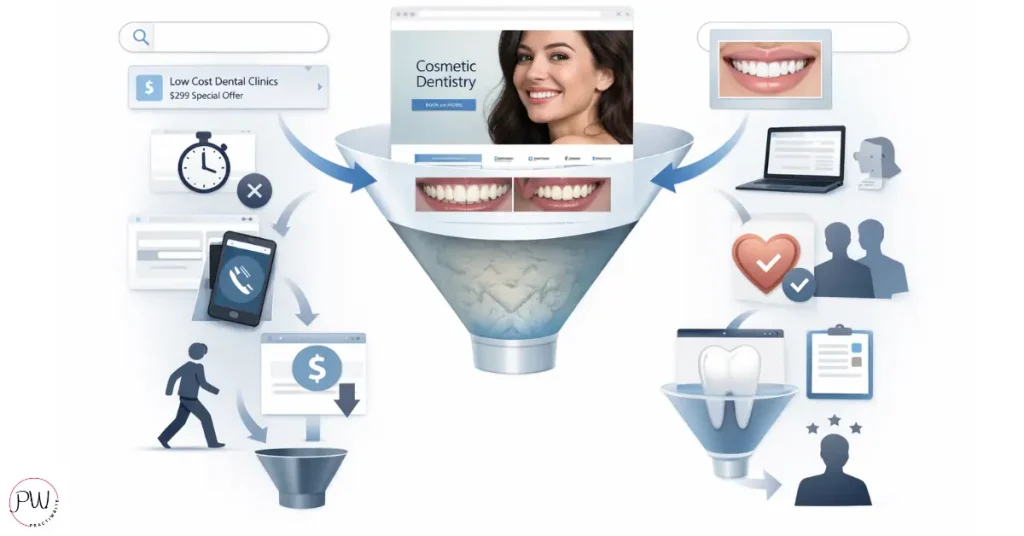
Walk through most dental websites’ content and the pattern is obvious. Cosmetic pages bolted onto a PPO-style site.
Insurance badges above the fold. “We work with most major dental plans” running across the header. A giant “verify your insurance” button next to the implant photo.
That’s not a cosmetic page. That’s an insurance verification page with cosmetic photography.
The cosmetic patient you want isn’t scrolling for a provider list. They’re scrolling for a decision.
They’ve usually been thinking about this for months, sometimes years. They’ve stared at their smile in enough bathroom mirrors to know exactly what they want to fix.
They’re not comparing copays. They’re comparing dentists.
Only 3.4% of dental patients actually reach their typical annual insurance maximum in a given year, according to a 2024 ADA Health Policy Institute analysis. Another 3.3% come within $100 of it. The overwhelming majority of dental spending, especially on cosmetic and restorative cases, already happens out of pocket.
-ADA Health Policy Institute
Let that sit for a second. Insurance isn’t paying for these cases anyway. But your content keeps pretending it is.
Here’s the mismatch. Your cosmetic pages promise volume-practice behavior:
- Speed
- Insurance optimization
- Low price
Meanwhile the patient you want is looking for the opposite:
- Craft
- Time
- Outcome
- Discretion
I worked with a practice last year whose implant page ranked on page one for a strong local keyword. Great traffic. Terrible calls.
Every other consult was a tire-kicker asking what their insurance would cover. We pulled the page apart and found the problem in the first scroll.
The word “affordable” appeared four times above the fold. “Insurance” appeared six. Meanwhile the word “outcome” didn’t appear once.
That page wasn’t ranking for the wrong keyword. It was repelling the right patient.
What Cash-Pay Cosmetic Patients Actually Read For
Let me be clear about this because most dental marketing agencies get it wrong. FFS cosmetic patients don’t read your service page the way PPO patients do.
The scan patterns are different. The trigger words are different. The things that make them trust you are different.
Here’s what they’re actually looking for.
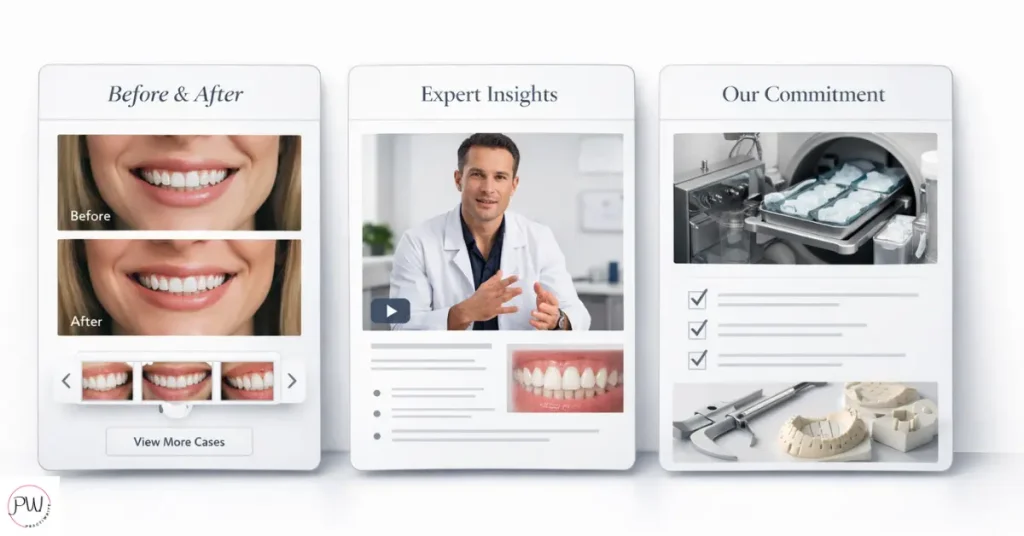
They read for proof you’ve done their case before
Not generic portfolios. Not stock photography. Not a slideshow of smiling models.
They want to see someone who looks like them. Same age range. Same starting point. Same stakes.
A 54-year-old woman considering full-mouth rehab doesn’t care about your 22-year-old model’s veneer case. She wants to see another 54-year-old woman who walked into your office with the same problems she has right now.
Specific, similar-case photography with context beats any “before and after” carousel on the market.
Caption the cases. Explain what was done. Tell the reader why you chose this approach for this patient.
They read for your opinion, not a menu
PPO patients read for options. FFS patients read for your recommendation.
Your cosmetic pages should show clinical POV:
- When do you use veneers instead of bonding?
- Why did you choose this implant system over the others?
- How do you decide when to stage a case versus doing it in one visit?
- What makes you say no to certain procedures?
Opinion builds trust faster than features ever will. And it does something features can’t. It pre-sells your expertise before the patient walks in.
They read for what you don’t do
Saying “we’re not the right fit for patients looking for the cheapest option” isn’t a problem. It’s a qualifier.
Tell them who you’re not for. Tell them when you’d refer out. Tell them what you won’t compromise on.
The right patient reads that and thinks, “finally, a dentist who actually has standards.” The wrong patient leaves. Both outcomes are wins.
Filtering is marketing.
Does your current cosmetic page give the reader any reason to believe you’re the right choice for them specifically, or does it just list procedures?
How to Write About Dental Implants, Veneers, & Cosmetic Cases Without Sounding Like Every Other Dentist
Most implant pages are a wall of procedure steps. Titanium post. Abutment. Crown. Healing timeline. Bone graft if needed. Then a paragraph about how implants look natural and function like real teeth.
That content belongs on page two, not page one. Not because it’s wrong. Because it’s not what the patient is deciding on.
The implant patient sitting on your site is weighing a decision.
Implant versus bridge. Single tooth versus full arch. Now versus wait another year.
They’re trying to figure out if this is worth the money, worth the time, and worth doing with you specifically.
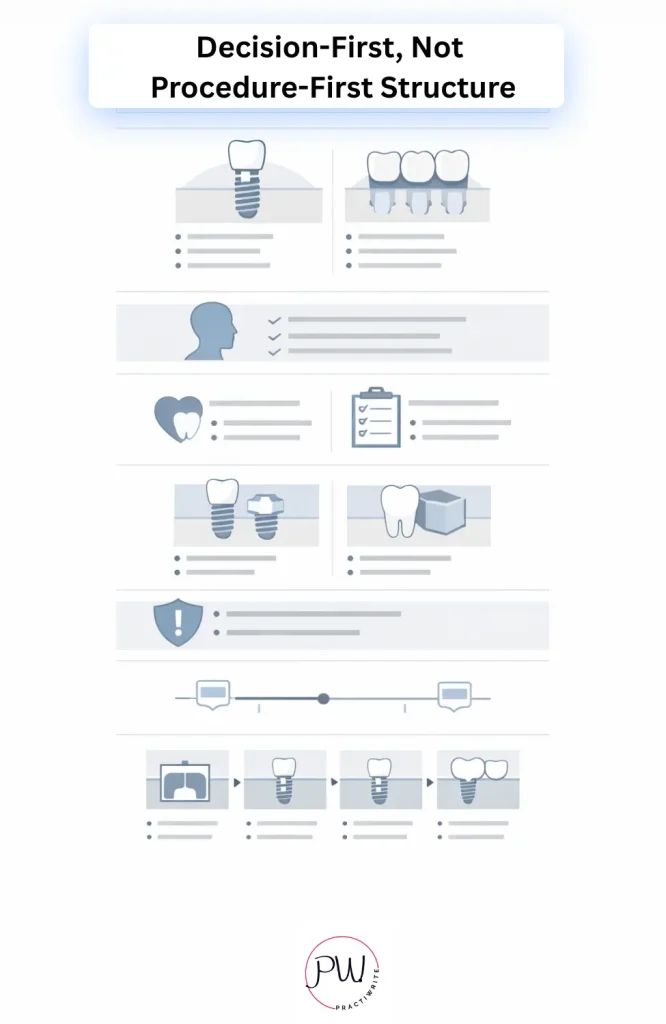
Lead with the decision. Not the procedure.
Open your implant page with the questions they’re actually asking:
- Why an implant instead of a bridge?
- What happens if they keep waiting?
- What makes someone a good candidate?
- What makes someone a bad one?
- Your philosophy on staging and materials
- How you handle complications
Then get to the procedure steps.
Consumer dental spending rose 4% from January through October 2025, reaching roughly 10% above pre-pandemic levels, according to the ADA Health Policy Institute’s Q3 2025 State of the U.S. Dental Economy report. At the same time, appointment wait times for new patients hit a three-year low of 12 days. Translation: more money is flowing into dentistry, but fewer patients are choosing to spend it. The practices winning right now are the ones attracting fewer, higher-value cases.
-ADA Health Policy Institute
That’s the FFS thesis in one stat.
Now let’s talk about the part nobody wants to talk about. Pricing.
Give a real range on your implant page. Not “it depends.” Not “call for pricing.” A real range with the reasons it varies.
Single implant from X to Y. Full arch from A to B. Here’s what drives the range. Here’s what’s included. Here’s what isn’t.
Insurance shoppers leave when they see that number. FFS patients keep reading.
One of our clients added a pricing range and a short explanation of what drove it to their implant page last spring.
Within one sprint, unqualified calls dropped noticeably. Consult-to-case rate climbed. They didn’t lose patients. They lost the patients they didn’t want anyway.
If your implant page could talk a tire-kicker into hanging up before they ever called, would that be a bad thing?
Veneer Content That Attracts the Right Kind of Picky
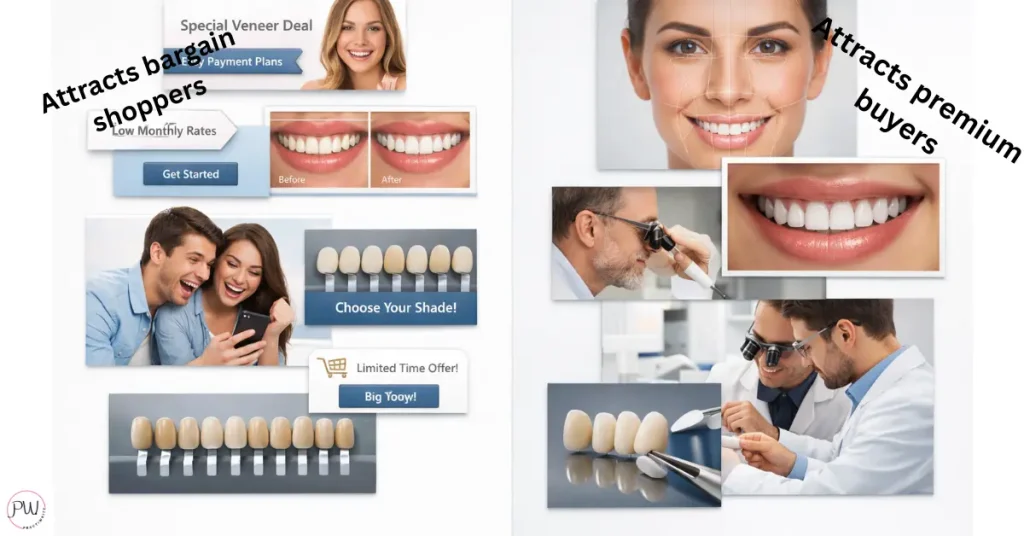
Veneer patients are the most brand-loyal FFS patients in dentistry, if they pick the right dentist. They’re also the most easily spooked by cheap-feeling copy. One wrong word and you’ve lost them.
Here’s what veneer content should sound like.
Confident. Aesthetic. Opinionated.
Specific on materials (porcelain versus composite, which lab you work with, which systems you prefer). Honest about prep versus no-prep, timeline, longevity tradeoffs, and what happens if one chips in ten years.
Here’s what it should never sound like:
- “Affordable veneers.”
- “Veneers for any budget.”
- “Insurance-friendly options.”
- “Financing starting at $99 a month.”
Every one of those phrases signals PPO shop. The veneer patient you want reads those and closes the tab.
I worked with a cosmetic-focused practice last year that rewrote their veneer page around design philosophy instead of procedure steps. Tooth shape, proportion, how the dentist thinks about facial symmetry, why certain shade choices look natural versus fake.
Nothing about insurance. Nothing about affordability. The consult quality changed within a sprint.
The clients they attracted after that rewrite were already sold on the dentist before they picked up the phone. They just needed to pick a date.
One of those patients told them during the consult, “I picked you because your page was the only one that sounded like an artist, not a shop.”
That’s the bar. That’s what veneer content should do.
If a veneer patient reads your page and can’t tell you apart from the three other cosmetic dentists they’re considering, why should they pick you?
How to Write About Full Cosmetic Cases
Smile makeovers. Full-mouth rehab. Full-arch implants. These are your highest-value pages.
Most practices write them the worst.
The patient reading a full-arch page is in research mode for weeks, sometimes months. This isn’t a cleaning. This is a five or six-figure decision that will change how they look and feel for the rest of their life.
Your content has to earn repeat visits. It has to give them something new each time they come back.
Here’s how to structure these pages.
Lead with identity. Who is this case for. What does life look like before. What does life look like after.
Paint the picture. A patient considering full-arch implants has probably avoided smiling in photos for a decade. Speak to that, not to the procedure.
Then move into clinical approach:
- How you sequence the case
- Which team members are involved
- Who your lab partners are
- What a realistic timeline looks like
- What happens at each visit
- How you handle complications if they come up
Then frame the investment. Not the cost. The investment.
Talk about value over decades. Compare to the cost of doing nothing, including what it’s costing them right now in confidence, social life, eating restrictions, and slow bone loss. Walk them through financing as a convenience, never as a rescue.
End with an FAQ built for big-case hesitations (you can even use real questions patients have had):
- Recovery time
- Function
- Maintenance
- What happens if something breaks in year eight
- Warranty or guarantee structure
And stop calling them “smile makeovers” if your patient calls it “finally fixing my teeth.” Write to their language. Not the industry’s.
The Five Words and Phrases to Delete From Every Cosmetic Page
Short list. One-line reason each. Open your cosmetic pages and go find these right now.
- “Affordable.” Signals PPO. Trains bargain hunters. Delete it.
- “Insurance-friendly.” You’re literally advertising to the wrong reader. Delete it.
- “Financing available for every budget.” Position financing as a convenience, not a rescue. The word “budget” on a cosmetic page is a red flag for the patient you want.
- “We accept most insurance plans.” Kill this on cosmetic pages specifically. Leave it on your new patient page if you must. Keep it off of implants, veneers, and full-mouth.
- “Call for pricing.” The most expensive sentence on your site. It filters out serious buyers while keeping price shoppers on the phone. Replace it with a real range.
Replace those with language of outcome, craft, investment, long-term value, and predictability.
- “Designed for patients who want their smile to last.”
- “Built around a clinical approach that has produced consistent results for two decades.”
That’s the register.
Page Structure and On-Page Signals That Support FFS Positioning
Content alone isn’t enough. How the page is built matters too. Good writing on a broken page still loses.
Your H1 and H2 hierarchy should be keyword-rich but outcome-led, not feature-led. “Dental Implants in [City]” is a weaker H1 than “Dental Implants Built to Last in [City].”
Google rewards specificity. So do readers.
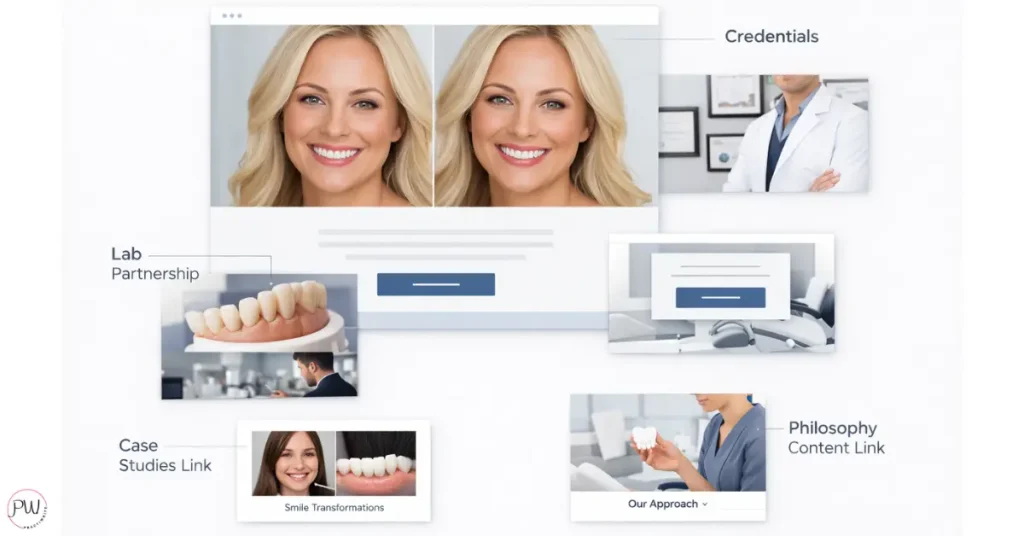
Your visual proof should be your own work, not stock pictures. Real cases. Real patients (with consent). Real photography.
Stock cosmetic imagery is the fastest way to signal “we don’t actually do this work often.”
The trust signals that matter to FFS patients are different from the ones on a typical dental site:
- AACD memberships
- AAID credentials
- Continuing education hours
- Named lab partners
- Membership or concierge plan options
- Speaking engagements
- Published work
Those signals tell a high-value patient you take this seriously. Insurance logos tell them the opposite.
The primary CTA on a cosmetic page should never be “verify your insurance.” It should be “request a cosmetic consultation” or “see if you’re a candidate.” That single switch can change the quality of every call your front desk takes.
Internal linking matters too. Link cosmetic pages to other cosmetic pages. Link to your clinical philosophy content and to case studies.
Don’t dump every internal link to your generic new-patient page. That flattens your site hierarchy and trains Google that your cosmetic pages aren’t a distinct service category.
This is the work we do in Sprint Two and Sprint Three together. The pages rank because the content is right. The content converts because the page supports it.
One without the other is half a job.
A Simple Framework to Audit Your Cosmetic Content This Week
You don’t need to rewrite everything today. You need to know where you stand. Open your three biggest cosmetic pages and ask these five questions:
- Does this page mention insurance or affordability anywhere above the fold? If yes, cut it. Move any insurance language to the bottom or to a dedicated insurance page.
- Is there a real price range on the page? If no, add one this week. Even a wide range beats “call for pricing.”
- Are the cases shown photographed in your office or are they stock? If stock, swap them out. Real work or no work.
- Does the page show your opinion on the procedure? If no, add a “How I approach this” section. Three paragraphs minimum. Your voice.
- Does the CTA match the reader’s intent? FFS CTAs ask for a consultation. Not a verification. Not a quote. A conversation.
If four out of five answers are “no,” your cosmetic content was built for a PPO practice.
And you’re not one.
How should a fee-for-service dental practice write about dental implants?
Lead with the decision the patient is weighing, not the procedure steps. Show your clinical philosophy, specify the implant systems you use and why, give a real pricing range, and describe who is and isn’t a good candidate. The procedure walkthrough belongs further down the page, not at the top.
What words attract cash-pay cosmetic patients instead of insurance shoppers?
Words tied to outcome, craft, long-term value, and clinical philosophy. Think “designed to last,” “built around your face shape,” “predictable results,” “patients who want their smile to last.” Avoid “affordable,” “insurance-friendly,” “budget-friendly,” and any pricing language that leads with cost rather than investment.
Should cosmetic dental pages include pricing?
Yes. A real range with the reasons it varies. Not “call for pricing.” Serious patients appreciate pricing transparency because it respects their time. Price shoppers leave, which is exactly the filter you want on a cosmetic page.
How long should a cosmetic service page be?
At least 1,200 words for a core service page, longer for high-value services like full-arch implants or smile makeovers. Length isn’t the goal. Depth is. The page needs to answer every major question a researching patient has so they leave informed, not confused.
Why do cosmetic dental pages underperform on FFS practice websites?
Most cosmetic pages are built on a PPO template. Insurance language, affordability framing, generic stock photos, and no clinical POV. They attract insurance shoppers instead of FFS patients and repel the exact readers who would have said yes to the case.
Should I mention insurance on my cosmetic page at all?
Keep it off. If you need to address it, address it on a dedicated insurance or financing page. Cosmetic pages exist to attract FFS patients. Mentioning insurance there works against the entire purpose of the page.
Wrapping Up: Your Cosmetic Content Is Either Filtering Patients In or Filtering Them Out
Every word on your cosmetic page is doing one of two things. Attracting the patient you want. Or attracting the one you’ve been tolerating.
Right now, most FFS practices are doing the filtering backwards. They’re repelling the high-value patient with PPO language, generic photography, and “call for pricing” CTAs.
Meanwhile they’re pulling in insurance shoppers who flake, price-shop the quote, and book the cleaning instead of the case.
Strip the PPO language off your cosmetic pages.
Lead with opinion. Price with confidence. Show real work.
Write to the patient you actually want sitting in your chair, not the one your template was built for.
Your cosmetic content has a job. It’s either doing that job or it isn’t. There’s no middle ground.
Want Practiwrite to do it for you? Schedule your 100% free Dental Practice Roadmap.
Your Dental Practice Roadmap is a GBP and website audit that shows you exactly where you stand, what keywords you’re ranking for now, what you should be ranking for, and a step-by-step plan to close those gaps.
No vague recommendations. No fluff. Just a clear picture of what’s broken and what to do about it.
Book your Dental Practice Roadmap and get yours today.

10+ year content strategist, writer, author, and SEO consultant. I work exclusively with fee-for-service dental practices that want to build value, not volume.