
You published. You posted. You waited.
And your phone sat there like a paperweight.
That’s the moment most dentists and practice managers feel something between exasperation and resignation.
You did what the agency told you to do.
You invested in content.
You were told Google would reward consistency.
But the appointments didn’t come, the calls didn’t spike, and your blog analytics look like a flatline with a few weak blips. So why isn’t your dental blog getting patients?
Here’s the diagnosis most people miss: your blog probably isn’t the problem. Your strategy is.
After auditing hundreds of dental practice websites, I can tell you that most dental blogs are written to check a box, not to fill a schedule.
And there’s a significant difference between a blog that exists and a blog that works.
So what does a blog that works actually look like? Let’s get into it.
Table of Contents
The Uncomfortable Truth About Most Dental Blog Content
I get it. Someone told you that blogging was essential.
Maybe it was a digital marketing agency, a dental consultant, or a well-meaning colleague at a CE course.
That advice wasn’t wrong in theory. Content does matter. However, what nobody told you was that the type of content matters far more than the volume.
Most dental blogs fall into one of three categories, and none of them are filling chairs.
The Textbook Post
This is the clinical explainer written with the best intentions but zero awareness of patient search behavior.
Think “What Is a Root Canal?” or “The Anatomy of Your Teeth.” Patients googling these phrases are curious, not committed. They’re in research mode, not booking mode, and they were never going to call you after reading a three-paragraph explanation of enamel.
These posts feel productive to write. They are not productive for your practice.
The Practice Newsletter in Disguise
“We’re thrilled to welcome Dr. Kim to our team!”
“We just upgraded our sterilization equipment!”
“Our office will be closed December 26th.”
These posts serve zero patients. They’re internal announcements wearing blog costumes.
No patient has ever searched “Riverside Dental new staff member” and booked a hygiene appointment. Yet these posts clog up dental blogs everywhere, diluting whatever topical authority the site might otherwise build.
The Keyword-Stuffed Ghost
This one is the most insidious because it looks like SEO. It’s loaded with keyword phrases but reads like it was written by someone who’s never set foot in a dental office.
“Dental implants, dental implants near me, best dental implants, affordable dental implants.” Google has gotten very good at identifying this content for exactly what it is, and it rewards it accordingly: with nothing.
Granted, most agencies sold you on this approach. That’s on them. But continuing to publish it is on you.
Why Google Doesn’t Care About Your Blog (Unless It Does This One Thing)
Google’s entire job is to match the right result to the right searcher at the right moment. That’s it. When you understand that, everything about content strategy changes.
The question is never “did we publish?” The question is always “does this match what our patient actually typed?”
The numbers make this impossible to ignore.
The Three Types of Search Intent
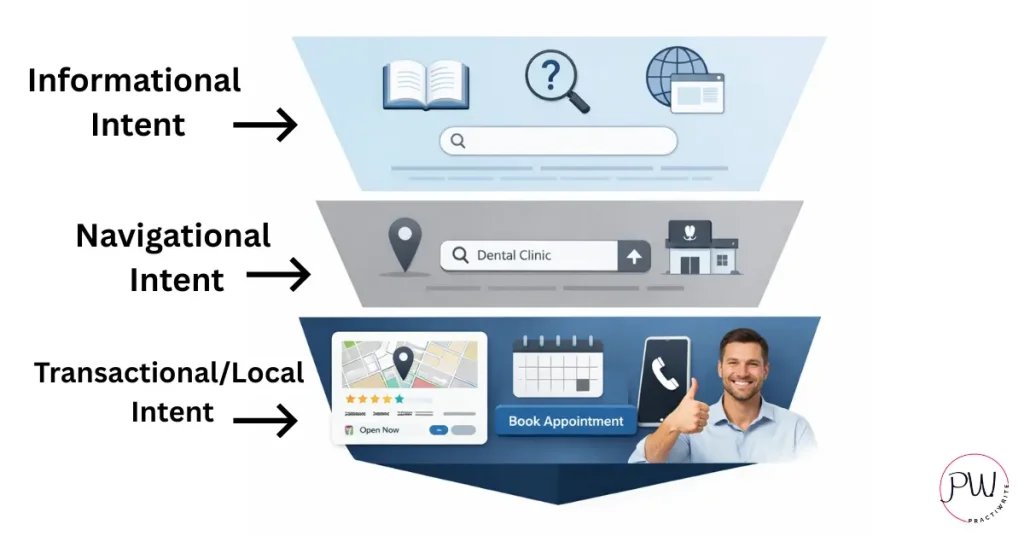
Informational intent is someone asking “what causes gum disease” or “how long does a root canal take.” They’re learning, not booking.
Navigational intent is someone searching for you by name. They already know you exist.
Transactional and local intent is where patient acquisition happens:
- “cosmetic dentist accepting new patients in Columbus”
- “veneers cost near me”
- “best dental implant specialist in Scottsdale”
These searchers have a problem they want solved and they’re ready to act. This is your buyer.
Where Most Dental Blogs Get It Wrong
Most dental blogs target 80% informational content and nearly zero transactional content. They’re building an audience of curious browsers while the phone collects dust. We see this constantly.
A practice has 25 published blog posts and ranks for nothing that drives a call. The content exists, but it’s invisible to the patients who would actually show up and pay for treatment.
When was the last time someone read your post about the history of dental implants and booked a consultation? That answer tells you everything.
The Fee-for-Service Problem Is Even Worse
If you’re a fee-for-service practice, or you’re in the process of transitioning away from PPO dependency, a weak blog strategy isn’t just frustrating. It’s actively costing you your best patients.
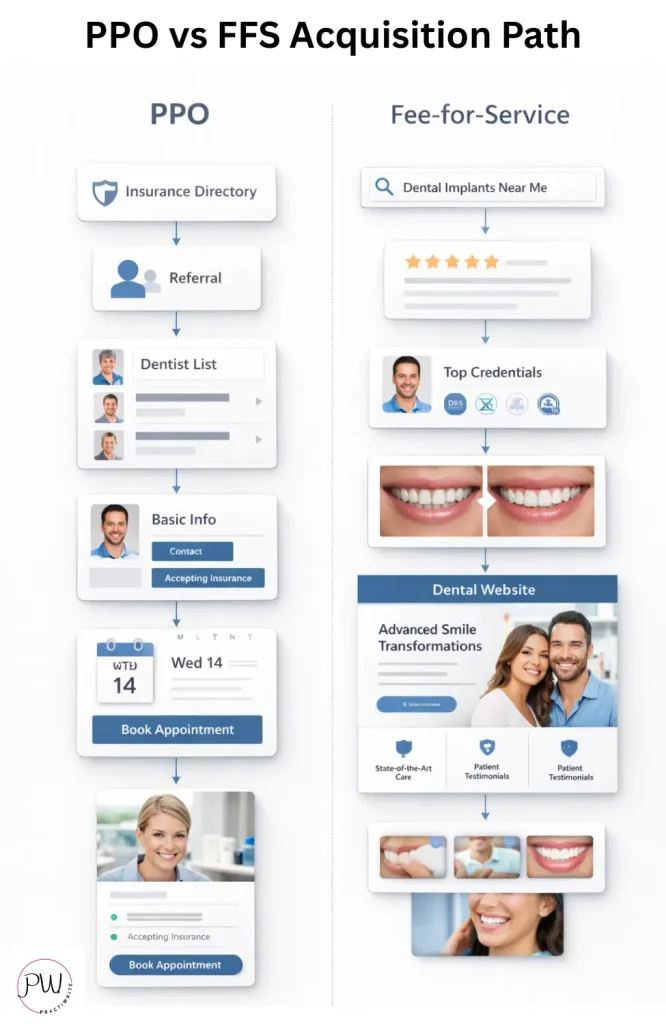
The PPO Safety Net You Don’t Have
PPO practices can absorb poor content strategy because they have a built-in referral channel: insurance directories. Patients get directed to them regardless of what their blog says.
Fee-for-service practices don’t have that safety net. Every single new patient is a choice. And that patient made their choice based on what they found when they searched. If your digital presence doesn’t hold up under that scrutiny, they move on to the next result.
When Your Content Attracts the Wrong Patient
Some FFS practices publish content that actively attracts the wrong patients. Writing about “what insurances do you accept” or “how to maximize your dental benefits” sends a clear signal: this is an insurance-driven practice.
That signal repels the exact patients you want and pulls in the ones who will push back on your fee schedule before they even see a treatment plan.
Early in my work with fee-for-service practices, I made the mistake of letting keyword search volume drive content decisions. High volume looked like opportunity. It wasn’t.
Volume means nothing if it pulls in patients who balk at your fee schedule on the first phone call. That lesson cost one practice three months of wasted content production before we course-corrected.
What FFS Patients Are Actually Searching For
The patients your FFS practice needs are searching differently.
They want to know if you can fix what they hate about their smile. They want your credentials and your approach. They want social proof from patients who look like them and had results they want.
They want cost explained in plain terms without insurance jargon clouding the picture. Your content needs to speak that language clearly, because your highest-value buyers are filtering for it.
Your content is either qualifying patients or disqualifying you. There’s no neutral ground.
Why Your Dental Blog Isn’t Getting Patients: 5 Reasons
Be honest with yourself here. Most practices can identify with at least three of these. Every one of them is fixable, but fixing them requires being willing to look at what you have and call it what it is.
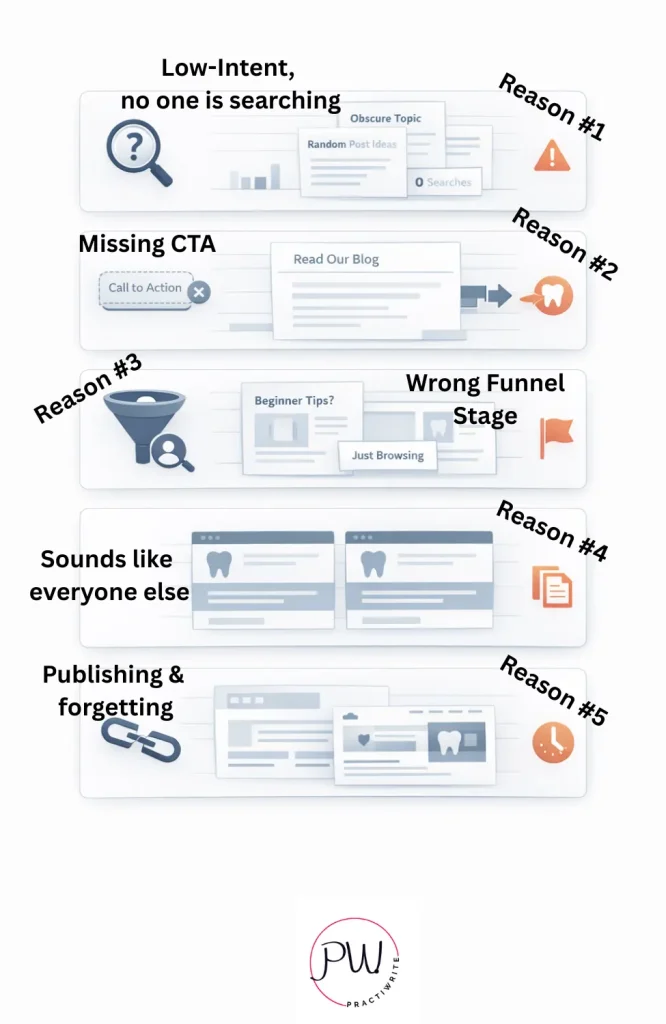
Reason #1: You’re Writing About Topics Nobody Is Searching For
No keyword research happened, or the keyword research was surface-level and missed what patients actually search at the decision stage. There’s a significant difference between “dental hygiene tips” and “teeth cleaning cost near me.”
One of those queries has a patient behind it who is ready to book. The other doesn’t.
Reason #2: Your Posts Have No Call to Action
The content ends, nothing happens, and the patient closes the tab. You left money sitting on the table by not telling them what to do next.
A blog post without a call to action is a conversation that walks out the door without leaving a number. Every post needs one clear, direct ask at the end.
Reason #3: You’re Targeting the Wrong Funnel Stage
You’re writing for people at the top of the funnel when your revenue lives at the bottom. Awareness-stage readers are browsers. Decision-stage patients are buyers.
If your content is designed for someone who is curious but not ready, you’ll get curiosity, not calls. The practices generating consistent patient flow from their blogs have their bottom-funnel content locked in before they ever touch awareness content.
Reason #4: Your Content Sounds Like Every Other Dental Practice
It reads generic. It could belong to any dental office in any city in America. There’s nothing in it that says why a patient should choose this practice specifically.
If someone could pull your blog post, swap out your logo, and publish it on a competitor’s site without changing a word, that’s your problem.
Reason #5: You’re Publishing and Forgetting
No internal links connecting your content. No updates when information becomes outdated. No promotion strategy pushing readers toward the post.
You hit publish and moved on.
A blog post is not a set-it-and-forget-it asset. It needs to be connected to the rest of your site, refreshed as your market changes, and actively promoted through your other channels to do its job.
What a Revenue-First Dental Blog Actually Looks Like
The shift I recommend to every practice I work with is uncomfortable but simple: stop starting with “what should we write about” and start with “which of our services drives the most production revenue?” That’s the anchor. Build content backward from there.
The Content Priority Stack
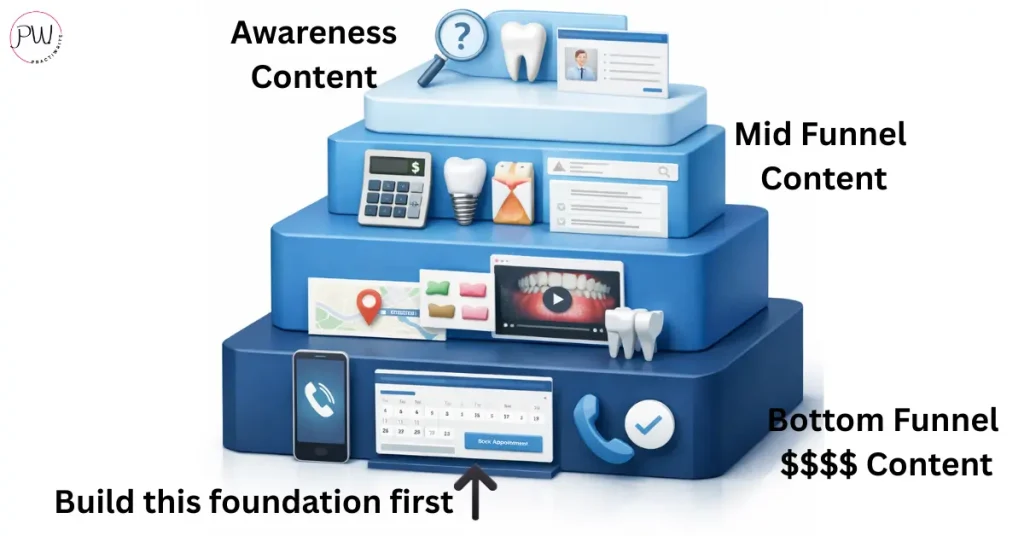
Tier one is bottom-funnel content: service plus location posts that target patients ready to book right now.
Examples:
- “Dental implants in Phoenix.”
- “Cosmetic dentist Raleigh.”
- “Invisalign provider Tampa.”
These posts generate calls. They should be the foundation of every dental content strategy.
Tier two is mid-funnel: cost, comparison, and process content for patients close to a decision but still evaluating.
Examples:
- “How much do veneers cost in Atlanta.”
- “Dental implants versus dentures.”
- “What is the Invisalign process.”
These patients need one more clear answer before they pick up the phone.
Tier three is top-funnel awareness content: symptom and pain-driven posts for people just beginning to research. This content has its place, but only after tiers one and two are fully covered.
Build the Floor Before the Roof
I don’t let practices touch top-funnel content until their bottom-funnel is airtight. Most agencies invert this completely, which is why their clients are getting traffic without getting calls. Start where the patient is closest to booking and work your way up.
One practice I worked with had 19 informational blog posts and zero service-plus-location content. I shifted focus to transactional content for their three highest-revenue services.
Within 60 days, they ranked on the first page for two local implant queries and booked four consultations directly from organic search in a single month. The blog finally paid for itself.
The Blog Post Anatomy That Actually Drives Calls
A patient-generating blog post is not complicated. It requires discipline to execute correctly, especially when most of what you’ve been shown as a model is wrong. Here’s what every post that drives calls actually contains.
A Headline That Matches the Search Query
No clever wordplay. No vague inspiration. “Dental Implants in Columbus Ohio: What You Need to Know” will outperform “Unlock Your Perfect Smile” every single time, because the first one is the phrase your patient actually typed.
Headline creativity is not an asset in local search. Precision is.
An Opening That Speaks to Their Situation
Not your practice philosophy. Not a generic overview of the procedure. Their specific problem or concern, addressed in the first two sentences.
Google’s AI now summarizes your content directly in search results. If your answer is buried below the fold, you’ve already lost the click.
Social Proof Woven In, Not Bolted On
Not a testimonials section at the bottom that nobody scrolls to. Social proof referenced naturally in context. “Patients who come to us for this procedure consistently tell us that the process was easier than they expected.”
That works harder than a star rating widget. It sounds like a practice that actually talks to its patients.
And the data backs this up: 81% of patients say they trust feedback from past patients as much as a personal referral. That number should change how prominently you weave patient outcomes into every piece of content you publish, not just your reviews page.
One Clear Call to Action
One ask. Not “contact us or call or fill out a form or follow us on Instagram.” Pick one door and point every reader toward it.
The more options you give, the more friction you create and the less likely they are to take any of them. A single, clear CTA at the end of every post is non-negotiable.
On length: longer is not better. More relevant is better.
A 700-word post that precisely matches a patient’s intent will outperform a 2,200-word post that wanders. Write until the question is thoroughly answered, then stop.
How to Audit What You Have Right Now
Before you write a single new post, you need to know what you have and whether it’s helping or hurting you. Publishing more content on top of a broken foundation does not fix the foundation. It makes it messier.
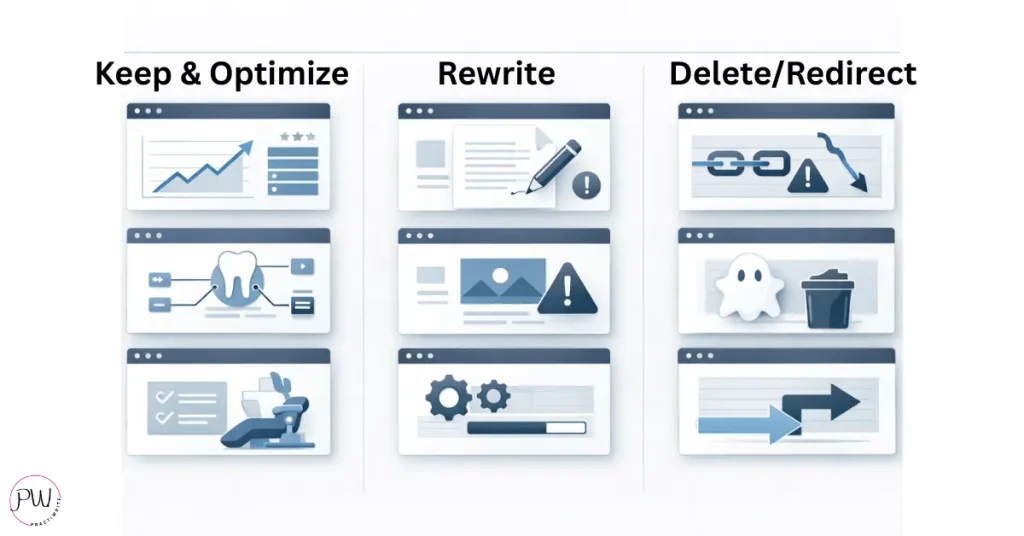
The Three-Category Sort
Keep and optimize: posts with existing traffic or that rank for something relevant to your services. These are worth investing in.
Rewrite: good topic, wrong execution. Wrong intent, weak call to action, thin content. The bones are there but they need work.
Delete or redirect: posts with no traffic, no relevance, and no realistic path to either. These are actively diluting your topical authority by telling Google your site covers everything and specializes in nothing.
Three Diagnostic Questions for Every Post
Does this target a query that a patient with money in their pocket is actually searching? Does it end with a clear, direct path to booking? And could this post live on any dental website in America, or does it sound specifically like this practice?
If the answer to all three is no, that post is gone. I’ve recommended deleting 60 to 70 percent of a practice’s existing blog content.
That might feel drastic. It might feel like throwing away work.
Yet a lean blog that ranks for ten revenue-driving queries will generate more patient calls than a bloated blog ranking for nothing that matters. The math is straightforward.
Why isn’t my dental blog getting any traffic?
The most common reason is that your posts target topics without sufficient search volume, or they target informational queries that don’t attract local patient traffic. Google prioritizes content that matches what people are actively searching for in your area. If your posts aren’t built around keywords your potential patients actually use at the decision stage, they will not rank regardless of quality.
What should a dental blog post be about to attract new patients?
The most effective dental blog posts target bottom-funnel, transactional searches: specific services combined with your location, cost, and process questions for high-value treatments, and comparison content for patients evaluating their options. Posts that answer “what is a crown” generate curiosity. Posts that answer “dental crown cost in Nashville” generate calls.
How long should a dental blog post be to rank on Google?
Length should be determined by how much space it takes to thoroughly answer the patient’s question, not by an arbitrary word count target. For local service-plus-location posts, 800 to 1,200 words is typically sufficient. For cost and comparison content, 1,200 to 1,800 words is more appropriate. Padding content to hit a word count hurts readability without improving rankings.
Do dental blogs actually help with SEO?
Yes, when they target the right keywords and are built around patient search intent. No, when they publish generic informational content that nobody in your market is actively searching for. The blog itself is not the issue. The strategy behind it is.
What is the difference between informational and transactional dental content?
Informational content answers curiosity-based questions: “what causes tooth sensitivity,” “how is a root canal performed.” Transactional content targets patients who are ready to take action: “dental implants near me,” “best cosmetic dentist in [city].” Transactional and local content drives patient acquisition. Informational content drives traffic from people unlikely to become patients.
How often should a dental practice publish blog content?
Consistency matters less than relevance and intent-match. One well-researched, properly targeted post per month will outperform four generic posts per week. Publish only when you have something worth publishing that serves a specific patient acquisition goal.
Should fee-for-service dental practices blog differently than PPO practices?
Definitively yes. FFS practices need content that attracts patients choosing to pay out of pocket for quality care. That means outcome-driven content, transparent cost information, strong social proof, and messaging that positions the practice around clinical excellence rather than insurance compatibility. Publishing insurance-adjacent content as an FFS practice actively attracts the wrong patients.
How do I know if my dental blog content is working?
Track calls, not clicks. If your blog is working, you should be able to connect organic search traffic to actual appointment requests over a 60 to 90 day window. Google Search Console will show you which queries your posts rank for. If those queries are not the ones your best patients would search before booking, your content strategy needs to be rebuilt from the revenue side, not the traffic side.
Wrapping Up: The Practiwrite Bottom Line
Asset or Liability. Pick One.
Your blog is one or the other. There is no middle.
An asset is a post that ranks for a local, transactional query, answers the patient’s question clearly, and routes them to your booking page.
A liability is a post that costs you time and money, ranks for nothing your patients are searching, and signals to Google that you’re a general information resource rather than a specialist worth recommending.
Smarter Beats More, Every Time
The FFS dental practices winning at local search right now aren’t publishing more. They’re publishing smarter.
They started with their most profitable services. They mapped the search journey. They created content that meets patients at the decision point, not at the curiosity stage.
Make no mistake: your blog can absolutely drive consistent new patient acquisition. But it’ll only do that if every post has a clear job and is built to do it.
I built my Practiwrite content system around one question: does this drive a call? If the answer is not clearly yes, I don’t write it.
Every month your blog sits as it currently is, your competitors with better-targeted content are collecting the patients who should be calling you. The fix starts with an honest look at what you have.
Start there. Or let my team and I do it for you.
Book your no obligation FREE strategy session and get your Dental Practice Roadmap. You’ll see how your site content (and your GBP) stand against your competitors and get a clear plan for making it bring in qualified fee-for-service patients.

10+ year content strategist, writer, author, and SEO consultant. I work exclusively with fee-for-service dental practices that want to build value, not volume.