
Most dental practice blogs are losing money.
Not because content strategy for dental practices doesn’t work. It does.
But because the content strategy behind those blogs was built backward, starting with keywords instead of patients, chasing traffic instead of revenue, and measuring success by page views instead of booked appointments.
The result? Practices spending thousands on content that ranks for nothing, converts no one, and sits on their website like an expensive digital paperweight.
Here’s what that actually costs you.
A single page-one ranking for a high-value service keyword like “dental implants in [your city]” can drive 30–60 appointment requests per month. If your content isn’t ranking, those patients are walking into the practice down the street.
That’s not a content problem. That’s a revenue leak.
And if you’re a fee-for-service practice? This hits even harder.
You left PPOs to stop leaving money on the table.
You stopped letting insurance companies dictate your treatment plans and your margins. Good.
But here’s the part nobody tells you: when you drop insurance networks, you also drop their built-in referral pipeline. Your content has to replace it.
Not eventually. Now.
Most dental marketing agencies won’t tell you this because they’re too busy selling you social media packages and generic blog posts about flossing. Two posts a month, $1,500 a pop, zero connection to patient acquisition.
That’s not a strategy. That’s a subscription to irrelevance.
This guide is different. It’s the framework I use with fee-for-service dental practices to turn content into a predictable patient acquisition channel.
One that drives revenue, not vanity metrics.
No fluff. No filler. Just the system that works.
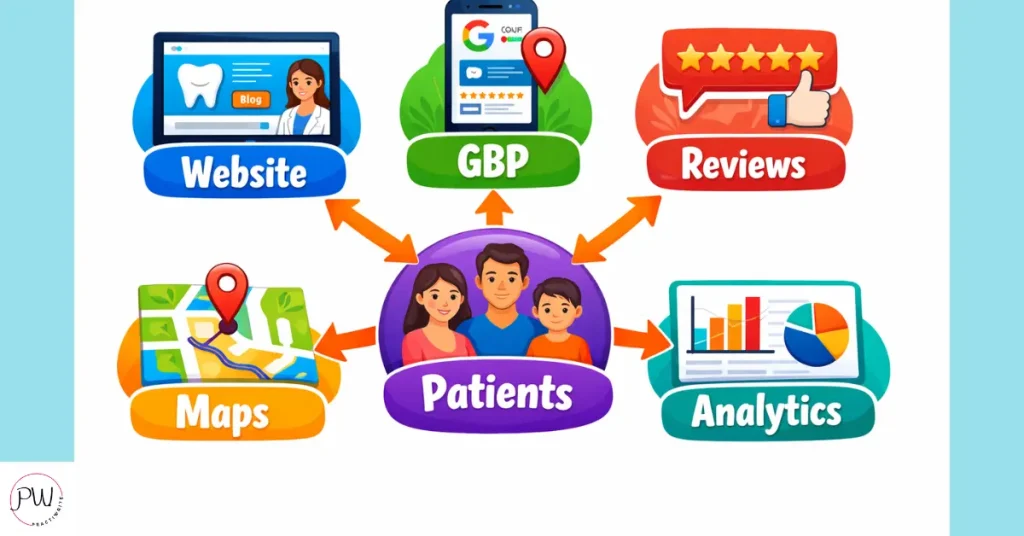
Why Your Content Is a Revenue Engine, Not a Marketing Expense
Let’s kill a tired narrative right now: content is not “part of your marketing mix.” For dental practices, content is the mechanism that puts patients in chairs.
It’s a revenue engine. And if yours isn’t running, you’re subsidizing your competitors’ growth.
Here’s why.
Your Patients Aren’t Asking Friends Anymore. They’re Asking Google.
The vast majority of patients start their search for a new dentist online. They’re not calling their neighbor for a recommendation like it’s 1997. They’re typing “dentist near me” into Google, scanning the results, and making a decision in minutes. If your practice isn’t showing up in those results, you don’t exist to them.
And here’s where it gets expensive.
In a typical local market, there are 700+ monthly searches for “dentist near me,” 300+ for “teeth whitening near me,” and 250+ for “dental implants.” Over 60% of those searches result in a booked appointment. The practices showing up at the top are capturing the lion’s share. Everyone else gets the scraps or nothing at all.
The Revenue Math Most Practices Ignore
The average lifetime value of a dental patient is $10,000–$15,000. If your content strategy is putting you on page one for even a handful of high-value keywords, you’re looking at dozens of new patient inquiries per month. Multiply that by lifetime value, and a single well-optimized blog post can be worth more to your practice than a year of social media posts that get 12 likes from your hygienist’s mom.
Why This Hits Fee-For-Service Practices Even Harder
You’re not competing for the $99-cleaning crowd. You’re going after patients who will accept a $5,000 implant case or a $15,000 full-mouth rehabilitation because they’ve done their research, they trust your expertise, and they found you through content that demonstrated authority, not a coupon.
Those patients are doing more homework than the average dental consumer.
They’re reading your service pages. They’re comparing your content against three other practices. They’re looking for substance, not stock photos of smiling families.
If your content doesn’t meet them where they are in that decision-making process, they’re gone.
This is also why generic content strategies fail FFS practices. A blog post titled “5 Tips for Healthy Gums” might drive some traffic, but it’s attracting browsers, not buyers. The content that drives revenue for fee-for-service practices is specific, service-oriented, and built around the exact questions your ideal patients are asking before they pick up the phone.
Google Isn’t the Only Game Anymore. AI Is Citing Your Competitors
One more thing most agencies won’t mention: AI search tools like ChatGPT and Google’s AI Overviews are now pulling content to answer patient questions directly. Consumer use of ChatGPT and generative AI tools for local business recommendations jumped from 6% to 45% in one year, making it the third most popular source of business recommendations behind Google.
If your content is comprehensive, authoritative, and well-structured, you’re positioned to show up in those AI-generated results too. If it’s thin and generic, those tools will cite the practice down the street instead.
Bottom line: content isn’t a line item. It’s the engine that drives patient acquisition, builds authority, and compounds over time. Paid ads stop working the second you stop paying. Content keeps working while you sleep.
Before You Write a Single Word Lay the Foundation First
This is where most dental content strategies fall apart before they even start. A practice owner gets excited, hires a writer (or worse, assigns it to the office manager who’s already drowning), and starts cranking out blog posts about teeth whitening and flossing tips.
Three months later? Crickets.
No rankings.
No calls.
No ROI.
And now they’re convinced “content doesn’t work.”
Content works. Skipping the foundation doesn’t.
Here’s what needs to be in place before you publish a single word.
Set One Goal That Actually Matters to Your Bottom Line
Your content strategy needs a goal, and “get more visibility” isn’t one. That’s a wish. A goal has a number attached to it.
For most fee-for-service practices, the goal is straightforward: generate more high-value patient appointments from search. Not traffic. Not followers. Appointments.
If your chairs are empty, your content should be laser-focused on patient acquisition. Brand awareness is a luxury for practices that are already full.
Here’s the mistake I see constantly: practices posting “awareness content,” i.e., behind-the-scenes videos, team introductions, holiday posts, while their schedule has gaps. That’s rearranging deck chairs on the Titanic. If patients aren’t finding you through search, no amount of Instagram reels will fix that.
Know Exactly Who You’re Writing For (Hint: It’s Not “Everyone Who Needs a Dentist”)
If you’re a fee-for-service practice, your ideal patient isn’t just anyone with a toothache. Your ideal patient is someone who values quality care, has the means to pay for it, and makes decisions based on research and trust, not the cheapest Groupon deal in their inbox.
That distinction changes everything about how you create content.
Content written for bargain shoppers attracts bargain shoppers. Content written for discerning, research-driven patients attracts the exact people who accept treatment plans, pay full fee, and refer others like them.
The best way to understand your ideal patients is to talk to the ones you already have. Not with a survey. With actual conversations. Ask them:
“How did you find us?”
“What stood out about our practice compared to others you looked at?”
“Were you considering another practice? What almost made you go there instead?”
“What was the one thing that made you choose us? Walk me through your thought process.”
The answers to these questions are gold. They tell you exactly what language to use, what concerns to address, and what your content needs to say to convert the next patient like them. Skip this step and you’re guessing. Guessing is expensive.
Define What Makes You the Only Choice, Not Just Another Option
There are hundreds of dental practices in your metro area. Your content needs to answer one question before anything else: why should a patient choose you over every other option?
That’s your Unique Value Proposition (UVP), and if you can’t articulate it in one sentence, your content won’t be able to either.
Maybe it’s a specialized service that nobody else in your area offers.
Maybe it’s your approach to patient care.
Maybe it’s the fact that you’ve done 2,000 implant cases.
Whatever it is, it needs to be front and center in your website messaging, not buried on an About page that nobody reads.
Your UVP becomes the thread that runs through every piece of content you create. Without it, you’re just another dental practice blog saying the same things everyone else is saying.
Study Your Competition. Then Do What They Won’t
Before you write anything, you need to know what you’re up against. A competitor analysis shows you what the top-ranking practices in your area are doing, what keywords they’re ranking for, and (most importantly) where they’re leaving gaps you can exploit.
When I do competitor analyses for my clients, I’m going through my database of dental practice websites looking at content quality, keyword coverage, and missed opportunities.
The goal isn’t to build a clone of what’s already ranking. It’s to find the openings where your content can provide something more valuable, more specific, and more relevant to your ideal patients.
One thing I consistently find: most dental practice websites are competing for the same generic keywords with the same generic content. The practices that win are the ones creating content that their competitors haven’t thought to create or were too lazy to create well.
Get Your Brand Voice Right or Your Content Will Sound Like Everyone Else’s
This is the piece most practices skip entirely, and it shows. Their blogs read like they were written by five different people (because they were) with no consistent tone, personality, or point of view.
A brand voice guide gives your content team, whether that’s an internal writer, a freelancer, or an agency, the blueprint for how your practice sounds. It covers tone, vocabulary, sentence style, and the specific perspective you bring to dental topics. Done right, every piece of content sounds like it came from the same practice, because it did.
I develop these for every client I work with. It starts with a voice finder session where we nail down what makes your perspective unique, and ends with a document your writers can reference every time they sit down to create something. No guesswork. No inconsistency. Just your voice, at scale.
Fix What’s Under the Hood Before You Invest in Content
I’m going to be blunt: if your website has technical SEO problems, the best content in the world won’t save you. Google can’t rank pages it can’t properly crawl, index, or understand.
A technical SEO audit looks at your site structure, URL architecture, metadata, redirects, indexability, and schema markup. It’s the “under the hood” work that most practice owners never see but that makes everything else possible. Think of it like this: you wouldn’t spend $50,000 on a kitchen renovation in a house with a cracked foundation. Same principle.
My team performs a technical audit before we touch any content. It’s that important. If you want the full breakdown of what goes into a technical audit, I cover that in my guide on the four pillars of SEO. For now, just know this: get it done by someone who knows what they’re doing before you invest a dollar in content.
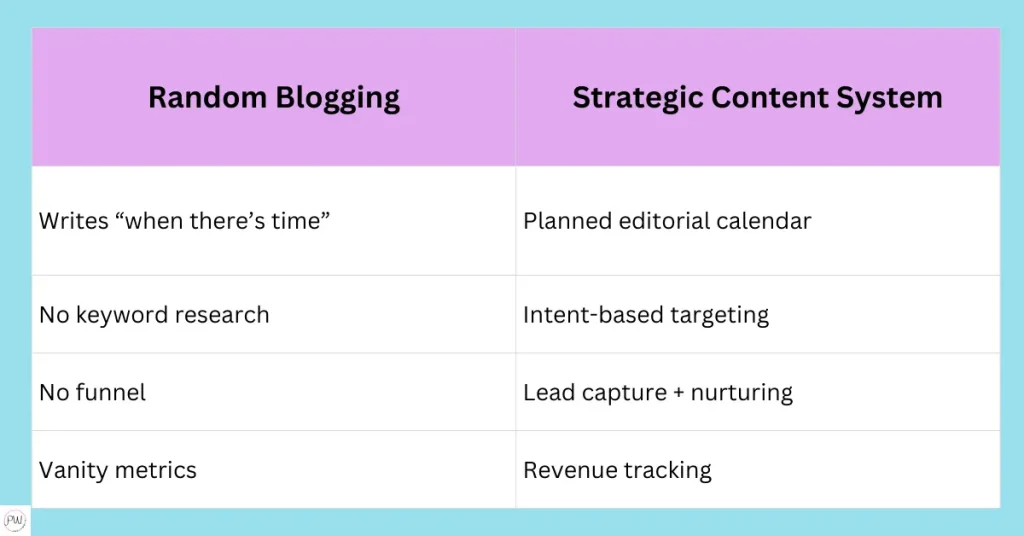
Build Content Pillars Around Revenue, Not Random Dental Topics
Most dental blogs are a graveyard of disconnected posts.
A whitening article here. A flossing tip there. A random piece about dental anxiety that links to nothing.
No structure. No strategy. No results.
A content pillar model fixes this. And for fee-for-service practices, it’s non-negotiable.
How the Hub-and-Spoke Model Works (And Why Google Rewards It)
Think of each major service your practice offers as a hub. That hub gets a comprehensive pillar page; a deep, authoritative piece of content that covers the topic thoroughly. Then you build supporting articles (spokes) around it, each targeting a specific question or subtopic that links back to the hub.
Google reads this structure as topical authority. Instead of one lonely blog post competing against every other dental website, you have an interconnected cluster of content that signals to Google: “This practice knows this topic inside and out.”
The result? Higher rankings across the entire cluster.
Not just one page; all of them lift together.
FFS Practices: Your Pillars Should Follow the Money
Here’s where fee-for-service practices need to think differently from PPO-dependent ones.
If your practice does $8,000 implant cases, your content pillar for dental implants should be your most built-out cluster on the site. 8 to 12 supporting articles covering cost, candidacy, process, recovery, alternatives, comparisons, and location-specific pages.
That’s not excessive. That’s how you own the topic in your market.
Compare that to a PPO practice pumping out articles about fluoride treatments and routine cleanings. Those are low-value keywords that attract low-value patients.
For FFS practices, your pillar priorities should map directly to your highest-revenue services: implants, cosmetic dentistry, full-mouth rehabilitation, sedation dentistry; those are the cases that justify your fees and keep your practice profitable.
Generic hygiene content has a place, but it’s not the foundation. It’s the garnish.
What This Looks Like in Dollar Terms
Let’s make this concrete.
Say you build a content cluster around “dental implants in [your city].” Your pillar page ranks on page one. Your supporting articles rank for long-tail variations like “how much do dental implants cost,” “am I a candidate for dental implants,” and “dental implants vs. bridges.”
Together, that cluster is capturing patients at every stage of the decision process. The person researching cost today is the person booking a $12,000 case next month. Multiply that across 3–4 high-value content pillars and you’re not guessing where next month’s production comes from. You’re engineering it.
One of my clients ranked for 217 additional keywords within 90 days of implementing this exact pillar/cluster approach, generating 43 new patient appointment requests directly from that content.
Don’t Know Which Keywords to Target? Start With How Patients Actually Search.
Keyword research isn’t about guessing what sounds right. It’s about mapping the exact terms your ideal patients type into Google when they’re looking for the services you offer. That mapping process (connecting keywords to services to content pillars to revenue) is what separates a content strategy from a content calendar.
I go deep on keyword strategy, including how to map keywords to revenue projections and build out a full topical authority framework, in my guide on content strategy ideas for dental practices. If you want the tactical playbook, start there.
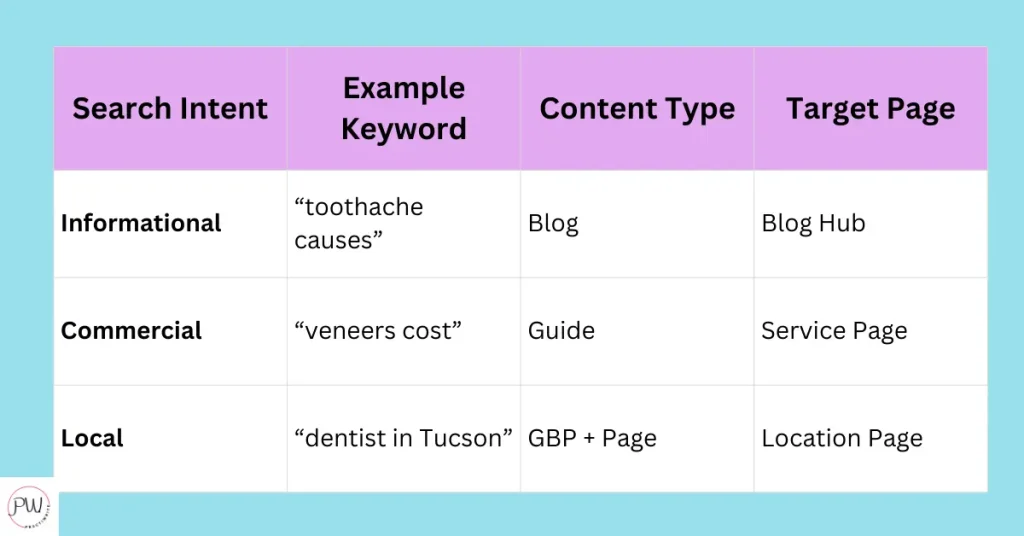
Creating Content That Converts Patients, Not Just Traffic
Traffic without conversions is just a vanity metric with a Google Analytics dashboard. If your content brings 5,000 visitors a month and none of them book an appointment, you don’t have a traffic win. You have an expensive hobby.
Here’s how to create content that actually moves people from search result to your schedule.
Answer the Question They’re Actually Asking
Every piece of content you create should start with one question: what does the person searching this term actually want to know?
This is called search intent, and ignoring it is the fastest way to waste a perfectly good blog post.
Example: someone searching “composite teeth bonding” isn’t looking for a history of dental materials. They’re either considering the procedure or ready to book. Your content needs to meet them there by explaining the process, addressing common concerns, showing what results look like, and making it effortless to take the next step.
If the search intent is informational, educate. If it’s transactional, sell. Most dental blogs get this wrong by writing educational content for transactional keywords and wondering why nobody’s calling.
Build Your Outline Before You Write a Word (Yes, Every Time)
Winging it doesn’t work. Every piece of content needs an SEO-optimized outline before the writing starts. Here’s the framework:
Your title (H1) and at least one H2 should include your target keyword. Your H2s and H3s should support the main topic in a logical progression that walks the reader from question to answer to action.
This isn’t just good writing. It’s how Google understands what your page is about and decides whether to rank it.
Structure your content so that AI search tools can pull from it too. Clear headings, direct answers near the top, and well-organized sections aren’t just reader-friendly. They’re LLM-friendly. That matters more every month.
Write for Your Ideal Patient, Not for the Algorithm
Here’s a contrarian take that will make some SEO people uncomfortable: stop writing for Google.
Write for the person who’s about to spend $8,000 on dental implants and is comparing your website against three competitors. That person is sophisticated, skeptical, and pressed for time. They can spot keyword-stuffed filler from a mile away. And if your content reads like it was generated by a prompt and published without a second thought, they’re gone.
FFS patients make decisions based on trust and expertise. Your content needs to sound like a knowledgeable peer explaining something clearly, not a robot optimizing for a keyword density target.
Use the terms your patients use. Answer the questions they’re actually asking in your consult rooms. Incorporate your clinical perspective and experience. That’s what makes your content inimitable.
Good SEO is a byproduct of content that genuinely serves the reader. Not the other way around.
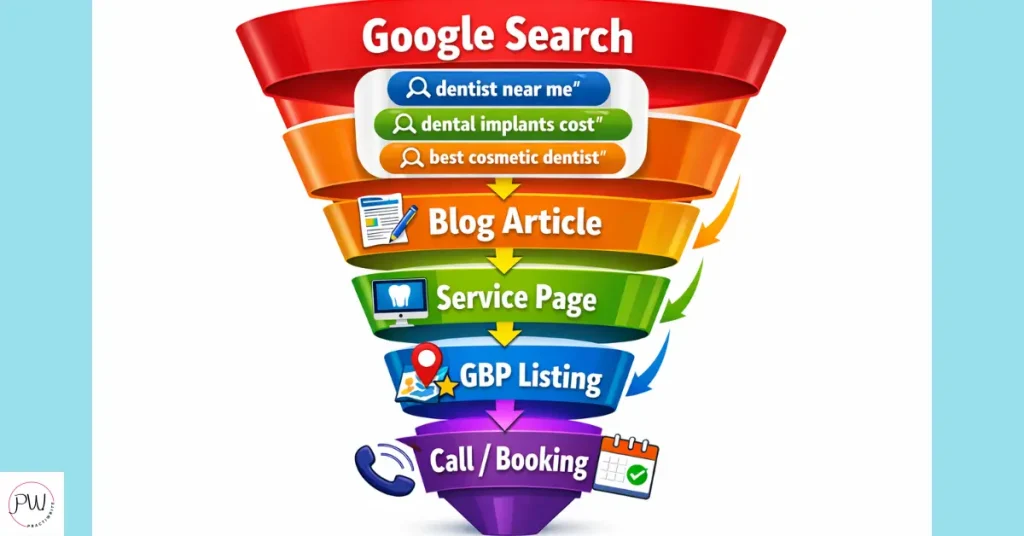
Prioritize Bottom-Funnel Content First
Not all content is created equal, and most practices get the priority order wrong.
Start with bottom-funnel content, the pages targeting patients who are ready to book. These are your service pages and location-specific content: “dental implants in [your city],” “Invisalign provider [your city],” “cosmetic dentist [your city].” This content has the shortest path to revenue.
Then build mid-funnel content that addresses specific concerns: “how much do dental implants cost,” “how long does Invisalign take,” “does dental bonding look natural.” These are the pages that catch patients in the research phase and move them toward a decision.
This is also where injecting your clinical point of view pays off. It builds trust in a way that generic content never will.
Top-funnel awareness content comes last. Blog posts about sensitive teeth and bleeding gums have their place, but they’re playing the long game. If your chairs need filling now, bottom-funnel content is where your investment goes first.
Practices following this prioritization system see a 3.8x higher conversion rate from their content compared to the “just publish blogs and hope” approach. That’s not a rounding error. That’s the difference between content that costs you money and content that makes it.
Link Strategically. Internal Links Are Free SEO Fuel
Every piece of content you publish should link to other relevant pages on your site. Your implant blog links to your implant service page. Your service page links to supporting articles. Everything connects.
Internal linking does two things: it helps Google understand the relationship between your pages (boosting your topical authority), and it keeps patients moving through your site instead of bouncing. Both lead to more conversions.
For external links, keep it to 3–4 per post. Link to high-authority sources that are relevant to the topic, such as the ADA, peer-reviewed research, and reputable dental organizations.
Never link to a competitor. And make sure your anchor text is descriptive.
“Click here” tells Google nothing. “Learn more about dental implant candidacy” tells Google exactly what that link is about.
Content Distribution: Stop Parking Your $150K Mercedes in the Garage
You just invested time, money, and expertise into a piece of content. Then you published it, posted it once on Facebook, and moved on with your life.
That’s the equivalent of buying a brand new Mercedes, driving it once, and letting it collect dust in the garage. Every piece of content you create is an asset. Treat it like one.
Every Piece of Content Needs a Distribution Plan Before It’s Published
Distribution isn’t an afterthought. It’s a deliverable.
For every piece of content I create for my clients, I include a distribution document that covers: the blog title, key themes pulled from the H2s, which channels to post on and how often, and platform-specific drafts ready to go for email, LinkedIn, Facebook, and YouTube. The content is written once. The mileage is multiplied.
If you’re publishing content without a distribution plan, you’re leaving 80% of its value on the table. Post and ghost doesn’t work. Never has.
Where FFS Practices Should (and Shouldn’t) Distribute Content
Not every platform deserves your time. For fee-for-service practices, focus where your ideal patients actually spend theirs.
Email is your most valuable distribution channel, period. An email list is an asset you own — no algorithm changes, no pay-to-play. Send practical tips with links back to your content. Build trust over time. Every email is a touchpoint that keeps your practice top of mind when they’re ready to book.
YouTube is where your patients get to see you before they meet you. Repurpose your blog content into short video scripts. Procedure explainers, FAQ walkthroughs, behind-the-scenes looks at your practice. A face builds trust faster than a paragraph ever will.
Facebook and LinkedIn work for longer-form posts with visuals. Before-and-after photos, patient success stories (with consent), and bite-sized takeaways from your blogs. Adapt the format to each platform. What works on LinkedIn doesn’t work on Facebook, and vice versa.
X/Twitter is best for quick insights, industry commentary, and linking back to your content. Good for reaching an older demographic and staying visible in dental industry conversations.
The point isn’t to be everywhere. It’s to be strategic about where you show up and consistent about how often.
Repurpose Ruthlessly. One Blog Should Become Ten Pieces of Content
A single 2,000-word blog post can become a YouTube script, an email series, four social posts, an infographic, a patient FAQ handout, and a Google Business Profile post. That’s not extra work. That’s extracting the full value of work you’ve already done.
Build a patient testimonial library while you’re at it. Video testimonials, written reviews, and before-and-after photos, all organized by service type so you can pull them into any piece of content at any time. Testimonials are the highest-trust content you can distribute, and most practices are sitting on a goldmine they never use.
Content creation is the expensive part. Distribution and repurposing is where the ROI multiplies.
Stop treating every platform like it needs its own original content. It doesn’t. It needs your best content, reformatted.
Measuring What Matters (And Ignoring What Doesn’t)
This is where I’m going to say something that puts me at odds with most SEO agencies: the majority of the metrics they report on are irrelevant to your bottom line.
Impressions. Engagement rates. Time on page. Social shares.
These look great in a monthly report. They look terrible when your chairs are half-empty and you’re wondering where the patients are.
The Only Number That Actually Pays Your Bills
New patient appointments attributed to content. That’s it. That’s the KPI.
If your content is driving patients to pick up the phone or book online, it’s working. If it’s not, it doesn’t matter how much traffic you’re getting or how many people “engaged” with your latest post. A blog with 200 monthly visitors that generates 10 appointment requests is infinitely more valuable than a blog with 5,000 visitors that generates zero.
Track the calls. Track the bookings. Track which pages those patients came from.
Everything else is noise.
Diagnostic Metrics: Check the Oil, Don’t Count It
That doesn’t mean you should ignore all other data. Rankings, organic traffic, and click-through rates are useful, but only as diagnostic tools, not success metrics.
Think of it like this: checking your oil level tells you if your engine needs attention. But you don’t measure the success of a road trip by how often you checked the dipstick. You measure it by whether you got where you were going.
If a page is ranking but not converting, the content might not match search intent. Fix it.
If a page has good content but isn’t ranking, you might have a technical issue or a keyword mismatch. Diagnose it.
If organic traffic is climbing but calls aren’t, you’re attracting the wrong audience. Reposition it.
These metrics tell you where to look when something’s off. They don’t tell you whether your content strategy is successful. Only revenue does that.
If Your Agency Reports Impressions While Your Chairs Are Empty, Fire Them
I’ll say it plainly: any agency sending you a report full of impression counts, follower growth, and “reach” metrics while your practice isn’t seeing new patients from their work is not doing their job. They’re doing their own job, justifying their retainer.
Content is a salesperson. If the salesperson isn’t making sales, you don’t celebrate how many business cards they handed out. You retrain them or you replace them.
The same standard applies to your content.
Review your pages quarterly. Which ones are driving appointments? Double down on those.
Which ones are underperforming? Re-optimize them. Confirm the search intent hasn’t changed, check that the metadata and internal links are still relevant, and make sure the content is still the best answer for that query.
If it’s not fixable, cut it.
Wrapping Up: Your Content Is Either Making You Money or It’s Not
Your content strategy doesn’t need to be complicated. It needs to be intentional.
Know your ideal patient. Build content pillars around the services that drive your revenue. Create content that matches search intent and speaks to the person holding the credit card, not the algorithm indexing the page.
Distribute that content strategically. And measure what actually matters: patients in chairs.
That’s the framework. It’s not glamorous. It doesn’t involve chasing trends or going viral or posting dancing reels.
It involves doing the work that compounds over time and turns your website into the most reliable patient acquisition channel your practice has.
For Fee-For-Service Practices: This Isn’t Optional
If you’ve transitioned away from PPOs (or you’re in the process), content isn’t a “nice to have.” It’s the replacement for the referral pipeline you just left behind.
Every month you operate without a strategic content system is another month of revenue walking into a competitor’s practice.
The practices that figure this out early build an advantage that compounds. The ones that don’t keep wondering why the phone isn’t ringing.
Ready to Stop Guessing and Start Engineering Your Patient Flow?
Practiwrite works exclusively with fee-for-service dental practices. We don’t do generic marketing. We don’t sell social media packages.
We build content systems that make your phone ring and your chairs fill using the exact framework laid out in this guide.
Book your free strategy session to get your Dental Practice Roadmap. This is a custom analysis of your Google Business Profile and where your content is leaving money on the table. So you know exactly what to fix first.

10+ year content strategist, writer, author, and SEO consultant. I work exclusively with fee-for-service dental practices that want to build value, not volume.