
Your dental practice website probably has SEO problems you can’t see.
Not the “you need more blog posts” kind.
The structural kind. The ones that silently prevent Google from ranking your site, no matter how good your content is.
Most practice owners assume that if they have a website, some service pages, and maybe a blog, their SEO is handled.
It’s not.
SEO for dental practices runs on four pillars: technical SEO, on-page SEO, off-page SEO, and content. Each one can independently tank your rankings. And most dental websites have problems in at least two of them.
Here’s what makes this expensive: the average lifetime value of a dental patient is $10,000–$15,000. If even one pillar is broken, your site isn’t showing up when those patients search. They’re booking with whoever does show up.
That’s not a visibility issue. That’s a revenue issue.
If you’re a fee-for-service practice, the stakes are even higher.
You’re not competing for the $99-cleaning crowd. You’re competing for patients willing to invest $5,000–$15,000 in implant cases, cosmetic work, and full-mouth rehabilitation. These patients do more research, evaluate more practices, and make decisions based on what they find online.
Every pillar failure costs you the highest-value cases.
Most dental SEO agencies focus on one or two pillars and ignore the rest. That’s like building a table with two legs and wondering why it keeps falling over.
This is how I audit every dental practice website that comes through my door, and here’s what I find wrong almost every time.
Table of Contents
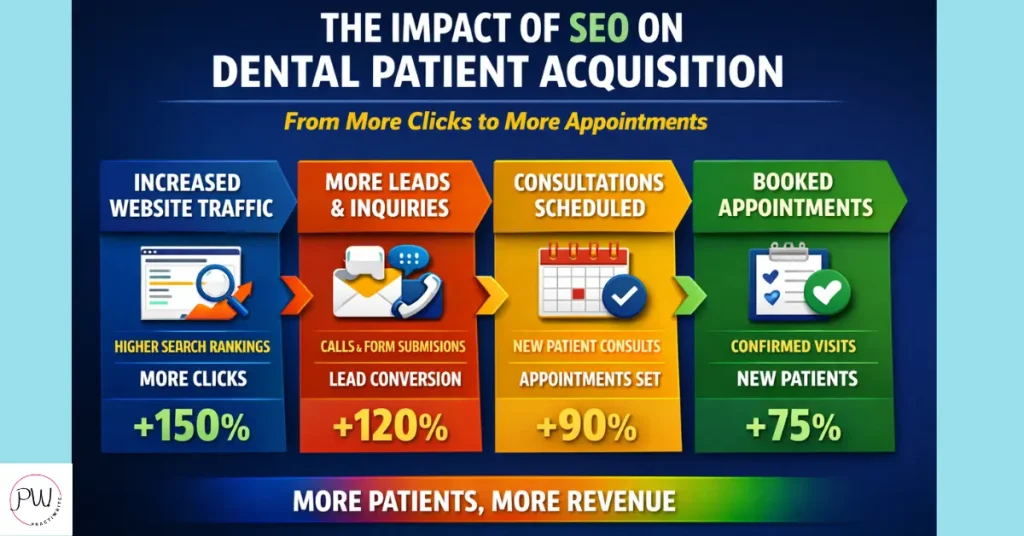
Technical SEO: The Foundation Your Website Is Probably Missing
Technical SEO is the “under the hood” work that determines whether Google can find, read, and rank your pages. It’s invisible to you when you look at your website. It’s not invisible to Google.
Why This Is the Pillar Most Dental Websites Fail First
Google can’t rank pages it can’t crawl, index, or understand. Full stop.
If your website has structural problems, like broken redirects, indexation errors, missing schema markup, or slow load times, it doesn’t matter how beautiful your site looks or how great your content is. You’re invisible where it counts.
Think of it this way: you wouldn’t spend $50,000 on a kitchen renovation in a house with a cracked foundation. But that’s exactly what practices do when they invest in content and design while ignoring the technical layer underneath.
Technical SEO is the pillar most dental practices skip, and the pillar most agencies skip for them.
It’s not flashy. It doesn’t make a good monthly report. But it’s the reason a lot of good websites don’t rank.
The Expensive Mistakes Hiding in Plain Sight
Here’s what I find when I audit dental practice websites:
Duplicate content: Multiple pages targeting the same keywords, cannibalizing each other instead of ranking. One practice I audited had three separate pages competing for “dental implants.” We merged them into one comprehensive page. Result: rankings jumped from page 3 to the top of page 1 in under a month.
Indexation issues: Service pages blocked by robots.txt. Location pages that Google doesn’t even know exist. Canonical tags pointing to the wrong URLs.
Speed problems: Uncompressed images, bloated plugins, and hosting that can’t keep up. If your site takes more than three seconds to load, you’re bleeding visitors before they see a single word.
Missing schema markup: Schema tells Google exactly what your practice is, where you’re located, what services you offer, and what patients think of you. Without it, you’re making Google guess. Google doesn’t like guessing.
Here’s the stat that should get your attention: after fixing technical issues alone on one client’s website, organic traffic increased by 117% in 28 days without creating a single piece of new content. That’s how much technical debt was holding them back.
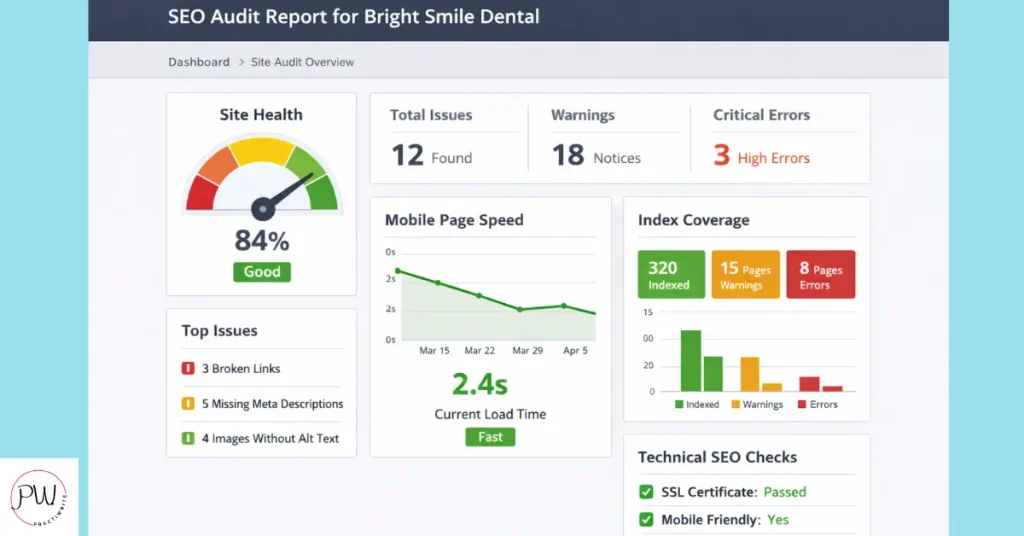
What a Proper Technical Audit Should Cover
A real technical SEO audit isn’t a free scan from an online tool. It covers
- Crawlability
- Indexation status
- Site architecture
- URL structure
- Redirect health
- Page speed
- Mobile responsiveness
- Schema implementation
- And canonical tag accuracy
It’s the diagnostic work that tells you exactly what’s broken and in what order to fix it.
My team performs a technical audit before we touch any content. It’s that important. If your current agency skipped this step, ask them why. And if they can’t give you a straight answer, that tells you everything you need to know.
On-Page SEO: Where Dental Practices Leave the Most Money on the Table
On-page SEO is the direct connection between what patients type into Google and whether your pages show up. It’s the pillar most dentists think they understand and consistently get wrong.
Your Service Pages Are Probably Doing Half Their Job
Most dental service pages have the right topic but the wrong optimization.
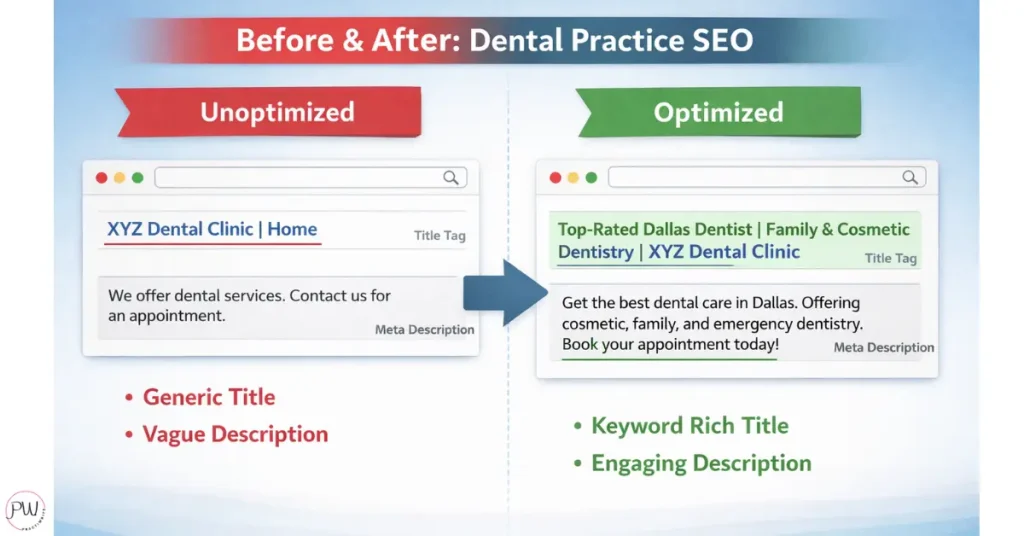
The page exists for dental implants, but the title tag doesn’t include the city name. The meta description is a generic sentence that could belong to any practice in any state. The content is 300 words of surface-level information that can’t compete with competitors writing 1,200+.
These aren’t minor issues. Title tags and meta descriptions are the first thing a potential patient sees in search results. If yours don’t include your target keyword and location, you’re handing clicks to whoever’s does.
When we rewrote the meta titles for a dental implant specialist (just the titles, nothing else) their click-through rate went from 4.2% to 8.7%. That doubled their implant consultation requests without changing a dollar of ad spend.
The On-Page Elements That Actually Move the Needle
Not every on-page element matters equally. Here’s where to focus:
Title tags with your target keyword and city. This is the single highest-impact on-page element.
Meta descriptions that drive clicks, not just describe the page. Write them like a headline, not a summary.
H1/H2 heading structure that matches search intent and helps Google understand your page hierarchy.
Internal links with descriptive anchor text connecting service pages to supporting content. “Learn more about dental implant candidacy” tells Google exactly what that link is about. “Click here” tells Google nothing.
Image alt text that describes what’s in the image, including location where relevant. This also improves accessibility.
Clear CTAs on every service page. If a patient reads your implant page and there’s no obvious next step to book a consultation, you’ve wasted the visit.
FFS Practices: Optimize for the Patient Doing Homework, Not the One Searching “Cheap Dentist”
On-page strategy for a fee-for-service practice looks fundamentally different than one chasing insurance patients. You’re optimizing for “dental implants in [city] not “affordable dentist near me.
Your content depth needs to reflect the research-driven behavior of patients making a $5,000–$15,000 decision. These patients read more, compare more, and scrutinize more before they pick up the phone.
That means your service pages need substance, not fluff.
Procedure details. Candidacy information. What to expect. Real answers to real concerns.
If your implant page is 400 words of marketing copy with a stock photo, you’re losing to the practice whose page actually helps the patient make a decision. I go deeper on keyword targeting strategy in my guide on winning content strategies for dental practices.
Off-Page SEO: Your Practice’s Reputation in Google’s Eyes
Off-page SEO is everything that happens outside your website that tells Google whether you’re trustworthy, authoritative, and relevant. For dental practices, this isn’t primarily about backlinks. It’s about local reputation signals.
Backlinks Matter Less Than Your Agency Wants You to Believe
I know this will make some SEO people uncomfortable, so let me be specific: for local dental SEO, citation consistency and review signals often outweigh traditional backlink building.
Agencies sell link-building packages because they’re scalable and easy to report on. For a dental practice serving a single metro area, your off-page priority should be:
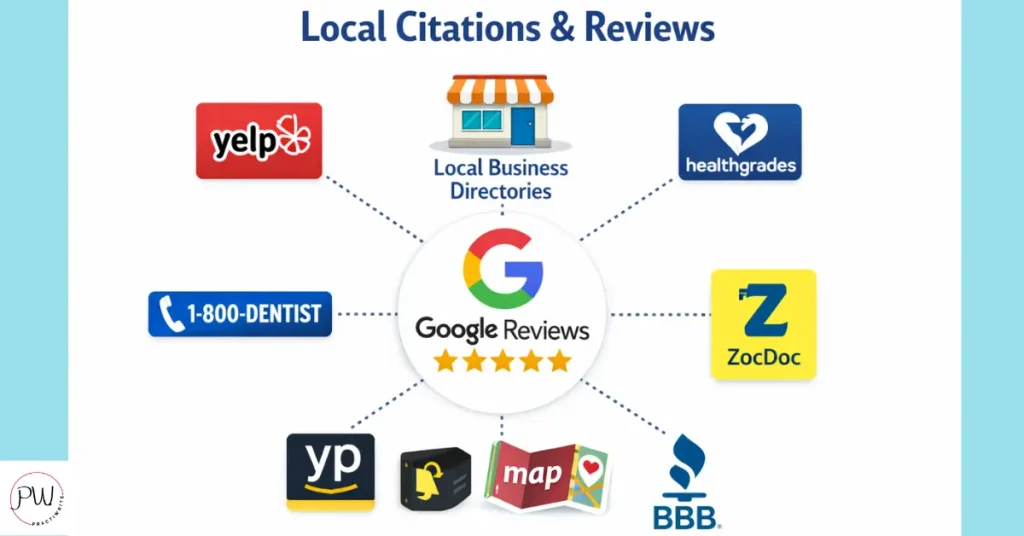
- NAP (Name, Address, Phone) consistency across every directory
- A systematic review acquisition strategy
- And local citations from dental directories and community organizations
Backlinks from relevant, authoritative sources help. But they’re not the magic bullet agencies present them as. And if your agency is reporting “we built 15 backlinks this month” while your Google Business Profile has inconsistent information across the web, they’re working on the wrong problem.
Reviews Are Off-Page SEO (And Most Practices Are Fumbling Them)
Patient reviews are one of the strongest local ranking signals Google uses. They’re also one of the most neglected.
Most practices either don’t ask for reviews systematically or don’t respond to the ones they get. Both are mistakes.
According to Bizrate’s research, 88% of consumers would use a business that replies to all of its reviews, compared to just 47% for businesses that don’t respond at all. That gap is massive, and it directly impacts whether a patient chooses you or the practice next door.
NAP consistency matters just as much. One of my clients had 14 different variations of their business name and address floating around online directories. After we standardized everything, their map pack visibility improved by 267% in 17 days.
No new content. No backlinks. Just fixing what was broken.
I cover the full review and local visibility playbook in my guide on Google Business Profile optimization for dental practices.
Content: The Pillar Everyone Thinks They’re Good At (They’re Not)
Content is the pillar that gets the most attention and the least strategic thinking. Every dental practice has some content on their website. Very few have content that’s actually driving patient acquisition.
Content Without the Other Three Pillars Is Just Expensive Digital Art
Here’s where the four pillars stop being separate categories and start being a system.
Great content on a technically broken site won’t rank. Perfectly optimized pages with thin content won’t convert. Content without off-page authority signals won’t get found.
The pillars work together or they don’t work at all.
Most agencies sell content as if it operates independently. It doesn’t.
If you’re investing in blog posts while your site has indexation issues and your Google Business Profile has inconsistent NAP data, you’re pouring water into a bucket with holes. Fix the bucket first.
What Dental Content Should Actually Look Like in 2026
Service pages of 1,200+ words that comprehensively cover the procedure, candidacy, process, cost considerations, and next steps. A pillar/cluster architecture that builds topical authority around your highest-revenue services.
Bottom-funnel content first (the pages targeting patients ready to book) before you invest in awareness-level blogs about flossing tips.
The differentiator for your practice? Your clinical perspective. Generic content written by a freelancer who’s never been inside a dental office will never compete with content that incorporates your actual expertise, your approach to treatment, and your experience with real patients.
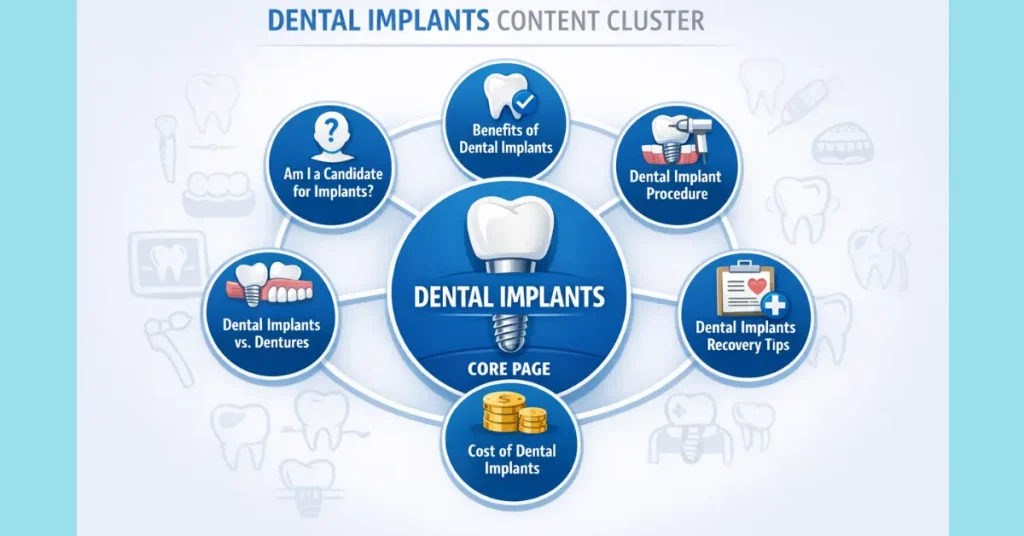
One of my clients ranked for 217 additional keywords within 90 days of implementing a strategic content system, generating 43 new patient appointment requests directly from that content. I’ve written the complete framework for building a dental content strategy in my content strategy guide for dental practices. If you’re going to read one guide on this topic, make it that one.
The Fifth Dimension in SEO For Dental Practices: AI Search Is Rewriting the Rules Right Now
The four pillars of SEO have been the framework for two decades. But there’s a fifth dimension emerging that most dental practices (and most dental SEO agencies) haven’t caught up to yet.
ChatGPT Usage for Local Recommendations Jumped From 6% to 45% in One Year
That’s not a typo. According to BrightLocal’s 2026 Consumer Review Survey, AI tools like ChatGPT are now the third most popular source for local business recommendations, behind only Google and word-of-mouth. In a single year, consumer behavior shifted from “novelty” to “mainstream.”
Google’s own AI Overviews are now pulling content directly into search results and answering patient questions before they click on any website. If your content isn’t structured for AI extraction, you’re invisible to a rapidly growing segment of searchers.
This isn’t a future trend. It’s happening now. And the practices that optimize for it today will have a compounding advantage over those that wait.
How to Make Your Content LLM-Ready (Without Losing Your Mind)
The good news: content optimized for AI is also better content for humans and for traditional Google rankings. The same principles apply — clear factual assertions, question-format headings, well-structured hierarchies, descriptive anchor text, FAQ schema markup, and original data points that give AI tools something specific to cite.
The practices that will dominate both traditional and AI search are the ones creating authoritative, well-structured, entity-rich content right now. I cover the full AI search optimization framework in my guide on GEO for dentists.
Wrapping Up: Which Pillar Is Leaking Revenue From Your Practice?
The practices that win aren’t doing more.
They’re fixing what’s broken first.
You don’t need more content. You don’t need more backlinks. You don’t need a new website.
You need to know which pillar is the weakest link and fix that first.
One fix in the right place can unlock the value of everything else you’ve already built.
A technical repair that lets Google finally crawl your implant pages.
A metadata rewrite that doubles your click-through rate.
A NAP cleanup that gets you back in the map pack.
These aren’t massive overhauls. They’re targeted fixes that produce outsized results.
If you’re a fee-for-service practice, every month operating with a broken SEO foundation is another month of high-value patients finding your competitor instead of you.
The practices that figure this out early build an advantage that compounds. The ones that don’t keep wondering why the phone isn’t ringing.
Get Your Dental Practice Roadmap
Practiwrite audits all four pillars for dental practices and delivers a prioritized roadmap (including an audit of your GBP) showing exactly what’s broken, what’s costing you patients, and what to fix first.
No guesswork. No generic recommendations. A custom analysis built for your practice, your market, and your goals.
Book your free strategy session to get your Dental Practice Roadmap and stop guessing.
Start with the data.

10+ year content strategist, writer, author, and SEO consultant. I work exclusively with fee-for-service dental practices that want to build value, not volume.