
Most dental practices are publishing content right now.
Blog posts. Service pages. “Why choose us” copy.
All of it telling Google and potential patients exactly what kind of practice they are.
The problem? For fee-for-service practices, that message is almost always pointed in the wrong direction.
The content most practices create was built for one type of patient. The patient who is shopping by insurance network.
The patient who searches “dentist that takes [insurance name].”
The patient who picks a provider based on in-network status, not clinical skill.
If your practice has moved away from PPOs (or is working toward it) that kind of content is not neutral. It is actively working against you.
This is not a post about writing better blogs.
It is about content strategy for fee-for-service dental practices. Specifically, why the content most practices produce cannot attract the patient who is willing to pay your full fee, trust your expertise, and become a high-lifetime-value case.
And it’s about what you do instead.
Table of Contents
Practiwrite, 2025
Content Strategy For Fee-For-Service Dental Practices: The Problem Most Don’t Know They Have
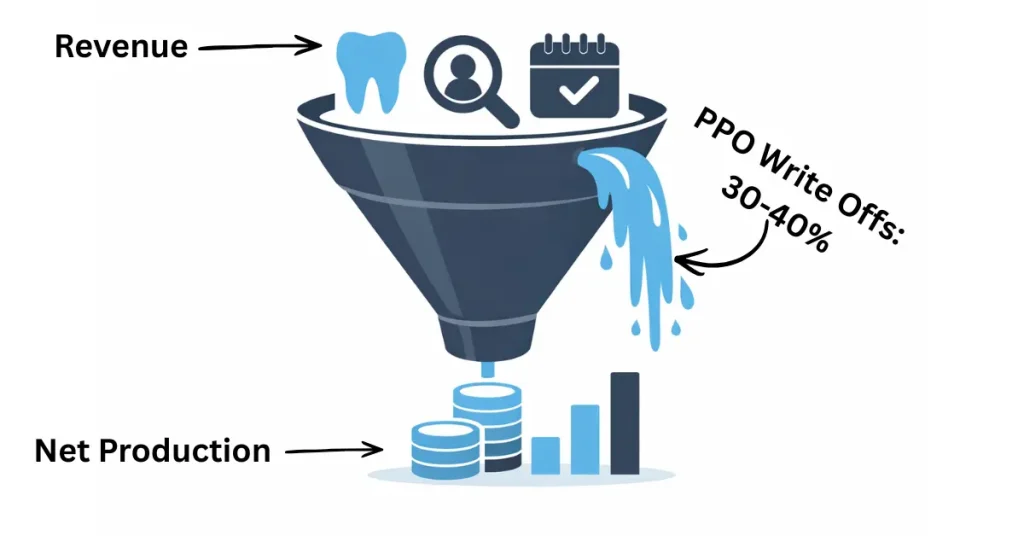
That last stat should make your ears perk up and your wallet clinch. 30-40% of revenue lost to PPO write-offs. That’s insane!
That number represents real money walking out the door. Your marketing should be helping you stop the bleeding, not sending the insurance-driven patient straight to your front desk.
Your Content Is Working, Just Not for the Patient You Want
Here is what almost every dental practice does. They optimize content around broad procedure terms. “Teeth whitening.” “Dental implants near me.” “Family dentist in [city].”
These are real keywords. People search them. And some practices rank for them.
But the person typing those searches is almost always an insurance-first patient.
They’re comparing prices. Checking networks. Looking for the lowest out-of-pocket cost.
That is not your patient. Not if you’re running a fee-for-service practice.
The problem isn’t that your content is bad. The problem is that it was built for someone else.
And until you fix that, you will keep attracting the wrong patients.
The Dollar Cost of Talking to the Wrong Person
Think about what it costs to get a new patient through your door. The ADA Health Policy Institute reported in Q3 2025 that dental practices are in a “fiscal squeeze”; rising overhead, rising costs, and flat insurance reimbursements.
In that environment, every dollar you spend marketing matters. A new patient who comes in expecting your PPO rate when you no longer accept it, is not a win. It is a waste of your time and theirs.
Your content should be choosing patients before they ever pick up the phone.
48% of patients research a dentist for over two weeks before booking an appointment.
Science Direct Research, 2025
Two weeks. That means your content has two full weeks to either build trust with the right patient or quietly send the wrong one somewhere else.
The Self-Pay Patient Has a Different Search Brain
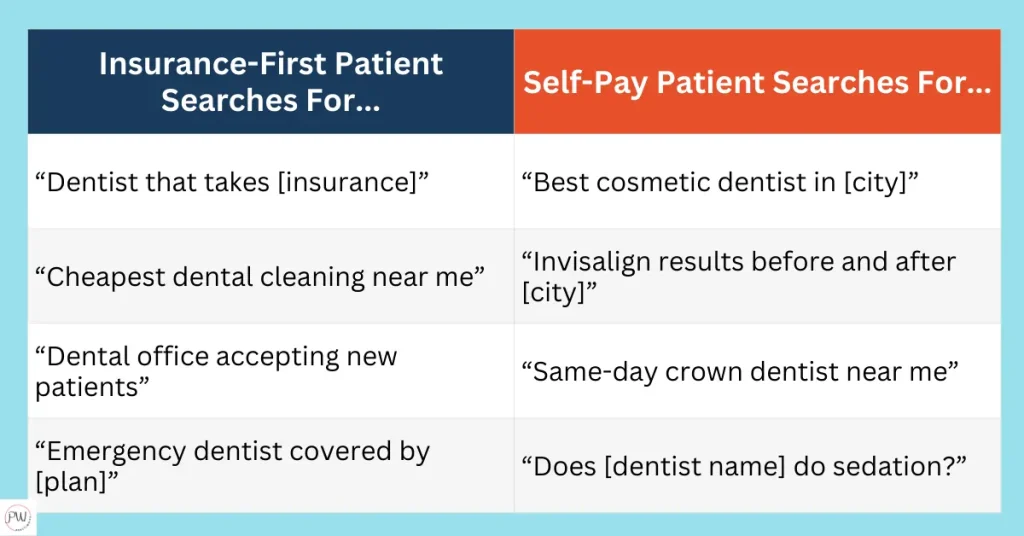
The insurance-first patient and the self-pay patient do not search the internet the same way.
They use different words. They ask different questions. They read different things before making a decision.
Understanding that gap is the foundation of FFS content strategy.
They Evaluate Differently Before They Call
The self-pay patient is making a trust decision. Not a coverage decision.
When someone is paying $1,200 out of pocket for a crown, they read more. They dig deeper. They look at your photos, read your reviews, and study your content before they ever pick up the phone.
They want to know: Do you really know what you’re doing? Do you explain things clearly? Are you the kind of practice I can trust with a big investment?
That research behavior creates an enormous opportunity. If your content answers those questions well, you will own the decision before the call even happens.
67% of dental patients would travel further to receive their preferred care.
National Library of Medicine
Read that again. Two-thirds of patients will drive past other dentists to get to the one they want. Your content is what makes them want you.
The Biggest Content Mistake FFS Practices Make
They fully transition their practice model. They drop the PPOs. They retrain the team.
And then they leave the same content on their website that they had when they were accepting every plan in town.
That content is sending signals to Google that you are a different kind of practice than you actually are. And it’s attracting a patient type who will be surprised (and often upset) when they learn you don’t take their insurance.
Your content has to catch up to your practice.
Four Content Types That Work for Fee-for-Service Practices
Not all content performs the same way for FFS patient acquisition. Here are the four types that consistently attract the right patient.
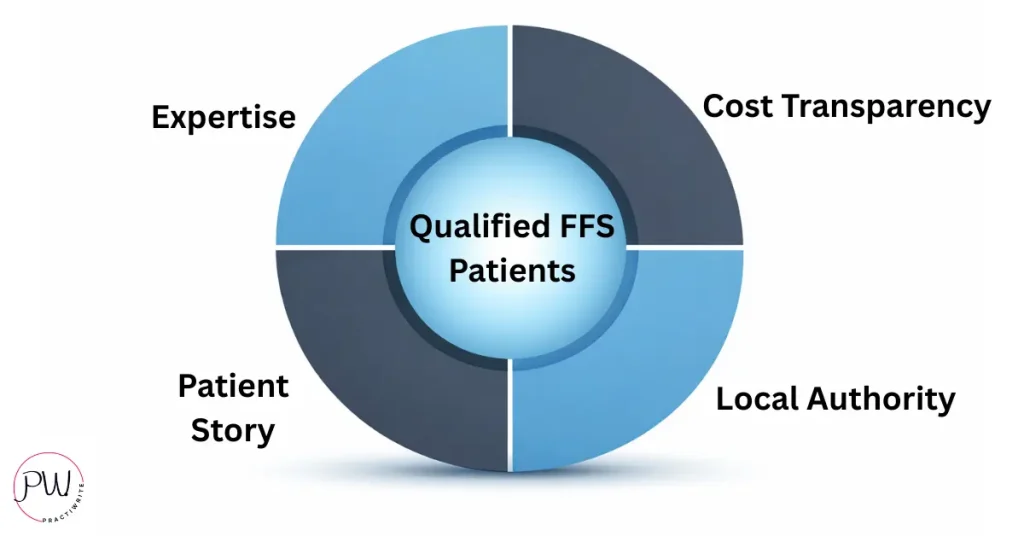
1. The Expertise Demonstration Post
The self-pay patient is hiring based on expertise. Not convenience. Not price.
A post that goes deep on a clinical topic (explained in plain language) signals authority in a way that a “services overview” page cannot.
The goal is not to show off. The goal is to demonstrate that you know your craft at a level the patient can feel.
Example angles that work well:
- “What Most Dentists Won’t Tell You About Same-Day Crowns”
- “Why We Turned Down This Patient for Veneers (And What We Did Instead)”
- “The Implant Consultation Questions We Get Wrong”
These titles create curiosity. They also show a level of honesty and expertise that the self-pay patient is specifically looking for.
2. The Cost and Value Transparency Post
The number one objection from a self-pay patient is cost. But it is not really about cost.
It is about value. They want to know what they are getting for their money. Why your fee is what it is. What the difference is between a practice that charges $800 and one that charges $1,500 for the same procedure.
A post that addresses this directly with honesty and detail removes the biggest barrier to the consultation call.
This type of post also ranks for searches that have very high buyer intent. Searches like “how much do dental implants cost without insurance” or “why is cosmetic dentistry so expensive.”
Those searchers are ready to spend money. They just need to know why your practice is worth it.
3. The Patient Decision Story
This is not a testimonial. Testimonials say “I love this practice.” Patient decision stories say “Here is how I chose this practice and why I am glad I did.”
A well-written patient story walks through:
- What the patient was worried about before they came in
- What made them decide to move forward without insurance
- What the experience was like
- What changed for them after treatment
This content format is SEO-friendly. It targets search phrases like “is fee-for-service dentistry worth it” and “should I go to an out-of-network dentist.”
And it does something no service page can do. It makes the self-pay patient see themselves in someone else’s decision.
4. The Local Authority Post
Hyper-local content builds two things at once. Trust with your community. And dominance in local search.
Most dental practices write generic location pages. “We are a dental practice in [city]. We offer cleanings, fillings, and crowns.” That copy could be copy-pasted from any practice in the country.
A true local authority post connects your expertise to your specific community. It answers the question: “Why is THIS practice the right choice for a patient in THIS city?”
When combined with your Google Business Profile, this type of content creates compounding local search visibility.
Your GBP drives awareness. Your website content drives trust.
Together, they close the decision.
Why E-E-A-T Hits FFS Practices Harder Than Anyone Else
E-E-A-T stands for Expertise, Experience, Authoritativeness, and Trustworthiness. It is the framework Google uses to decide which content deserves to rank.
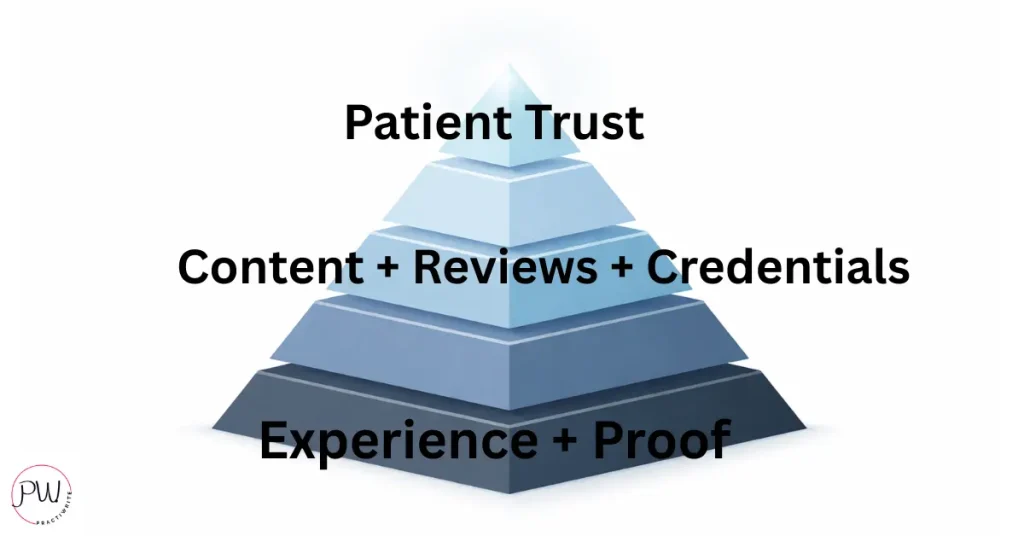
Google’s Trust Framework Is Built for Exactly Your Patient
The concept matters for every business. But for fee-for-service dental practices, it matters more.
Here is why.
When a patient is relying on insurance to decide, trust is almost automatic. The insurance company already vetted you. You are “in network.” That is enough.
When a patient is paying out of pocket, they do their own vetting. And your content is where that vetting happens.
Every Word You Publish Is Part of the Trust Decision
A self-pay patient reads your content differently than an insurance-first patient. They are not just looking for information. They are looking for signals.
Is this dentist honest? Do they know their stuff? Do they explain things clearly? Can I trust them with my money?
Weak content kills the conversion before it starts. Thin, generic service pages make your practice look like every other office on the block. Expert-authored, specific, honest content makes you look like the obvious choice.
77% of patients use search engines before booking an appointment.
Dental Practice Reporter, 2026
Those 71% are reading your content and forming an opinion. Give them something worth reading.
How to Build E-E-A-T in Every Piece You Publish
You do not need a PhD to demonstrate expertise. You need to show that you have been in the room.
Share your clinical approach. Explain why you do things a certain way. Show real outcomes.
Use your patient stories (with permission, of course) to prove you have actually solved the problems your future patients are worried about.
That is E-E-A-T in action. And it is exactly what the self-pay patient is looking for before they book.
The SEO Reality for FFS Practices in 2026
Here is a fact most dental marketing agencies will not tell you:
You Are Competing in an Uncrowded Space
The keyword landscape for FFS-specific searches is dramatically less competitive than general dental SEO.
Every practice in your market is fighting for “dentist near me.” That fight is brutal. Big budgets. Corporate chains. Well-established practices with years of backlinks.
But fee-for-service-specific keywords? The searches that a self-pay patient actually types? Those are largely uncontested.
Searches like “how to find a fee-for-service dentist,” “out-of-network dental care in [city],” or “cosmetic dentist who doesn’t accept insurance” are wide open. And the person typing them is your exact buyer.
AI Search Is Changing the Rules in Your Favor
Google’s AI Overviews and platforms like ChatGPT are changing how patients find providers. And for practices with strong, expert-level content, this change is a massive opportunity.
AI search surfaces authoritative, specific content. It prefers clear answers from trusted sources. A thin, keyword-stuffed service page cannot compete in that environment.
But deep, honest, well-written content on FFS-specific topics? That is exactly what AI systems are looking for.
And right now, almost no dental practice is producing it.
Brands cited in AI Overviews earn 35% more organic clicks than those that are not.
Dataslayer, November 2025
Being the recognized expert in your content niche doesn’t just help you rank. It gets you cited. And in the AI search era, being cited is the new ranking.
Local Search Is Still the Most Valuable Real Estate
Here is one more fact worth holding onto. According to Ahrefs research from 2025, only 7.9% of local searches trigger an AI Overview.
That means local search (i.e., the kind your patients use to find a dentist) still works the old way.
The Google Map Pack. The local results. The Google Business Profile.
These still drive real phone calls.
Your content strategy and your local search strategy should work together.
Great content builds authority. Authority improves your local visibility. Local visibility drives calls from real patients in your market who are actively looking for a provider.
That is the full system. And FFS practices that build it now are going to be very hard to compete with in three years.
What Good FFS Content Looks Like: Before and After
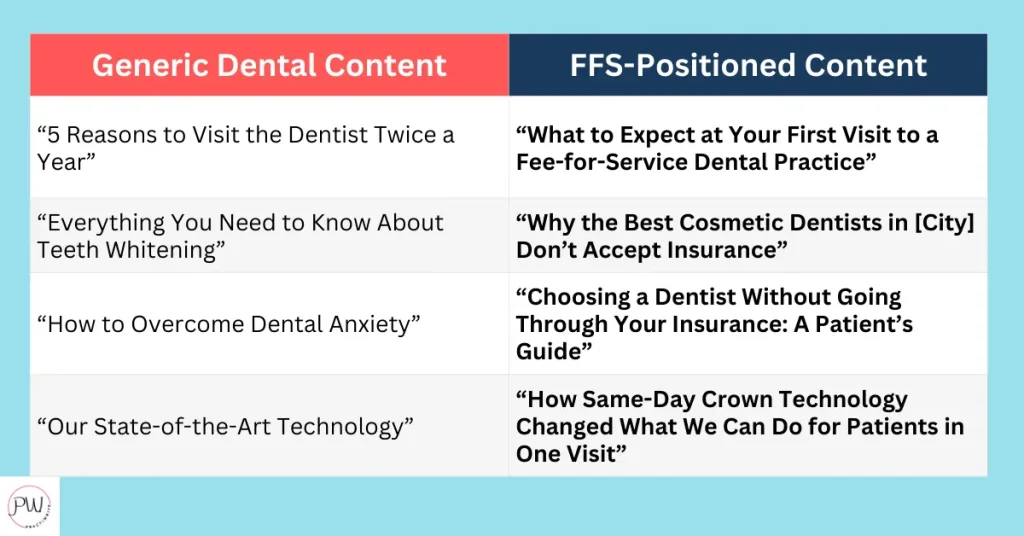
The content angle you choose determines the patient you attract. Here is what that looks like in practice.
The Same Topic. A Very Different Patient.
Every Title Tells Google What You Are
Look at the “before” column. Those are fine topics. Any dental practice could use them.
That is exactly the problem.
The “after” titles signal something different. They say: this practice understands a specific type of patient, a specific set of concerns, and a specific reason someone would choose to pay out of pocket. That signal attracts a different searcher. And a very different phone call.
The patient who clicks on “Choosing a Dentist Without Going Through Your Insurance” is already mentally prepared for the FFS conversation. You’ve done half the work before they even get there.
How to Know If Your Content Is Actually Working for FFS Patient Acquisition
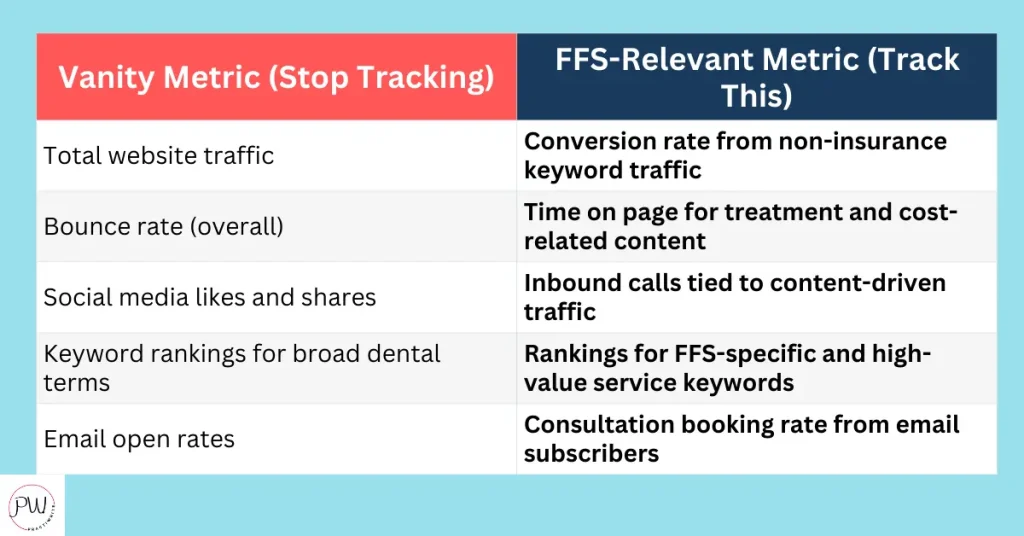
Most practices measure content performance with vanity metrics.
Total traffic. Page views. Social media likes.
Those numbers feel good. They don’t pay the bills.
Stop Measuring the Wrong Things
For a fee-for-service practice, the metrics that matter are different. You’re not trying to attract everyone. You are trying to attract the right patient. That means your performance indicators need to match your patient type.
The Metric That Tells You Everything
Track this: what percentage of your new patient inquiries come from patients who already understand that you do not accept insurance?
If your content is doing its job, that number should be high. Very high.
A patient who calls already knowing you are fee-for-service is a qualified lead.
They have self-selected.
They have done their research.
They are not going to be surprised by your fees.
If you are constantly having to explain your model on the phone, your content is not doing its job. Fix the content, and you fix the conversation.
Wrapping Up: Your Content Should Work Before the Phone Rings
Most dental practices treat their website like a digital brochure. A place to list services and hours.
Fee-for-service practices cannot afford to do that.
Your content is the first thing a self-pay patient sees. It is where they decide whether to trust you. Whether you are worth the investment. Whether your practice is the kind of place they want to spend their money.
The practices that understand this and build their content strategy around it, are building a patient acquisition advantage that gets stronger every month.
That patient exists. They are in your market right now. They are searching, reading, and making decisions based on what they find online.
The only question is whether they find you.
Your content strategy is the answer to that question. Build it for the patient you want. And the patient you want will find you.
If you’re not sure whether your current content is built for the right patient, the answer is almost certainly no.
We audit dental practice content as part of your Dental Practice Roadmap and what we find is consistently the same problem this post describes.
Book your strategy session to get your Dental Practice Roadmap. You’ll get an audit of your website content and your Google Business Profile.
So you can stop guessing if your content is working.

10+ year content strategist, writer, author, and SEO consultant. I work exclusively with fee-for-service dental practices that want to build value, not volume.