
You’re about to hand a marketing agency real money, and you’ve got your list of questions ready:
- Pricing
- Contracts
- References
- What the reporting looks like
Somebody told you those were the smart things to ask, so you’re asking them.
Here’s the problem. Those are the same questions every dentist asks, and a slick, well-run agency will sail through all of them and still be completely wrong for you.
The standard questions to ask a dental marketing agency test whether an agency is good. They don’t test whether it’s built for a fee-for-service practice, and for you, that’s the only thing that matters.
Think about it this way. A competent volume agency is more dangerous to your practice than an incompetent one.
The incompetent one wastes your money slowly.
The competent one efficiently fills your schedule with exactly the wrong patients, the price-shoppers who flinch at your fees and never accept treatment.
Both leave you worse off. Only one of them looks great on the monthly report while doing it.
So the questions that actually protect you aren’t about polish. They’re about fit.
The right ones cut straight to whether an agency markets for patient count or for case value, and they expose the answer fast, usually in the first ten minutes of the call.
I’ll give you those questions, grouped by what they reveal, with the green-flag answers worth trusting and the red-flag answers that should end the conversation.
Ask these before you sign, not six wasted months after.
Table of Contents
Why Don’t The Standard Questions To Ask A Dental Marketing Agency Work For FFS Practices?
They don’t work because they test general competence instead of model fit, and a volume-built agency can ace every generic question while being structurally wrong for a practice that runs on case value. Pricing, references, and reporting all measure whether an agency can do the work. None of them measure whether the work it does fits how you make money.
That gap is the whole issue. A fee-for-service practice profits from case value, not case count, so an agency built to maximize patient count is solving the wrong equation with real skill.
(The full mechanism behind why this happens is its own subject, and I break it down in why most dental marketing agencies fail fee-for-service practices.)
The questions below don’t re-argue that. They give you the tools to test for it on a live call.
So why do we keep vetting agencies like we’re buying a commodity, when the one thing that decides your return is whether they fit your model?
The rest of this post fixes that. Each section is a cluster of questions, and each question comes with the answer that should reassure you and the answer that should worry you.

Does This Agency Actually Understand The Fee-For-Service Model?
An agency’s real grasp of your model shows up in seconds, in how it talks about patients, volume, and value. If it treats every practice the same, it doesn’t understand yours.
This is the most important cluster, because an agency that misreads your model here will misread everything downstream. If an agency can’t tell you what makes your practice different, how would it ever market to that difference?
How Many Fee-For-Service Practices Do You Work With Right Now?
This question reveals whether the agency has real fee-for-service experience or is about to practice on you. Experience with volume practices does not transfer cleanly, because the strategy runs in the opposite direction.
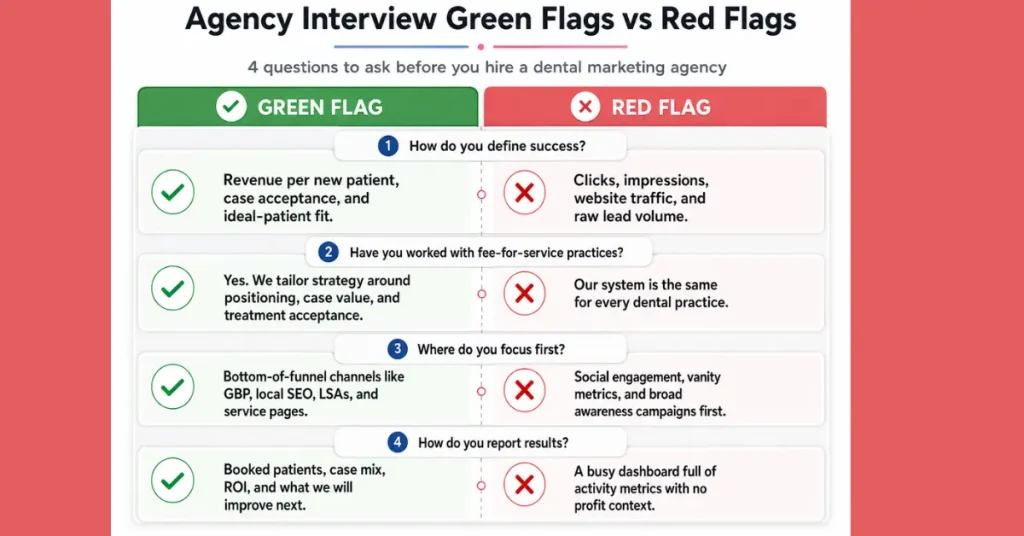
Green flag: They can name current FFS clients and offer to connect you with one.
Red flag: They say dentistry is dentistry, or every client they mention is insurance-driven and volume-based.
What’s Different About Marketing An FFS Practice Versus A PPO Practice?
Their answer tells you whether they understand the core difference between the two models or only the surface. This is a fast way to separate genuine specialists from generalists reading a script.
Green flag: They lead with patient quality, positioning, and case value, not just more of everything.
Red flag: They describe doing the same things faster or cheaper, or they can’t name a real difference.
Who’s Your Ideal Client, And Am I Actually It?
An agency that tries to serve everyone owns one system, and it probably wasn’t built for you. A clear ideal client is a sign of focus, and focus is what you’re buying.
Green flag: A specific, FFS-shaped answer that sounds a lot like your practice.
Red flag: Everyone, or a description that’s really a high-volume, insurance-driven practice.
Will They Market For The Right Patients, Or Just More Patients?
The goal of fee-for-service marketing is to sort for value-ready patients, not to maximize headcount, so the right agency talks about who it attracts, not just how many. Would you rather an agency that brings you a hundred of the wrong patients, or ten of the right ones? Their answers to these three questions tell you which one you’re about to hire.
How Do You Attract High-Value Patients Instead Of Price-Shoppers?
This separates agencies that understand patient sort from agencies that just chase reach. Attracting more people is easy. Attracting the right people on purpose is the actual skill.
Green flag: Positioning, messaging, and targeting designed to filter for value-ready patients.
Red flag: Reach, impressions, and volume tactics, with no mention of who those patients actually are.
What’s Your Position On Discounts, Coupons, And New-Patient Specials?
How an agency feels about discounting tells you whether it will protect or erode your premium brand. Every discount you advertise teaches your market that you compete on price, which is the opposite of what a fee-for-service practice sells.
Green flag: Cautious about discounts for a premium practice, and uses them sparingly if at all.
Red flag: Discounts and new-patient specials are the default growth lever.
If You Took My Practice On, How Would You Position It?
Their instinctive positioning is a live preview of the patients they’ll attract. You don’t need a finished strategy on the call, but the direction of their first answer is revealing.
Green flag: A value-first angle built on quality, expertise, and outcomes.
Red flag: Affordable, convenient, and we take your insurance.
How Does This Agency Define And Measure Success?
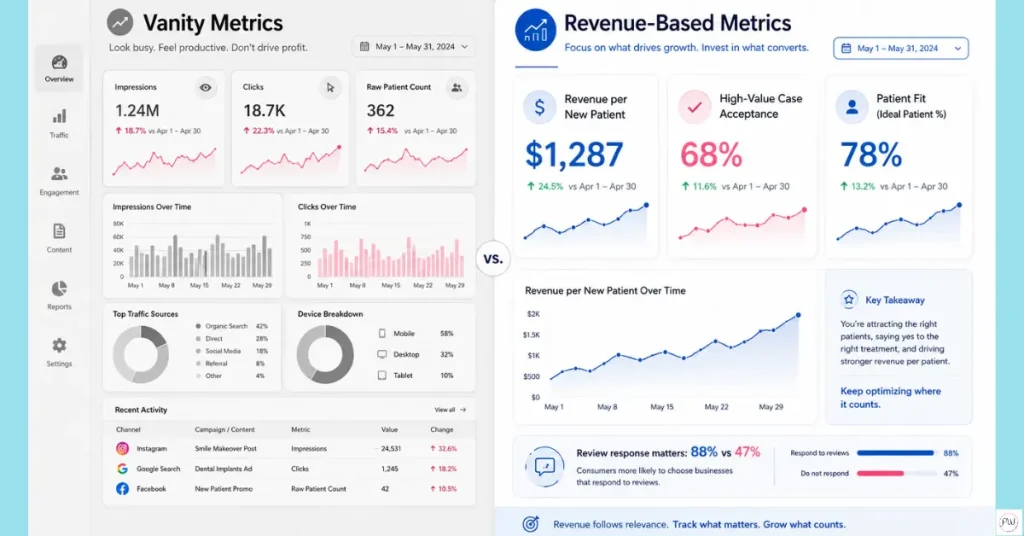
An aligned agency measures case value and patient quality, while a volume agency measures activity, so their metrics quietly reveal what they’re really optimizing for. If a report never mentions a dollar, what is it actually measuring? Ask these before you get dazzled by a dashboard.
What Exactly Will You Report On Every Month?
Their default metrics tell you what they’ll spend your money chasing. A team that leads with impressions is a team that will optimize for impressions.
Green flag: Revenue per new patient, high-value case acceptance, and patient fit.
Red flag: Impressions, clicks, and raw call or new-patient counts, with no revenue in sight.
How Do You Connect Your Work To My Actual Revenue?
This question exposes whether an agency ties its work to your profit or hides behind a busy dashboard. Activity is easy to show. Impact is what you’re paying for.
Green flag: A real method for linking their work to revenue and case value.
Red flag: A shrug, or a wall of numbers that never reaches dollars.
What GBP And Website Fundamentals Will You Own?
The fundamentals that drive patient quality are exactly the ones most agencies skip, so a strong one should be able to name how it handles them. Review response is a perfect test, because it’s cheap, it’s public, and it moves patient decisions.
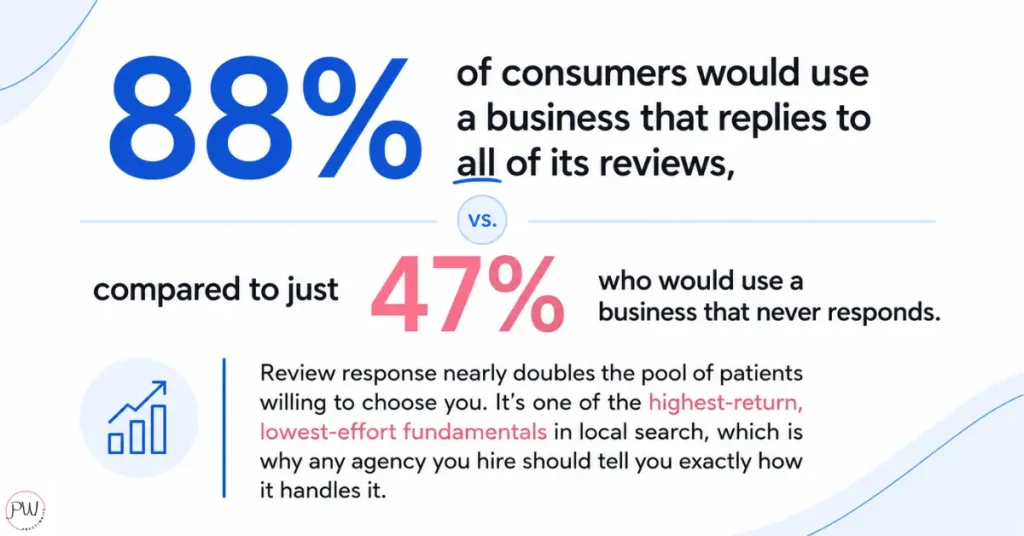
Here’s why that question separates the good from the generic. In my own analysis of 2,000 dental Google Business Profiles across all 50 states, a large share of practices never respond to reviews at all, including practices with strong ratings and plenty of reviews.
The money is sitting right there, unclaimed, and most agencies walk past it because they’re counting calls, not managing trust. A good agency will name review response, profile completeness, and website conversion basics without you prompting.
Green flag: Specific ownership of GBP completeness, review response, and website conversion fundamentals.
Red flag: A vague promise to handle your online presence, with no specifics.
What’s The Real Strategy, And Who Actually Does The Work?
A strong agency can describe a specific plan for your first 90 days and tell you exactly who executes it, while a weak one hides behind packages and buzzwords. Why would you buy a strategy nobody in the room can describe? These questions force specifics.
Walk Me Through My First 90 Days. What Happens?
A specific plan proves they’ve thought about your practice. A generic one proves they haven’t. You’re listening for sequence and priorities, not a sales script.
Green flag: A sequenced, concrete plan with clear priorities and timelines.
Red flag: Vague packages, buzzwords, and it depends.
Where Do You Actually Specialize?
Honest focus beats a promise to do everything, because nobody does everything well. An agency that names its strength is telling you the truth about its limits, which is a good sign.
Green flag: A clear area of strength, whether that’s local search, GBP, website, or ads, stated plainly.
Red flag: We do it all, with no real depth anywhere.
Who Does The Work, And Is Any Of It Outsourced?
You’re paying for execution, so you deserve to know whose hands it’s actually in. Outsourcing isn’t automatically bad, but hiding it is.
Green flag: Transparency about the team and about any outsourcing.
Red flag: Dodging the question, or vague answers about our process.
Who Owns Your Website, GBP, And Data When It’s Over?
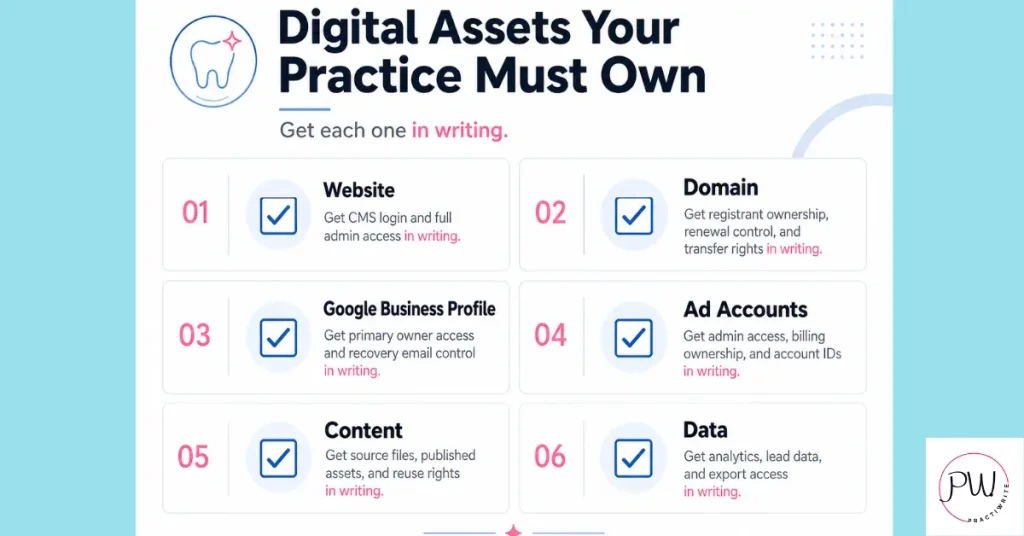
Ownership and exit terms decide whether you keep your digital assets when the relationship ends, and vague answers here are how practices get held hostage. What good is great marketing if you don’t own a single thing it builds? Settle this before you sign, never after.
Do I Own My Website, Domain, GBP, And Ad Accounts?
If you don’t own your assets, you don’t control your practice’s future, you rent it. This is the single most overlooked question in agency contracts, and the most expensive to get wrong.
Green flag: Yes, you own everything, and it’s spelled out in writing.
Red flag: We manage all of that for you, with no ownership clause you can point to.
How Do You Handle HIPAA And Access To My Systems?
A dental agency that hasn’t thought about HIPAA is a liability, not a partner. Marketing touches patient information more often than people assume, so this cannot be an afterthought.
Green flag: A clear acknowledgment and a defined process for access and compliance.
Red flag: A blank stare, or that’s not really our department.
What’s The Contract Length, And What Happens If We Part Ways?
The exit terms matter more than the onboarding pitch, because they decide what you walk away with. A confident agency earns your stay. It doesn’t trap it.
Green flag: A reasonable term and a clean handover of your assets.
Red flag: Long lock-ins and a fuzzy or punitive offboarding process.
What Questions Should I Ask A Dental Marketing Agency Before Hiring Them?
Before hiring a dental marketing agency, a practice should ask questions that test model fit rather than general competence. The most revealing questions cover the agency’s experience with fee-for-service practices, how it attracts high-value patients rather than price-shoppers, which metrics it reports, who executes the work, and who owns the website, Google Business Profile, and data if the relationship ends. Standard questions about pricing and references confirm competence but do not confirm that the agency is built for a fee-for-service model.
How Do I Know If A Dental Marketing Agency Is Right For A Fee-For-Service Practice?
A dental marketing agency is a good fit for a fee-for-service practice when it measures success by case value and patient quality rather than raw patient volume. Signs of alignment include real fee-for-service clients, positioning built on quality rather than discounts, reporting focused on revenue per new patient and high-value case acceptance, and a clear plan for managing Google Business Profile fundamentals. An agency that treats every practice the same, defaults to discounts, or reports only vanity metrics is usually built for volume practices instead.
Should I Hire A Dental Marketing Agency That Specializes In Dentistry?
Specializing in dentistry helps, but alignment with the practice’s business model matters more than dental experience alone. Many dental marketing agencies specialize in high-volume, insurance-driven practices, and that experience does not transfer cleanly to a fee-for-service practice, which requires marketing designed to attract fewer, higher-value patients. The more important question is whether the agency’s strategy, metrics, and incentives are built around case value rather than patient count.
Do I Own My Website And Google Business Profile If I Hire A Marketing Agency?
Ownership depends entirely on the contract, so it must be confirmed in writing before signing. A practice should retain ownership of its website, domain, Google Business Profile, advertising accounts, content, and performance data. Some agencies retain control of these assets, which can leave a practice unable to take its digital presence elsewhere if the relationship ends. Clear ownership and a defined handover process protect the practice’s long-term interests.
What Are The Biggest Red Flags When Interviewing A Dental Marketing Agency?
The biggest red flags are an agency that treats all practices the same, defaults to discounts and new-patient specials, reports only vanity metrics such as impressions and clicks, cannot describe a specific plan or name who does the work, and avoids clear answers about asset ownership and exit terms. Individually, any one of these can be a conversation. Together, they signal an agency built for patient volume rather than case value, which is a structural mismatch for a fee-for-service practice.
Wrapping Up: Hire For Fit, Not For Polish
Hiring an agency was never about finding the most impressive one. It was about finding the one built for how you actually make money. The questions above are how you tell the difference in a single call, before you sign, instead of learning it the expensive way six months in.
The most polished agency in the room can still be the most wrong for your practice, so why hire for polish?
You don’t have to take my word that fit beats polish. You can watch it happen.
The fastest way to see what a fee-for-service-aligned approach actually looks like is to let one diagnose your practice before it ever pitches you.
Schedule your 100% free Dental Practice Roadmap. It’s a diagnosis, not a sales pitch.
Your Dental Practice Roadmap is a GBP and website audit that shows you exactly where you stand, what keywords you’re ranking for now, what you should be ranking for, and a step-by-step plan to close those gaps.
No vague recommendations. No fluff. Just a clear picture of what’s broken and what to do about it.
Book your Dental Practice Roadmap and get yours today now.

10+ year content strategist, writer, author, and SEO consultant. I work exclusively with fee-for-service dental practices that want to build value, not volume.