
Pull up your dental practice website.
Count the blog posts. Count the service pages. Count the resources section, the dental tips archive, the team announcements dressed up as content.
Now ask yourself one honest question: how many of those pages produced a single phone call from a patient you actually wanted to see?
Most practice managers I work with go quiet at that question. Not because they don’t know the answer.
Because they do.
They’ve been publishing. Consistently, faithfully, exactly like the agency told them to.
And the phone does ring. It rings with patients asking if they take Delta Dental. It rings with people asking about payment plans for a cleaning.
The content has been working. Just not for the right patients.
Here’s what nobody tells FFS dental practices about content: for a PPO office, mediocre and scattered content is expensive but survivable. The insurance directory is upstream doing the qualification work. Patients arrive pre-screened.
For a fee-for-service practice, that safety net does not exist. Your website content is your only patient acquisition filter. Every word on it either attracts the patient who is ready to invest in their health, or it invites someone into your calendar who was never going to say yes to your fee schedule.
The FFS dental practice content audit I run for practices is not the same audit I would run for a PPO practice.
The questions are different. The stakes are different. The standard for what stays and what goes is entirely different.
What if the reason your consult calendar is full of patients who balk at your fees isn’t your pricing? What if it’s your content?
A dental practice content audit for a fee-for-service practice isn’t spring cleaning. It’s a positioning decision. And for most FFS practices, it’s the most important one they haven’t made yet.
Table of Contents
PPO Content and FFS Content Are Not the Same Thing And Pretending They Are Is Costing You
This is the argument that everything else in this post rests on. If you don’t accept this premise, the audit framework that follows won’t land with the weight it deserves. So let’s establish it clearly.
Let’s also consider the fact that FFS patients, the patients you’re trying to reach, don’t have the luxury of insurance directories to rely on to find your practice. More than 77% of dental patients use search to find providers.
What PPO Content Is Designed to Do
PPO content is built for volume. Its job is to attract as many local searchers as possible, regardless of their financial profile, and funnel them toward a practice that participates in their insurance network.
The signals are deliberate and consistent:
- “affordable”
- “we accept most insurance”
- “flexible payment plans”
- “gentle care”
- Broad service category pages
- FAQ content about coverage and copays
This content works for a PPO practice because the financial qualification already happened inside the insurance directory. By the time a patient lands on the page, price sensitivity has been pre-screened as acceptable. The page’s only job is to not lose them.
That content is neutral to actively harmful for an FFS practice.
Your site is the qualification mechanism. There is no directory doing that work upstream. Every piece of content you publish is either attracting your ideal patient or wasting your consultation calendar on someone who was never going to say yes.
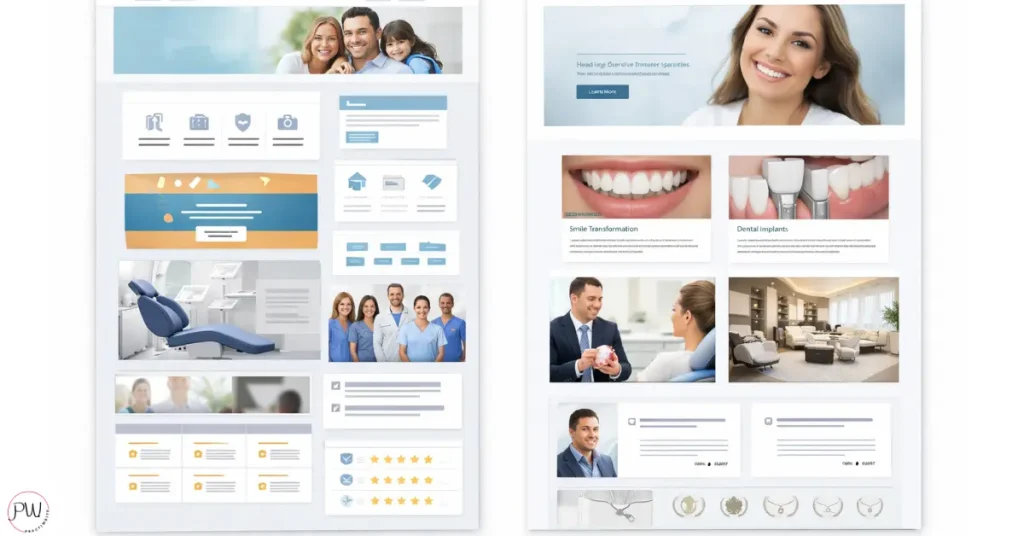
What FFS Content Is Actually Designed to Do
FFS content has one job above all others: identify and attract a patient who has already decided to invest in their oral health and is now evaluating which practice deserves that investment.
That patient isn’t searching for “affordable dentist near me.” They’re searching for:
- “best cosmetic dentist in [city]”
- “dental implant specialist [city]”
- “how long do veneers last”
- “what to expect from full-mouth reconstruction”
They arrive at your site with more knowledge than a casual patient, a sharper filter for vagueness, and zero patience for generic copy that could belong to any practice in any ZIP code.
FFS content meets that patient at the moment they are qualifying practices, and it signals, through specificity, clinical authority, and outcome-first language, that your practice is the answer they’ve been looking for.
The function of FFS content is not to reach the most people. It is to reach the right people and efficiently disqualify everyone else. That is a fundamentally different design goal than PPO content, and it requires a fundamentally different audit standard.
The Dangerous Middle Ground Most FFS Practices Are Living In
Most FFS and transitioning practices are not publishing purely one type of content or the other. They’re publishing a mixture of both.
Some content is FFS-positioned. Some is PPO-adjacent. And a significant portion is completely generic (i.e., dental tips, team announcements, seasonal posts) that serves neither buyer.
This mixture is the most damaging state to be in. It sends a contradictory signal to Google about who you serve. It sends a contradictory signal to prospective patients about what kind of practice you are. And it dilutes the topical authority you need to rank for the specific, high-value queries your ideal patient is actually searching.
“A practice trying to speak to every patient type through their content ends up owning none of them. The audit cleans up that contradiction.“
Nicole Kolesar, Founder & CEO of Practiwrite
How Google Reads Your Content And Why the FFS Standard Is Higher
Before you can make smart audit decisions, you need to understand how Google actually evaluates your content. Not in theory. In the specific way that affects an FFS practice’s ability to rank for the searches that drive high-value patient acquisition.
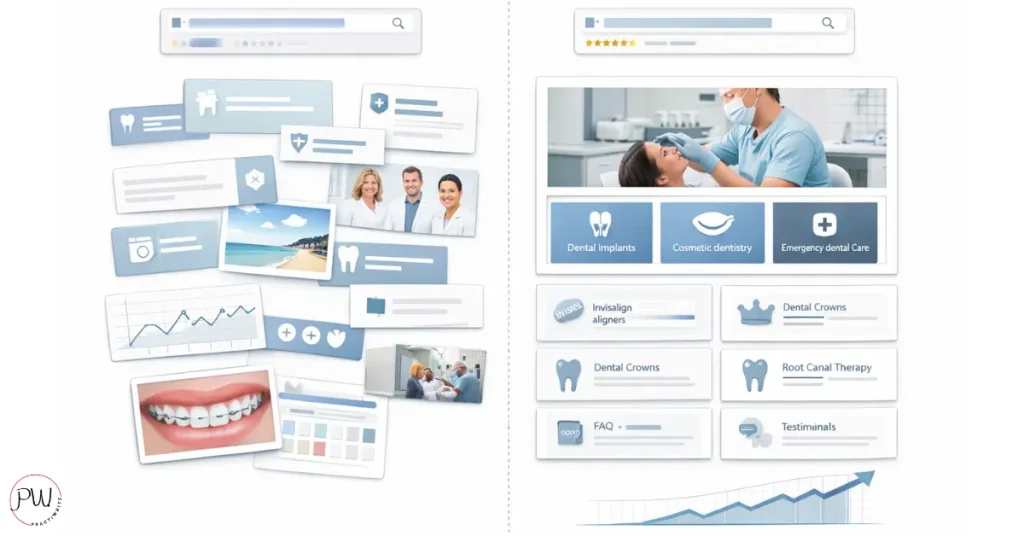
Topical Authority Is Built Through Depth, Not Volume
Google evaluates your site’s authority on a topic based on how deeply and consistently your content covers that topic. A site with ten tightly focused, substantive posts on dental implants for out-of-pocket patients will outrank a site with fifty scattered posts covering implants, insurance tips, team news, oral hygiene basics, and holiday hours.
Every. Single. Time.
Topical authority tells Google: this is the site to recommend when someone searches within this specific domain. For an FFS practice, that domain is quality-focused, out-of-pocket dental care. Every post that lives outside that domain dilutes the signal.
The FFS standard is higher because the keywords worth ranking for, the high-intent, quality-seeking, transactional queries, are more competitive. Winning them requires a cleaner topical signal than most practices currently have.
What Thin and Misdirected Content Costs You in Search
Google’s Helpful Content guidelines measure one thing above all: was this content created to genuinely help a real searcher, or was it created to chase rankings?
Thin posts, under 600 words with no substantive depth, drag down the authority of the entire domain. Not just the individual page. The whole site.
Pages that exist but generate zero organic traffic, zero impressions, and have been live for six months or more are not neutral. They are adding crawl burden and pulling authority away from the pages that actually matter.
For an FFS practice, there is a second layer of cost: every piece of misdirected content is a page Google could be crawling and weighting for your high-value service queries instead. Opportunity cost in search is real, even when it’s invisible.
The Positioning Signal Your Entire Site Sends to Google
Google reads the aggregate of your site to understand who you are and who you serve. If your site has posts about maximizing dental insurance benefits sitting next to a cosmetic dentistry service page positioned for out-of-pocket buyers, Google sees a contradictory identity. Contradictory identities rank for nothing cleanly.
An FFS practice that has cleaned up its content, focused and topically coherent around quality care for out-of-pocket patients, sends a coherent identity signal.
Google rewards coherence with authority. Authority drives rankings. Rankings drive calls from the right patients.
This is why the FFS content audit isn’t optional maintenance. It’s the prerequisite for everything else in your digital marketing to work properly.
Before You Delete Anything, Pull Your Data First
The emotional impulse when you realize your content is working against you is to start deleting immediately. Resist that.
Gut decisions made without data produce inconsistent results and a spreadsheet full of exceptions that never get resolved. Pull the data first. Then decide.

The Tools You Need (And Already Have Access To)
Google Search Console is the most reliable source of truth for organic performance. It shows impressions, clicks, average position, and the exact queries triggering each page. It is free, native, and dramatically underused by most practices.
Google Analytics 4 shows page-level traffic, session duration, and whether visitors take any action after landing.
A simple spreadsheet pulls it all together: one row per URL, with columns for page type, publish date, 90-day organic clicks, impressions, average position, backlinks (yes or no), and a notes column for audit decisions. That’s it.
You don’t need expensive SEO tools to run a functional content audit. The data you need already exists. The only requirement is the discipline to look at it honestly.
The first time I ran a full audit for an FFS practice in transition, the data was uncomfortable. Not because it was complicated. Because it made the problem impossible to ignore.
The Five Data Points That Matter — With the FFS Filter Applied
Organic clicks in the last 90 days: Is this page bringing anyone in from search? Zero clicks for six months is a verdict, not a warning.
Average position: Position 21 and above is functionally invisible. If a page is not showing on page one, it is not contributing to patient acquisition.
Query data: This is where the FFS filter enters. What are people actually searching to find this page? If the queries are insurance-related, cost-comparison-driven, or general dental health curiosity searches, this page is attracting the wrong audience, even if it has traffic.
Time on page and bounce behavior: Patients landing on the right content stay and read. Patients landing on content that doesn’t match their intent leave immediately. High bounce rates on a page that supposedly targets FFS patients is a signal the content isn’t speaking their language.
Backlinks: Any page with external sites linking to it must be handled carefully regardless of performance. Deleting a backlinked page without a redirect is a permanent authority loss that no amount of new content recovers.
Set Your Evaluation Window Before You Start
New content needs 90 to 180 days to accumulate ranking signals. Do not kill a post that is six weeks old.
For pages older than six months with zero organic clicks and zero impressions: Google has evaluated this page and passed on it. That’s a clear signal, not a slow start.
Establish your evaluation criteria before you open a single page. Consistency in the audit matters. And whatever you do, do not change the criteria halfway through because a post you like is underperforming.
The FFS Three-Category Sort: Keep, Rewrite, or Kill
Here is where the work gets concrete. Every page on your site goes into one of three categories.
The difference between an FFS audit and a standard audit is that every decision has two layers: the standard performance test, and the FFS positioning test. You cannot evaluate one without the other.

Category One: Keep and Optimize (But Only If It Passes Both Tests)
Standard test: The page has measurable organic traffic, ranks in positions 1 through 20 for a relevant keyword, has backlinks, or demonstrably drives appointment requests.
FFS test: The queries driving traffic to this page are the kind an out-of-pocket, quality-seeking patient would actually search. A page getting clicks from insurance-related queries or cost-comparison searches passes the data test and fails the FFS test.
For an FFS practice, that page belongs in Rewrite, not Keep. Traffic from the wrong patient is not a success metric.
Keep and Optimize means:
- Refresh outdated statistics
- Strengthen internal links to related high-value service pages
- Sharpen the CTA toward your FFS offer
- And scan for any PPO-coded language that needs replacing
We had a practice with a dental implants FAQ post ranking in position 14 for a solid local keyword. We refreshed the stats, added two supporting sections, tightened the CTA, and removed the insurance-adjacent language that had crept in.
Six weeks later it was in position four. That page went from invisible to one of their top three patient-acquisition pages without writing a single new post.
Category Two: Rewrite (When the Topic Is Right but the Positioning Is Wrong)
Standard test: The topic is strategically valuable. It targets a query your ideal patients are actually searching. But the execution is wrong. Content is thin, the intent doesn’t match, the CTA is absent or generic, or the language is PPO-coded for an FFS audience.
FFS test: This is where the Rewrite category expands significantly. A page with decent traffic written for an insurance-sensitive buyer is not a success. It is a misdirected success.
For a transitioning practice, content written during the PPO years that is now attracting the wrong patient type belongs in Rewrite, even if the traffic numbers look acceptable on the surface.
Rewrite means: Start from a new content brief using the same URL. The URL preserves any residual domain signal. The content is rebuilt from scratch with the FFS patient’s decision framework as the filter from the first sentence forward.
The test for Rewrite vs. Kill is straightforward: If you were starting fresh today, would you choose this topic for your FFS-positioned practice? If yes, rewrite it for the right buyer. If the topic itself is wrong for your practice model, kill it.
Category Three: Kill (No Traffic, No Fit, No Future)
Standard test: The page has been live for more than six months, has zero organic traffic, zero impressions, no backlinks, and no realistic path to relevance for any search query your ideal patient would use.
FFS test: Even pages with some traffic qualify for Kill if they are irretrievably PPO-coded and not worth rebuilding. Posts about insurance maximization, finding in-network dentists, affordable care options, and generic dental health tips that compete with WebMD and lose aren’t just weak performers. They’re active signals that your practice is calibrated for a different kind of patient.
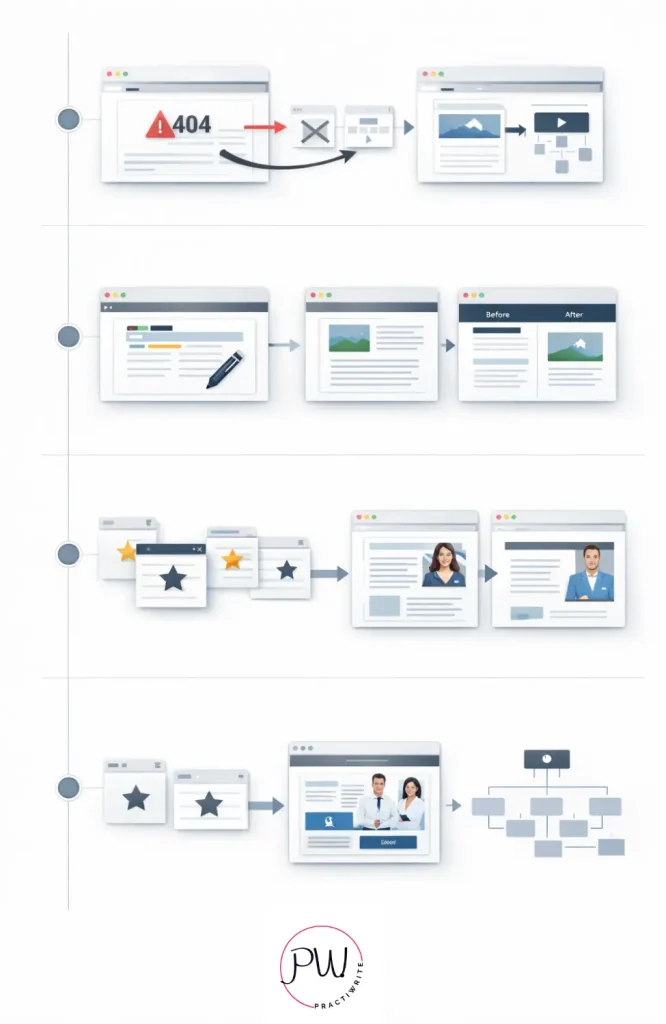
Kill means: Delete the page and implement a 301 redirect from the deleted URL to the most topically relevant live page on the site. Never delete without redirecting.
A client of mine had an Invisalign service page that was getting good traffic, but was attracting PPO patients she didn’t want. After I rewrote the page so it would attract the FFS patients she wanted (and implemented a 301 redirect for the old service page), her site started getting more traffic for Invisalign FFS patients. Her calls and service bookings jumped 34%.
A 404 error from a deleted page is not just a technical nuisance. It’s a trust signal failure for both Google and any patient who saved or shared that link. A 301 redirect is a ten-minute implementation that preserves every link signal that page has accumulated.
The reluctance to delete content because of the time it took to produce is the single most common reason FFS practices stay stuck with websites that produce the wrong patients. Sunk cost is not a content strategy.
The FFS Content Gap: What Your Audit Reveals Is Missing
The three-category sort tells you what to do with what exists. But the most valuable output of the audit is what it reveals about what doesn’t exist yet. Once you’ve cleared the noise, the gaps become obvious.

The Most Valuable Output of the Audit Is the Gap List
After completing the three-category sort, look at your highest-revenue services and procedures. For each one, ask a single question: do I have bottom-funnel, FFS-positioned content targeting the transactional query a ready-to-book patient would actually search?
If your top revenue driver is dental implants and your only implant content just landed in the Kill category, your audit has identified your single most important content gap.
The gap list is not a wish list. It is a revenue map. The pages that don’t exist yet are the ones currently sending patients to your competitors.
FFS Content That Most Practices Are Missing
Service-plus-location pages targeting transactional, quality-seeking queries: “cosmetic dentist [city],” “dental implant specialist [city],” “full-mouth reconstruction [city].” These are bottom-funnel pages. They belong at the top of the gap list for every FFS practice, and they are almost always the first category that’s missing entirely.
Outcome-and-investment content: “how much do dental implants cost,” “are veneers worth the investment,” “how long do dental implants last.” These mid-funnel pages serve the FFS buyer who has accepted the investment but is still evaluating where to commit it. They are the pages that convert a searcher who is close but not yet ready into a patient who books a consultation.
FFS-specific positioning content: “what is fee-for-service dentistry,” “why choose a fee-for-service dentist,” “what to expect from a dentist who doesn’t accept insurance.” These pages do the explicit qualification work and actively attract patients who are seeking an FFS practice.
Most practices have none of these. Yet they are the clearest signal to Google and to your ideal patient that you know exactly who you serve.
Most practices have the reverse of what they need: plenty of top-funnel curiosity content and almost nothing at the bottom of the funnel where patients actually book. The audit makes that imbalance visible and impossible to rationalize.
Prioritizing the Gap List by Revenue Potential
Not all content gaps are equal. Prioritize by production revenue: the service that generates the most revenue per case gets its content gap addressed first. Always.
Within each service, build bottom-funnel first, the transactional location-specific page, then mid-funnel cost and comparison content, then top-funnel symptom and awareness content only after the first two are live and indexed. This is the sequence. The practices that skip to top-funnel content because it’s easier to write are the practices that get traffic without getting calls.
Run the cleanup and the new content buildout in sequence, not simultaneously. Complete the Kill and Rewrite actions first. Then build new content into a cleaner, more coherent site architecture.
New content performs better when it lands on a site with a clear topical identity.
The 90-Day FFS Dental Practice Content Audit: A Practical Timeline
You now have a spreadsheet full of decisions. Here is what to do with it, in the order that produces results.
Sequence Is as Important as Speed
Do not start publishing new FFS content before the cleanup is complete. New content landing on a topically noisy site gets a weaker authority signal than the same content landing on a clean, coherent site.
The sequence is:
- Kill and redirect first
- Rewrites second
- New gap content third
In that order, every time.
Deleting and redirecting underperforming and misdirected content improves the site’s topical authority signal within two to four weeks of Google’s next crawl. That improvement benefits every remaining page before a single new word is written. It is definitively the highest-leverage action you can take in the first two weeks.
Weeks 1 Through 2: The Cleanup
Implement all Kill decisions. Set up 301 redirects from every deleted URL to the most topically relevant live page.
As a general rule: deleted blog posts redirect to the most relevant service page or to the blog index. Deleted service pages redirect to the closest related service.
Submit an updated sitemap to Google Search Console immediately after completing redirects. Note every Rewrite-category page in the spreadsheet with a target publish date.
Do not start rewrites during this phase. The cleanup takes priority and the two tasks interfere with each other when run at the same time.
Weeks 3 Through 6: The Rewrites
Execute rewrites starting with the highest-traffic pages in the Keep and Optimize category first, then the highest-revenue-relevance pages in the Rewrite category. Apply the FFS content brief to every rewrite: outcome-first headline, FFS-buyer-coded language throughout, contextual clinical authority, process clarity, outcome-specific social proof, direct cost framing, single CTA.
Do not publish a rewrite until it fully passes the FFS positioning test. A half-rewritten page with residual PPO language is worse than the original because it sends a split signal to both Google and the reader. Every word on the rewritten page should serve the out-of-pocket, quality-seeking buyer.
Weeks 7 Through 12: The New Content Build
Begin publishing new content targeting identified FFS content gaps, starting with bottom-funnel, transactional, location-specific service pages first. One well-built bottom-funnel page per week is a sustainable pace for most practices. Do not sacrifice depth for frequency. A thin page published quickly does less work than a comprehensive page published on a reasonable timeline.
The goal by week twelve: every high-revenue service has at least one fully optimized, FFS-positioned, bottom-funnel page live and indexed. Mid-funnel content follows in months two and three of the ongoing buildout.
This timeline assumes a practice with 30 to 60 pages of existing content. Larger sites with 100-plus pages need a longer cleanup window. Scale the timeline to the site.
Do not skip phases to reach new content faster. That shortcut costs you the foundation the new content needs to perform.
Wrapping Up: Every Page on Your Site Is a Vote for the Kind of Practice You Are
Google reads the aggregate of your site to understand who you are and who you serve. Every page that doesn’t belong, PPO-coded content, generic dental tips, team announcements, thin posts ranking for nothing, is a vote for a practice identity that isn’t yours anymore. Or was never yours to begin with.
For an FFS practice, the cost of that misaligned identity is not just lower rankings. It is a patient acquisition funnel that pulls in the wrong patients, fills your consultation calendar with people who aren’t a fit, and burns your team’s time on cases that don’t convert.
The audit fixes the foundation. Your GBP, your Local Service Ads, your new content: all of it performs better on a site with a coherent FFS identity than on a site that has been trying to speak to everyone for years.
The Audit Is Not a One-Time Event
Run a full content audit every six months. New posts age into underperformers. Strong pages need refreshing as the competitive landscape shifts.
The queries your ideal patients use change as the market evolves. Practices that audit consistently never face the problem of a bloated, misdirected site because they catch the drift before it costs them rankings, before it costs them positioning, and before it costs them the patients they spent real money trying to attract.
We built the Practiwrite content system around one rule: nothing stays on the site because it took effort to create. Everything stays because it serves the FFS patient we’re trying to reach. That standard is what separates a website that compounds its authority over time from one that silently decays into irrelevance.
Every month you delay the audit, your competitors with cleaner, more coherent, FFS-positioned sites are collecting the patients who should be calling you.
Schedule your free Dental Practice Roadmap. Your Dental Practice Roadmap is a GBP and website audit that shows you exactly where you stand, what keywords you’re ranking for now, what you should be ranking for, and a step-by-step plan to close those gaps.
No vague recommendations. No fluff.
Just a clear picture of what’s broken and what to do about it.
Book your Dental Practice Roadmap and get yours free.

10+ year content strategist, writer, author, and SEO consultant. I work exclusively with fee-for-service dental practices that want to build value, not volume.