
Most FFS dental practices are optimizing their content for the wrong patient.
They’re writing service pages and blog posts that answer questions insurance-shoppers ask.
They’re targeting keywords that attract people who want to know which plans you accept, what your copay looks like, and whether you’re in-network with their employer’s dental plan.
That’s not your patient.
Your patient doesn’t care about any of that.
They care whether you’re the best option in your area for the care they need.
They care whether they can trust you with their mouth and their money.
They’re doing research before they ever pick up the phone, and they’re reading everything they can find about you.
Herein lies the problem. Most fee-for-service practices don’t know what those patients are actually typing into Google.
So they create content that sounds good, checks a few keyword boxes, and then sits on a website wondering why it doesn’t convert.
What fee-for-service dental patients are searching for is fundamentally different from what a PPO patient is searching for. That difference isn’t subtle. It changes the keywords you target, the questions you answer, the tone you use, and the content types you prioritize.
Every single piece of content on your website should be built with that distinction in mind.
It’s not. For most FFS practices, it’s not even close.
This post breaks down exactly what your ideal patients are searching for, why it’s different, and what your content needs to do to actually show up when they’re looking.
Table of Contents
Why Fee-for-Service Dental Patients Search Differently Than PPO Patients
Let’s start with the core difference, because if you don’t get this right, the rest of your content strategy is built on a cracked foundation.
According to Dental Practice Reporter, more than 75% of patients research providers online before booking an appointment. They’re not walking in cold. They’re vetting you first.
Your content either earns that trust or it doesn’t.
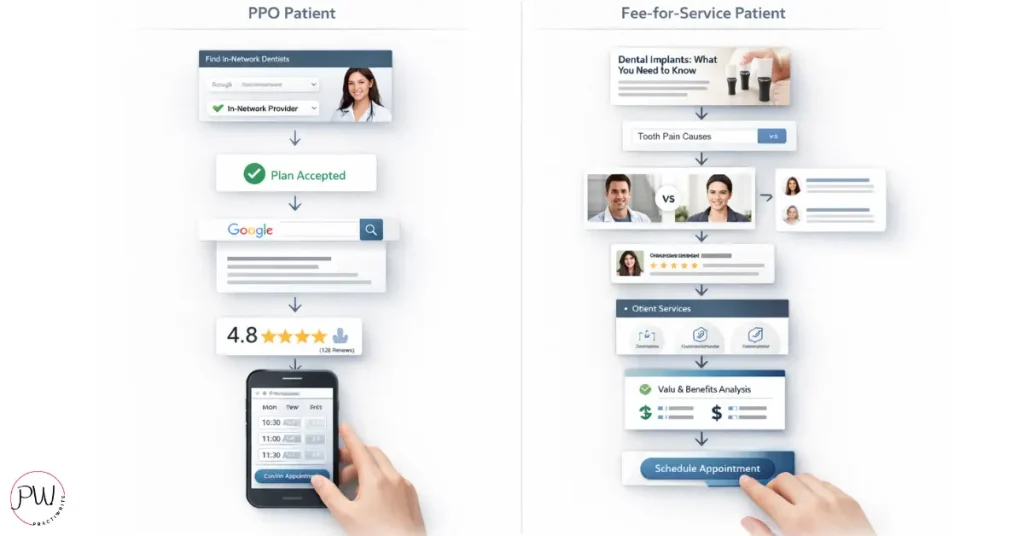
PPO patients are searching for fit. They want to know whether your practice works with their insurance plan. Once they confirm it does, the decision is mostly made for them.
They’re not spending three days reading your blog. They’re booking an appointment because their plan says you’re a preferred provider.
FFS patients are searching for conviction. They’re already paying more than they would at an in-network practice, or they’re choosing to pay out of pocket entirely.
That means they need a real reason to choose you. They’re doing the research to build that case in their own head before they ever contact your office.
Those are completely different emotional and practical search journeys.
The PPO Patient’s Search Journey
The PPO patient usually starts with their insurance portal. If they end up on Google, they’re searching by insurance name first. “Dentist that takes Cigna near me.” “Delta Dental in-network dentist [city].”
Once they find a match, reviews become the tiebreaker.
The research window is short. The content requirements are minimal. They just need confirmation and a good star rating.
The FFS Patient’s Search Journey
The FFS patient starts with a problem, a goal, or a recommendation. They search by procedure, by concern, by symptom, or by the specific quality of care they want.
They read. They compare. They look for a practice that sounds like it actually gets them.
And they take longer to decide because the financial commitment feels more significant, even when the actual cost difference is smaller than they expect.
Is your content written for the patient who’s already convinced, or for the patient who still needs to be?
What Fee-for-Service Dental Patients Are Searching For (4 Things)
There are four categories of searches your FFS patients are running. Most dental practices are capturing one of them, maybe two, if they’re lucky. Here’s the full picture.
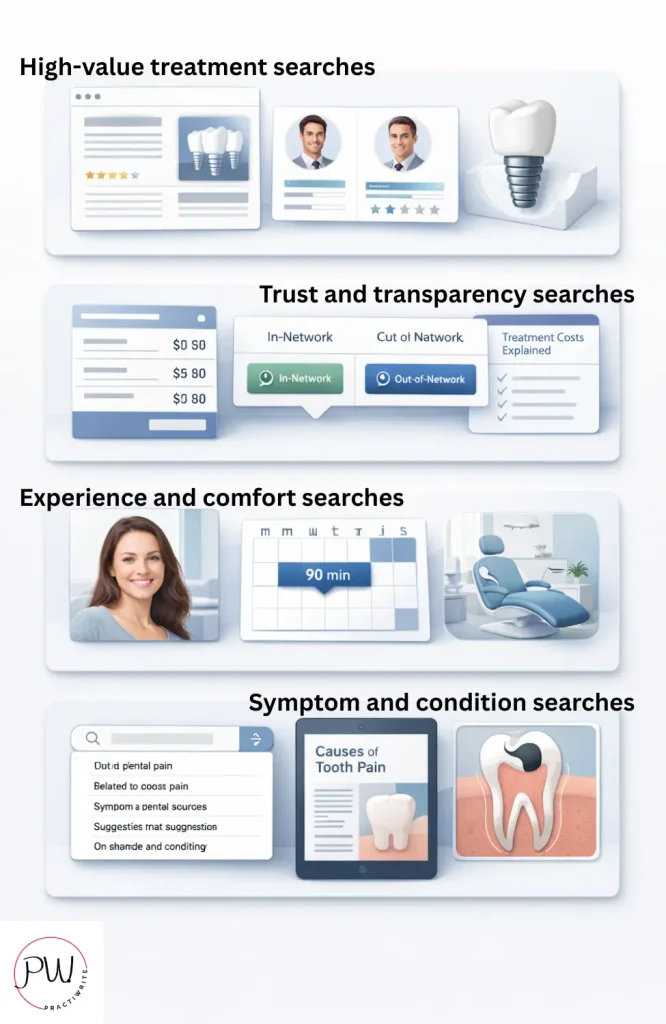
1. Procedure-Quality Searches
These patients aren’t just looking for “a dentist.” They’re looking for the best dentist for a specific procedure. They’ve either been told they need something done, or they’ve decided they want something specific and they’re choosing who does it based on expertise.
What they’re typing:
- “best dentist for dental implants in [city]”
- “experienced cosmetic dentist [city]”
- “full mouth reconstruction specialist near me”
- “porcelain veneers dentist [city]”
- “Invisalign provider [city]”
- “dental implant specialist vs general dentist”
These patients are past the “who’s cheapest” phase. They’ve mentally accepted that quality has a price, and they’re in the “who’s best” phase.
Your service pages need to answer that question directly. Not with generic language about “state-of-the-art technology” that every dental website in the country says. With specifics:
- Your training
- Your case volume
- What you do differently
- What your patients say about the experience
If your implant page reads like a Wikipedia article about the implant process, you’re not showing up for these patients, and if you do show up, you’re not converting them.
2. Trust and Transparency Searches
FFS patients are self-pay patients or willing out-of-pocket spenders. That means they’ve made a deliberate choice to step outside what insurance dictates. And they want to feel confident they made the right call.
What they’re typing:
- “how much do dental implants cost without insurance”
- “why is fee-for-service dentistry worth it”
- what does fee-for-service dental mean
- “is it worth going to an out-of-network dentist”
- “dentist that doesn’t take insurance near me”
- “out of network dentist worth the cost”
This is where most FFS practices leave serious revenue on the table.
These searches are asking directly, “convince me this is worth it.” And the practices that answer honestly, clearly, and without sugarcoating it, win. The ones that dodge the cost question or bury it behind contact forms lose.
You don’t have to post a fee schedule on your website. But you do need content that honestly explains the value equation.
What does your patient actually get at a fee-for-service practice that they don’t get at a high-volume in-network office? If you can’t answer that plainly, in writing, for a prospective patient to read before they call you, you have a content problem.
3. Experience and Comfort Searches
Dental anxiety is more common than most practices acknowledge. A significant portion of patients, especially adults who haven’t been to the dentist in years, specifically look for a practice where they won’t feel rushed, judged, or processed.
What they’re typing:
- “dentist for anxious patients [city]”
- gentle dentist near me
- “dentist that doesn’t rush you”
- “dentist that explains everything before doing it”
- “dental sedation options [city]”
- “dentist good with nervous patients”
Here’s where FFS practices have a structural advantage they almost never use in their content.
By design, your appointments run longer. You see fewer patients per day. You have more time to actually talk to people.
That’s not just a nice perk. It’s the exact thing these patients are searching for.
Your content isn’t saying it. Say it.
A peer-reviewed study published in the International Dental Journal (2025) surveyed U.S. dental patients and found that the top factors driving patient trust were quality of care, clear and honest communication, and the overall patient experience. Not price. Not convenience. Trust and quality. That’s the FFS patient in a nutshell.
(Source: Levin et al., International Dental Journal, April 2025)
A peer-reviewed study published in the International Dental Journal (2025) surveyed U.S. dental patients and found that the top factors driving patient trust were quality of care, clear and honest communication, and the overall patient experience. Not price. Not convenience. Trust and quality. That’s the FFS patient in a nutshell. (Source: Levin et al., International Dental Journal, April 2025)
4. Symptom and Condition Searches
These patients don’t know what they need yet. They’re in pain, worried, or noticing something they can’t ignore.
They’re not searching for a dentist. They’re searching for answers. But if your content gives them those answers, you’re the first practice they trust before they even know they’re looking for one.
What they’re typing:
- “why do my gums bleed when I brush”
- “tooth pain that comes and goes”
- “how do I know if I need a crown or a filling”
- “sensitive teeth when drinking cold water”
- “gum recession treatment options”
- “loose tooth as an adult”
This is top-of-funnel content, and it’s the most misunderstood part of a dental content strategy. Most practices skip it entirely because it feels too far from “book an appointment now.” But that’s exactly the wrong way to think about it.
When a patient searches for “why do my gums bleed when I brush” and lands on your helpful, honest educational post, they form their first impression of your practice before they even realize they need to see a dentist. Done right, they arrive at their first appointment already trusting you.
That’s not a soft metric. That’s a pre-sold patient.
Why Your Current Content Isn’t Showing Up for These Searches (4 Reasons)
Knowing what your patients are searching for is only half of it. The harder question is why your content isn’t there when they look. Most FFS practices are making the same mistakes.
Reason #1: You’re Targeting Volume, Not Intent
Generic keywords like “dentist [city]” and “teeth cleaning [city]” attract every patient type, including the ones who’ll leave the moment they find out you’re out of network. If your content doesn’t signal FFS-specific intent, you’re competing on the same playing field as every PPO practice in your market. That’s a fight you don’t need to pick and one you’re unlikely to win on volume alone.
Reason #2: Your Content Is Written for Search Engines, Not Your Patients
Keyword-stuffed service pages that describe the procedure but never address the patient’s actual question aren’t working.
FFS patients read for trust signals. They’re looking for a voice, a perspective, a sense of who you are before they meet you. If your website sounds like a brochure that could belong to any dental practice in any city, it’s not doing the job.
Reason #3: You’re Missing the Middle of the Funnel Entirely
Most dental websites have a homepage, a few service pages, and a contact form. That’s it.
There’s no content catching a patient mid-research. The phase where they’re comparing options, asking better questions, and deciding who feels right.
That gap isn’t small. It’s where most of your potential new patients quietly move on to someone else.
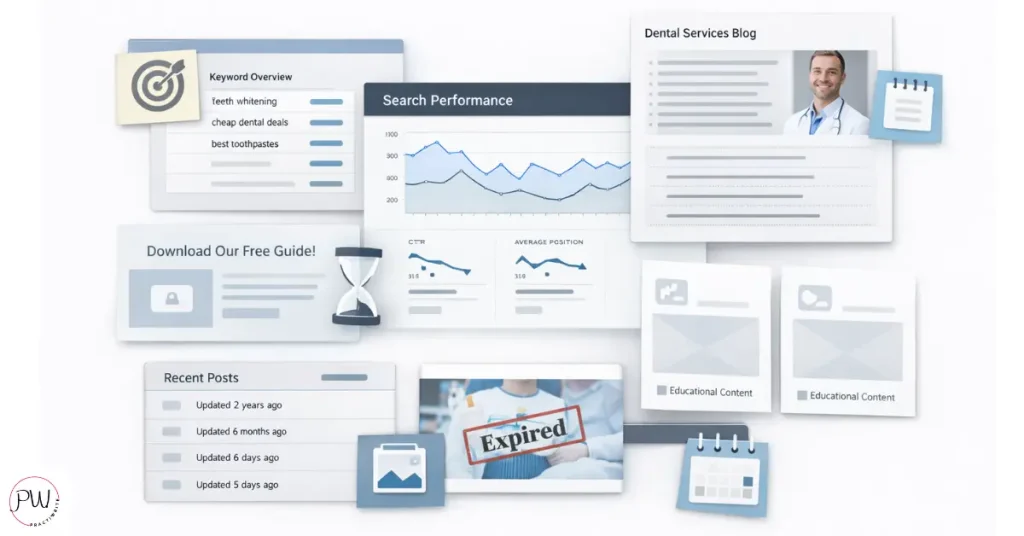
Reason #4: Google Doesn’t Trust a Practice That Barely Publishes
Search authority compounds over time. A practice that publishes one blog post a quarter isn’t sending the right signal to Google or to the patient who finds three posts on your site and twelve on your competitor’s. Consistent content is how you demonstrate expertise, and expertise is what the FFS patient is specifically looking for.
How to Show Up for the Searches Your Fee-for-Service Patients Are Running
Now for the part that actually matters.
Match Your Content to the Type of Search
Not all content is the same, and not all of it belongs in the same format. Match the content type to the search intent.
Procedure-quality searches need strong, specific service pages. These pages should be comprehensive, rich with your actual clinical perspective, and optimized for the specific long-tail keyword your ideal patient is using.
“Dental implants in [city]” is a service page. “What makes a good dental implant candidate” is a supporting blog post.
Trust and transparency searches need educational content that answers the hard questions directly. Cost pages. FFS explainers. Comparison content that doesn’t shy away from the conversation.
If you’re afraid to address cost in writing, you’re losing the patient who would’ve paid it.
Experience and comfort searches need patient-centered narrative content. Patient stories, process walkthroughs, content that makes a nervous first-timer feel like they already know what to expect. This content converts anxious browsers into booked appointments.
Symptom searches need educational blog content with clear clinical authority. Answer the question your patient is actually asking. Then connect it naturally to the care your practice provides.
Make Your FFS Identity Unmistakable
Your website shouldn’t make a prospective patient guess what kind of practice you are. State it plainly. Explain what it means for them.
More time in the chair means more thorough care. No insurance-dictated treatment plans mean your dentist recommends what your mouth actually needs. Out-of-pocket costs are often more comparable to in-network than patients assume.
If you’re not saying it explicitly, patients can’t factor it into their decision.
Build Content Around What Patients Are Actually Asking
Google’s “People Also Ask” feature and autocomplete are showing you exactly what your patients type when they’re looking for what you offer.
Those phrases are your blog post topics. Those questions are your H2 headings.
Not what you think they’re asking. What they’re demonstrably, provably typing into the search bar right now.
Stop guessing. Look at the data.
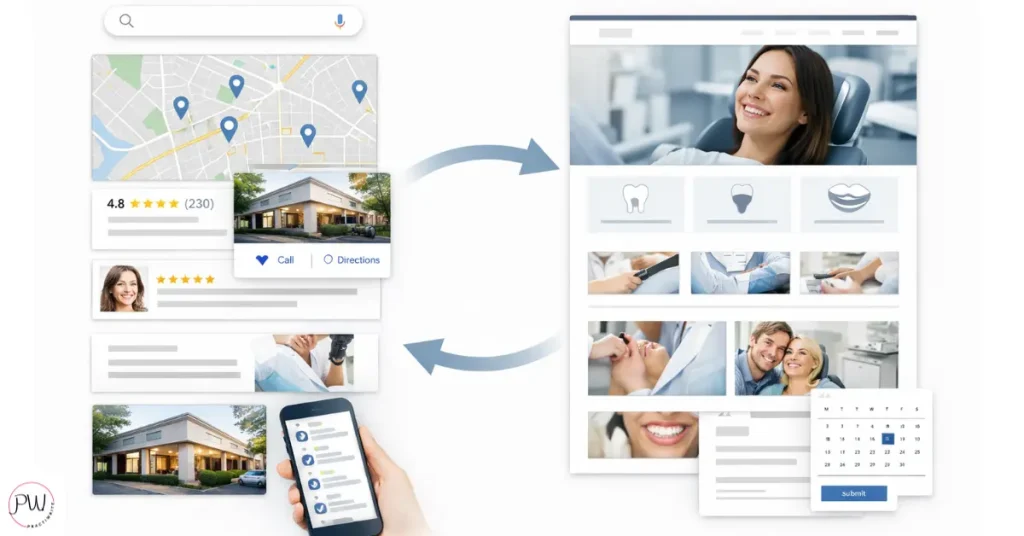
Let Your GBP and Website Work Together
Your Google Business Profile catches local and “near me” search traffic. Your website content catches intent-based and research-phase traffic.
They’re not separate strategies. They’re a system, and they only work at full strength when they’re optimized together and pointing to the same message.
Most practices treat them like two unrelated projects. They’re not. They’re two doors into the same room, and if one is locked or the signage is wrong, you’re losing patients who were already looking for you.
The Content Most FFS Practices Still Aren’t Creating
This is the gap your competitors probably haven’t closed yet. Consider adding:
Cost transparency pages. “How much does [procedure] cost at a fee-for-service practice?” These rank well, they attract exactly the right patient, and they pre-qualify before the first call.
FFS explainer content. “What is fee-for-service dentistry and is it right for me?” These convert well because the patient who reads to the end has already self-selected.
Before/after case content. Not as a gallery. As a story. What did this patient need? What did we do? What changed? Quality over quantity, every time.
Patient experience content. What does a new patient appointment actually look like at your practice? Walk them through it. Reduce the unknown. Book more appointments.
Honest comparison content. FFS vs. in-network. Don’t be afraid of this one. The patients who read it and still call you are exactly the patients you want.
Wrapping Up: Ready to See Exactly Where Your Content Is Falling Short?
Schedule your 100% free Dental Practice Roadmap. Your Dental Practice Roadmap is a GBP and website audit that shows you exactly where you stand, what keywords you’re ranking for now, what you should be ranking for, and a step-by-step plan to close those gaps.
No vague recommendations. No fluff. Just a clear picture of what’s broken and what to do about it.
And if you’re thinking about or already deep into a PPO to FFS transition, these details matter to your success.
Book your Dental Practice Roadmap and get yours free.

10+ year content strategist, writer, author, and SEO consultant. I work exclusively with fee-for-service dental practices that want to build value, not volume.