You want out of insurance. You’re tired of the write-offs, the denied claims, and the feeling that a faceless network gets to decide how you treat your own patients.
But every time you picture dropping all your PPOs at once, your stomach drops with them.
What happens to the schedule? What happens to the mortgage?
Here’s the good news. You don’t have to choose between full PPO and full fee-for-service.
There’s a third path, and it’s the one most dentists actually take.
It’s called the hybrid dental practice model, and it means keeping one or two carefully chosen PPOs while you run, price, and market everything else like a fee-for-service practice.
So can you keep a couple of plans and still build a real fee-for-service practice? Yes. The hybrid model works when you choose those plans on purpose, for reasons you can say out loud.
It backfires when you keep them out of fear and let them quietly decide who fills your chairs.
That difference is the whole ballgame. Two practices can both keep two PPOs and end up in completely different places.
One uses those plans as a tool.
The other wears them like a security blanket and never grows past volume.
Let’s break down
- What the hybrid model really is
- When keeping PPOs is smart
- When it turns into a trap
- Which plans are worth keeping
- And how to market a hybrid practice so the right patients find you anyway
No all-or-nothing scare tactics. Just a clear way to think about a decision most agencies oversimplify.
Table of Contents
What Is a Hybrid Dental Practice Model?
A hybrid dental practice model is a practice that stays in-network with one or two PPO plans while running everything else as fee-for-service. Your fee schedule, your positioning, your patient experience, and your marketing all operate like a fee-for-service office.
The plans you keep are the exception, not the identity.
It’s not PPO with a fresh coat of paint. And it’s not a practice that couldn’t commit. A real hybrid practice made a deliberate call to keep specific plans for specific reasons.
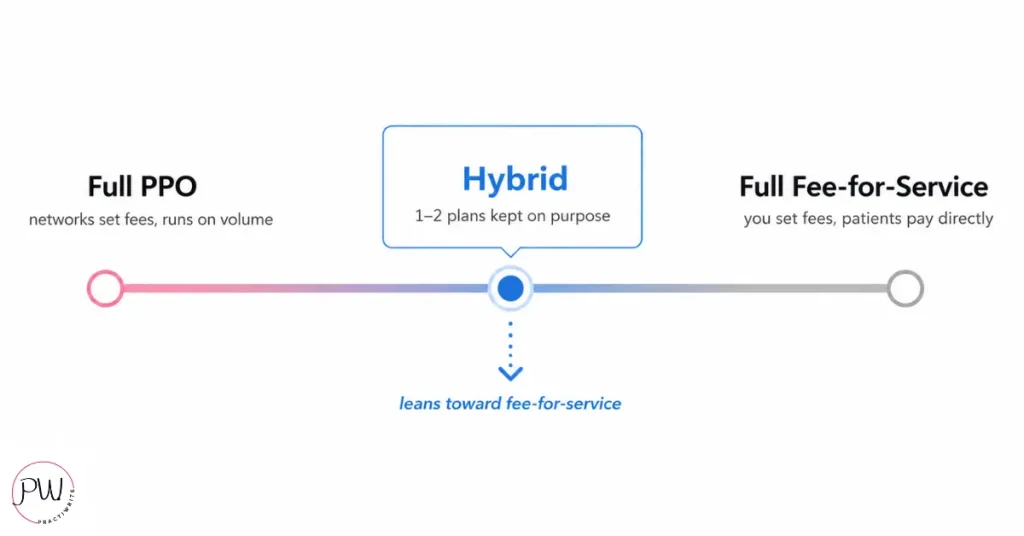
Think of it as a spectrum. On one end sits the full PPO practice, where networks set the fees and the whole thing runs on volume. On the other end sits the full fee-for-service practice, where you set your fees and patients pay you directly.
The hybrid model lives in the middle, but it leans hard toward the fee-for-service end. Most of the dentists we work with are somewhere on this line and assume they’re stuck wherever they happen to be standing.
So here’s the question worth sitting with: Is your practice hybrid by design, or hybrid because you never actually decided?
Why Do Most Dentists End Up Running a Hybrid Practice?
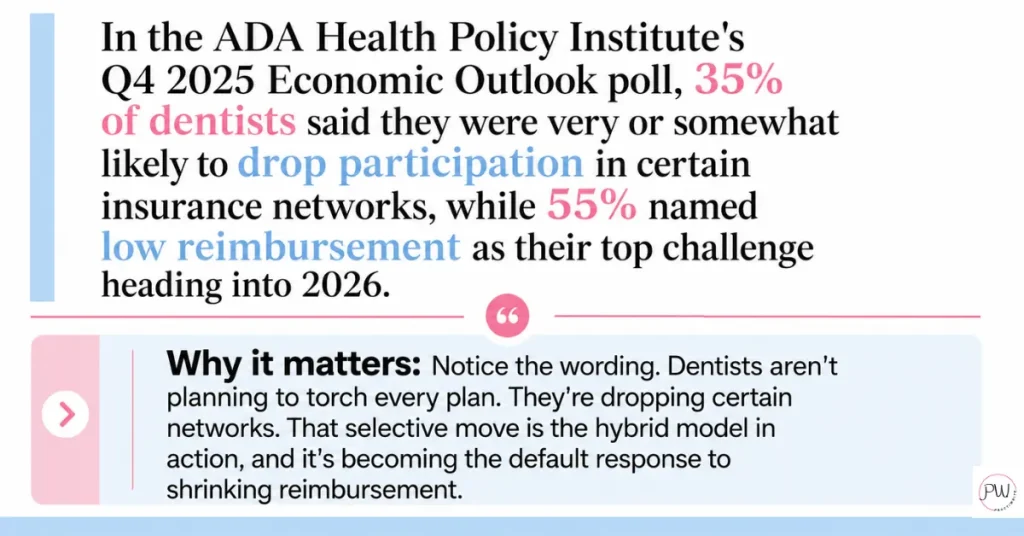
Most practices become hybrid by accident, not by strategy. They drop their worst-paying plans, feel the relief, get nervous, and then stop right there.
The fear behind that freeze is real, and we’re not going to pretend otherwise.
Dropping every plan at once can open a revenue cliff. Patients who picked you only because you were in-network start calling around. The schedule thins out before the higher-value patients show up to replace them.
That risk exists, and ignoring it is how transitions blow up.
But here’s where it goes sideways. Rational caution slowly hardens into permanent indecision. You keep eight plans “for now.” Then “for now” stretches into next year.
Then it’s been five years and you’re still in-network with plans you can barely remember signing, telling yourself you’ll deal with it later.
So the freeze is understandable. The question is whether you stay frozen. When does “for now” quietly become “forever”?
Is Keeping 1-2 PPOs A Smart Strategy Or Just A Security Blanket?
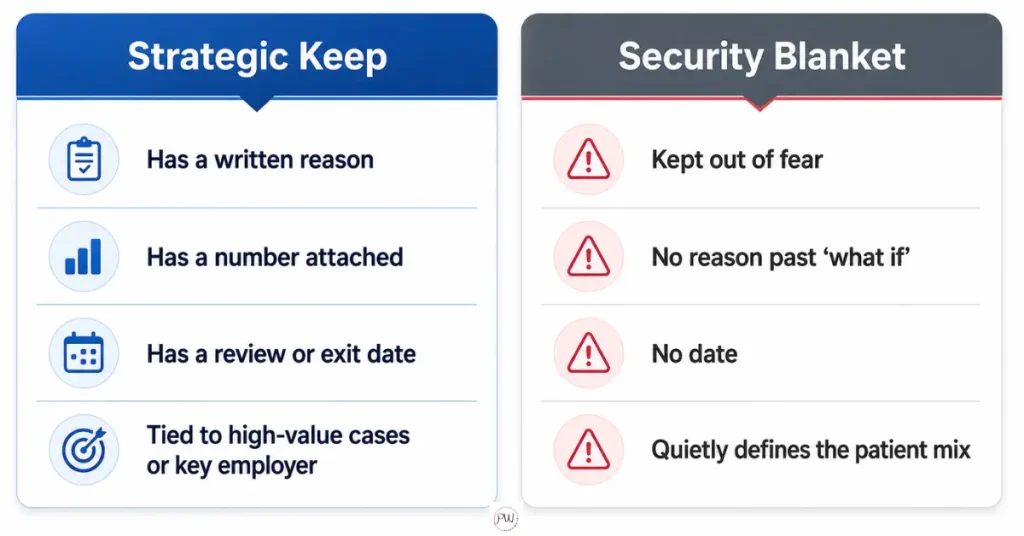
The difference between a smart hybrid strategy and a security blanket is simple. If you can name exactly why you kept each plan, it’s strategy. If you can’t, it’s a security blanket.
A strategic keep sounds like this. “I kept this plan because it covers the biggest employer in town and feeds my implant cases.” Or, “I kept it to steady cash flow for the next twelve months, and I’ve already set the date I’ll drop it.” Every kept plan has a reason and a number attached to it.
A security blanket sounds like this. “I kept them because dropping more feels scary.”
No date. No number. No reason past “what if.”
Here’s the part nobody wants to hear. A security blanket doesn’t keep you warm. It keeps you small.
The write-offs on those patients don’t stop. The network still has a say in how you treat them. You’ve just made the trap comfortable enough to live in.
If you want the full math on what those plans actually cost you, that’s a separate conversation I break down in The True Cost of PPO.
If you can’t say out loud why you kept that plan, who’s really running your practice, you or the network?
When Does The Hybrid Model Become a Trap?
The hybrid model becomes a trap the moment the PPOs you kept start running your practice, your schedule, your patient mix, and your marketing instead of the other way around.
Here’s how the trap springs. The plans you kept keep sending volume patients. Volume patients fill the schedule. A full schedule feels like success.
And because it feels like success, the fee-for-service side never gets the room or the attention it needs to grow. You end up busy and broke at the same time.
There’s a tell, and it’s almost always the marketing.
The practice still talks to “everyone.” The website still puts insurance front and center. The Google Business Profile still reads like every other office in town. So the wrong patients keep finding it, and then the hybrid model takes the blame for a problem the marketing created.
I dig into this failure pattern in Why Most PPO-to-FFS Transitions Fail.
Get this part. A hybrid practice that markets like a PPO practice isn’t transitioning to anything. It’s just a PPO practice that dropped a couple of plans and called it a strategy.
So be honest with yourself. Are you actually transitioning, or did you trim the worst plans and stop?
Which PPOs Should a Hybrid Practice Actually Keep?
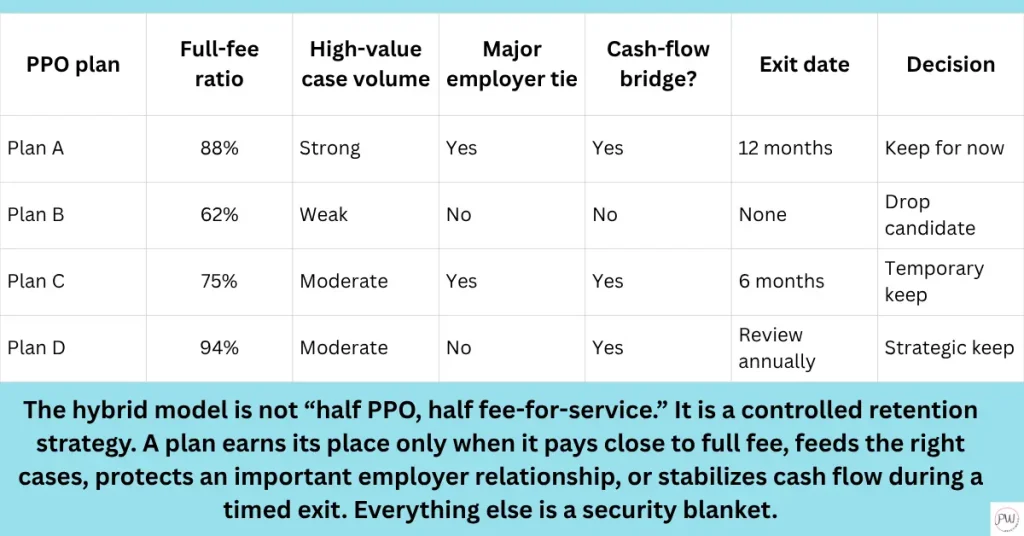
Keep the plans that pay closest to your full fee, feed your highest-value services, or buy you a defined runway with an exit date. Drop everything else. Here’s how to weigh each one.
Reimbursement Against Your Full Fee
Look at what each plan actually pays compared to your full fee. The gap is your write-off. A plan that pays close to your fee costs you little to keep. A plan with a huge gap is just a slow leak you’ve agreed to.
Patient Value, Not Headcount
Judge plans by the value of the cases they bring, not the number of bodies they send. One plan that feeds implant, ortho, or full-mouth cases can earn its keep. A plan that fills your schedule with low-margin cleanings does not.
Local Employer Concentration
If one plan covers the largest employer in your town, it behaves differently than the rest. Dropping it could mean losing a big slice of your community at once. That’s a real reason to keep it, at least for a while.
A Cash-Flow Bridge With An Exit Date
Sometimes you keep a plan just to steady cash flow during the transition. That’s fine, as long as the keep comes with a date on the calendar. A bridge with no end is just a road to nowhere.
Picture two versions of the same practice. Version one keeps six plans because letting go feels risky, and the schedule stays packed with low-margin work.
Version two keeps the same two plans on purpose, drops the other four, and watches the patient mix shift toward higher-value cases over the next year.
Same practice. Same town. Completely different business, decided entirely by which plans they kept and why.
Here’s the test. Every plan you keep needs a written reason and a review date. No reason, no keep. It really is that strict.
When you’re ready to start dropping plans, the order and timing matter, which I map out in the PPO to FFS Transition Timeline.
Could you write a one-sentence reason for every plan you’re still in-network with today?
The following chart is an example of how to approach choosing which PPOs to drop:
How Do You Market A Hybrid Practice As Fee-For-Service?
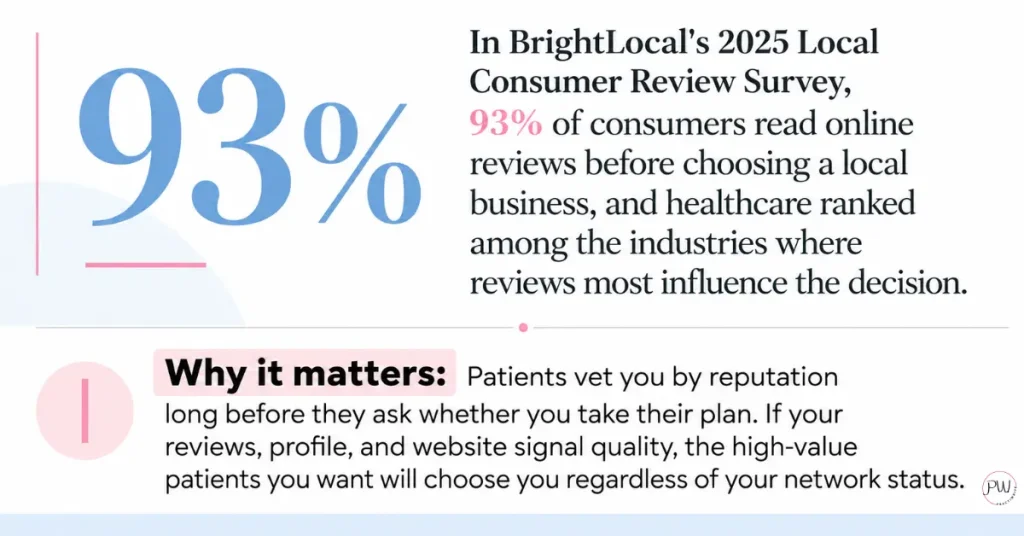
You market a hybrid practice exactly like a full fee-for-service practice, because the patients you actually want don’t care which one or two plans you happen to keep.
Your positioning isn’t set by your insurance roster. It’s set by who you want to attract.
If you want high-value patients who choose you for your skill and your care, your marketing has to speak to those patients, not to insurance shoppers.
In practice, that means your Google Business Profile, your website copy, and your front desk scripts all sell value, outcomes, and experience. Not “we take your insurance.” The plans you kept stay in the background where they belong.
They’re a payment detail, not your headline.
Here’s the mechanism that keeps the hybrid model from sliding back into volume. When your marketing speaks to high-value patients, the price-shoppers sort themselves out and the right patients self-select in.
You’re not chasing everyone. You’re sorting for the patients you actually want, and letting the rest go find a cheaper chair.
This is the exact work of repositioning a practice from “takes everyone” to “built for the right patient,” and I walk through it step by step in Fee-For-Service Dental Marketing: How To Reposition Your Website & GBP For The Right Patients.
If a patient picked you only because you took their insurance, did you really win them, or just rent them until a cheaper office opens down the street?
Wrapping Up: The Hybrid Dental Practice Model Is Strategic, Not Compromise
The hybrid dental practice model isn’t a compromise, and it isn’t a cop-out. It’s a real strategy, but only on two conditions.
You can name why you kept every single plan. And your marketing pulls the patients you actually want, not the ones the network sends.
Keep your PPOs on purpose and they’re a tool.
Keep them out of fear and they’re a leash.
The dentists who get this right stop marketing like hybrid practices and start marketing like the fee-for-service practice they’re building.
And you can’t fix your patient mix until you can see what your online presence is telling people. If your Google Business Profile and website still read like an office that takes everyone, the right patients will keep scrolling right past you, no matter how many plans you drop.
Schedule your 100% free Dental Practice Roadmap.
Your Dental Practice Roadmap is a GBP and website audit that shows you exactly where you stand, what keywords you’re ranking for now, what you should be ranking for, and a step-by-step plan to close those gaps.
No vague recommendations. No fluff. Just a clear picture of what’s broken and what to do about it. Book your Dental Practice Roadmap and get yours today now.

10+ year content strategist, writer, author, and SEO consultant. I work exclusively with fee-for-service dental practices that want to build value, not volume.