
Most fee-for-service dental practices set their marketing budget the same way a PPO practice does.
That’s the first mistake, and it’s an expensive one.
A fee-for-service dental marketing budget is the money you set aside to attract patients who choose you for your care, not your in-network status.
Here’s the problem. Almost every budgeting rule you’ll find online was built for volume practices.
Spend 3 to 7 percent of revenue. Chase more calls. Fill more chairs.
That math works when your business runs on patient count. Yours doesn’t. Your practice runs on case value.
So when you copy a volume practice’s budget, you spend to attract the wrong patients. More calls from price shoppers. More leads that ghost after the free exam. A busier front desk and a flat bank account.
You didn’t overspend. You spent in the wrong direction.
Here’s the real answer, and I’ll spend the rest of this post proving it. Your fee-for-service dental marketing budget shouldn’t start with a percentage of revenue. It should start with the value of the cases you want.
Figure out what one ideal patient is worth to your practice, what it costs to acquire one, and how many you need to hit your production goal. Multiply. That’s your budget.
Everything else is guessing dressed up as a benchmark.
The good news? When you build your budget around case value instead of patient volume, a smaller number often does more work. You stop paying to be busy and start paying to be profitable.
Let’s do the math.
Table of Contents
What Is A Fee-For-Service Dental Marketing Budget?
A fee-for-service dental marketing budget is the amount you invest to attract high-value, insurance-independent patients, calculated from case value rather than patient volume. It answers one question: how much does it cost to put the right patient in your chair, and how many of them do you need?
Notice what’s missing from that definition. There’s no percentage. No industry benchmark. No ‘what’s everyone else spending.’
Those numbers feel safe because they sound official, but they’re averages pulled from practices that don’t run like yours.
Think about it this way. A volume practice measures success in bodies. Two hundred new patients a month, most of them insurance-driven, low value per visit, high churn.
A fee-for-service practice measures success in cases. A dozen implant consults, a few full-mouth rehabs, a handful of cosmetic cases that each clear five figures.
Same marketing category. Completely different budget logic.
Would you set your fee schedule by copying the office down the street that takes every PPO under the sun? Of course not. So why set your marketing budget that way?
Why Do Percentage-Of-Revenue Budgets Fail Fee-For-Service Practices?
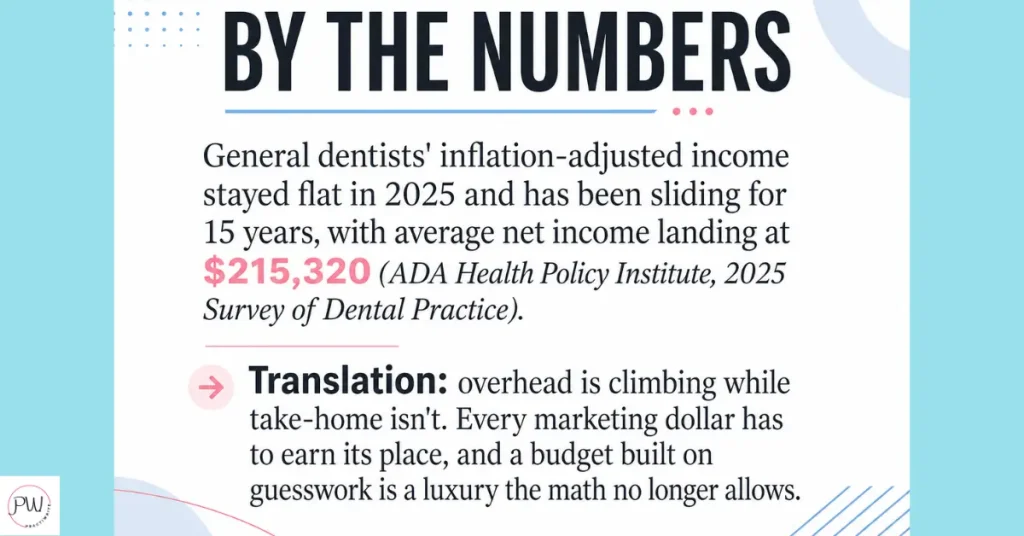
A percentage-of-revenue budget sets your marketing spend as a fixed slice of what you collect, usually somewhere between 3 to 7 percent. It’s simple, it’s common, and for a fee-for-service practice, it’s backwards.
Here’s why. The percentage model assumes every dollar of revenue costs roughly the same to earn. In a volume practice, that’s close enough to true. Lots of patients, similar value each, predictable churn.
But your revenue doesn’t work like that. One implant case might equal forty routine cleanings. When your revenue is lumpy and case-driven, a flat percentage has no idea what it’s actually paying for.
The model also aims at the wrong target. Percentage-of-revenue budgets are designed to maintain volume. Keep the chairs full, keep the number steady.
But you didn’t go fee-for-service to be busy. You went fee-for-service to be profitable with fewer, better patients. A budget engineered to maximize headcount actively fights the reason you transitioned.
And here’s the part nobody tells you. When you set a percentage and hand it to a generic agency, they’ll spend it the way they spend everyone’s, on volume tactics that look productive and quietly attract the exact patients you’re trying to filter out.
You wanted a patient sort. You paid for a patient flood.
So what should you do instead? Build the budget from the case up.
How Do You Calculate A Marketing Budget Based On Case Value?
Case-value budgeting means you build your marketing spend backward from the cases you want, using three numbers: what a target case is worth, what it costs to acquire one, and how many you need. Get those three, and your budget stops being a guess and becomes a plan. Let’s walk through it.
What Is Your Target Case, And What Is It Worth?
Your target case is the specific type of high-value patient your marketing exists to attract, and its worth is the average production that case generates. Not your average patient. Your target patient.
Pick the case you actually want more of. For example:
- Implants
- Full-mouth rehab
- Veneers
- Clear aligners.
Then pull the real number from your practice management software, average production per case, not per visit. Say your target is single-tooth implant cases and they average $4,500 in production. That $4,500 is the anchor for everything that follows.
Most practices skip this step and budget against a blended patient value that includes every cleaning and checkup. That blended number makes premium marketing look expensive. The target-case number makes it look like the bargain it actually is.
What Does It Cost To Acquire One High-Value Patient?
Cost per acquisition, or CPA, is the total marketing spend it takes to turn a stranger into a booked, paying patient. For fee-for-service practices chasing high-value cases, that number runs higher than the volume-practice averages you’ll see quoted online, and that’s fine.
Here’s the logic volume marketers miss. If a new implant case is worth $4,500 in production, spending $300 to acquire it isn’t expensive. It’s a return of 15 to 1. A price-shopper cleaning patient worth $180 can’t absorb that same $300, which is exactly why volume practices obsess over driving CPA down.
You’re not playing that game. You can afford to outbid every discount-driven practice in your market for the patients who matter, because your case value backs it up.
Don’t know your CPA yet? Start with a working estimate, track it for 90 days, and correct. A rough number you’re measuring beats a perfect number you’re guessing.
How Many Cases Do You Need To Hit Your Goal?
Your case target is the number of high-value cases you need to book to reach a specific production goal, and it’s the multiplier that turns CPA into a real budget. Set the goal first, then reverse into the spend.
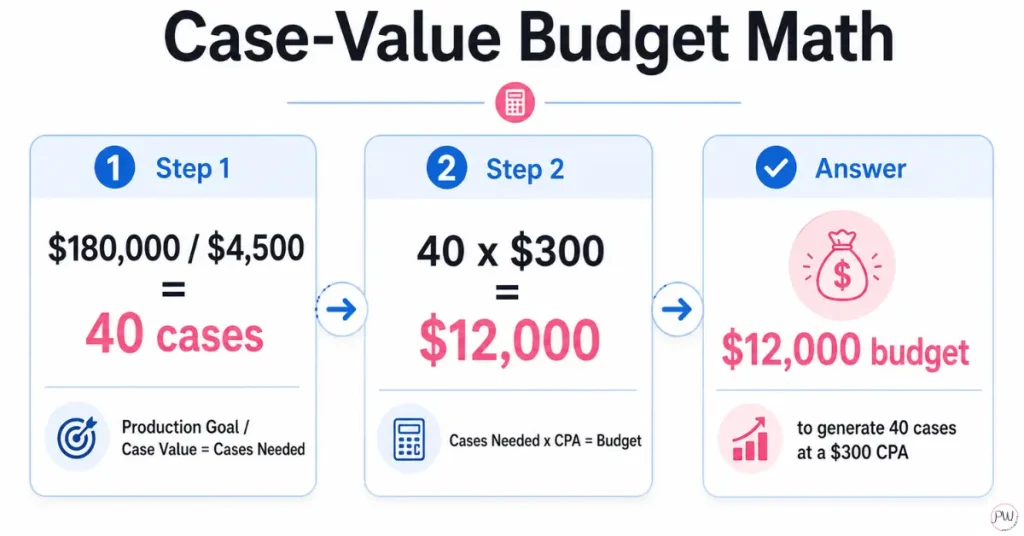
Here’s the full math in one line. Take your production goal, divide by your target case value to get the number of cases you need, then multiply that by your CPA.
Say you want an extra $180,000 in implant production this year. At $4,500 per case, that’s 40 cases. At a $300 CPA, that’s a $12,000 marketing budget to hit a $180,000 goal.
Read that again. Twelve thousand dollars, aimed with precision, to produce a hundred and eighty thousand. No percentage-of-revenue rule would ever hand you a number that clean, because no percentage rule knows what you’re trying to build.
This one does.
Where Should A Fee-For-Service Practice Actually Spend The Budget?
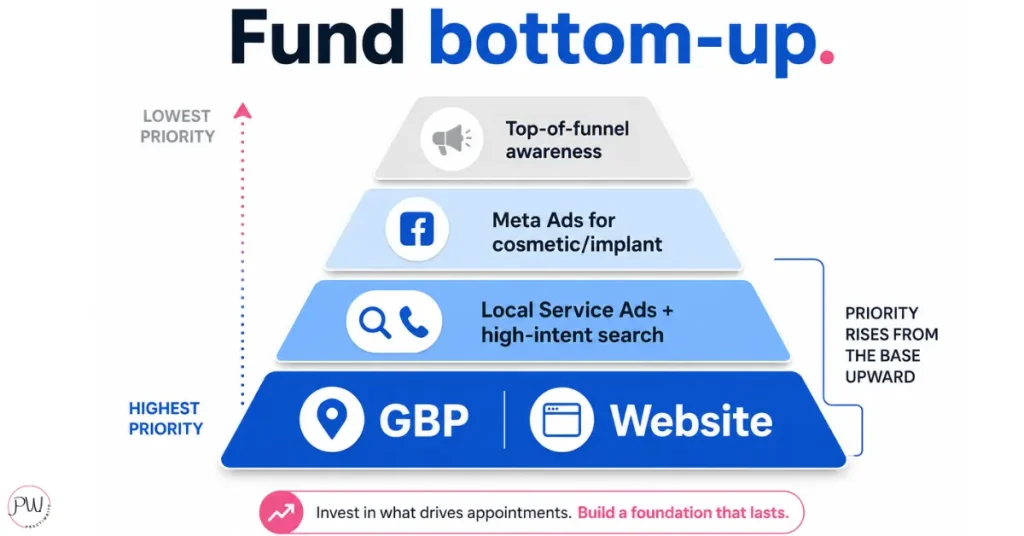
Channel priority is the order in which you fund your marketing channels, and for a fee-for-service practice it runs bottom-of-funnel first, because that’s where high-intent, high-value patients decide. Fund the channels closest to the booking, then work outward.
Most agencies do the opposite. They lead with top-of-funnel awareness plays, brand posts, follower counts, reach, because those are easy to sell and easy to show off.
But awareness doesn’t fill an implant chair. Intent does. So here’s the order that actually works.
Your Google Business Profile And Website, Funded As One System
Your Google Business Profile and your website are the two halves of the same buying decision, and they have to be funded together, not in isolation. A patient finds you on Maps, then lands on your site to confirm you’re the right choice. Break either half and the whole thing leaks.
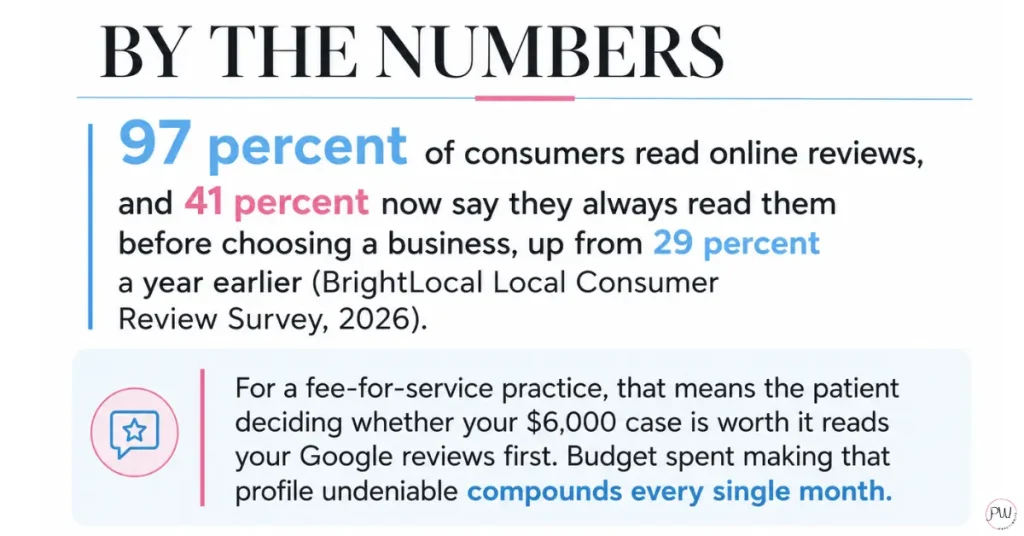
This is the single highest-leverage line item in a fee-for-service budget, and it’s usually the most neglected. When a high-value patient vets you, they read your reviews, scan your profile, and click through to your site, all in about 90 seconds.
If your GBP is thin and your website reads like an insurance brochure, you lose them before the phone ever rings. Fund this first.
Local Service Ads And High-Intent Search
Local Service Ads are Google’s pay-per-lead placements that sit above the map, and they’re a strong fee-for-service line item because you pay for contacts, not clicks. Someone who taps a Local Service Ad is ready to book, not browsing.
Fund this after your profile and site are solid, because ads that point to a weak profile just help patients decide against you faster. Get the foundation right, then pour traffic on it.
Meta Ads For Cosmetic And Implant Cases
Meta Ads let you put a specific high-value case in front of a specific audience, which makes them a targeted tool for cosmetic and implant production, not a general awareness play. You’re not building a brand. You’re sourcing five-figure cases.
This is where a fee-for-service budget can pull ahead of any volume practice, because you can afford to spend real money to land one veneer case that a PPO office could never justify. Fund it once the high-intent channels are working and you’re ready to manufacture demand instead of just capturing it.
What Should You Stop Spending Money On?
Budget cuts, in a fee-for-service practice, are the volume-era tactics that generate activity without generating cases. Every dollar you pull out of these is a dollar you can aim at patients who actually pay.
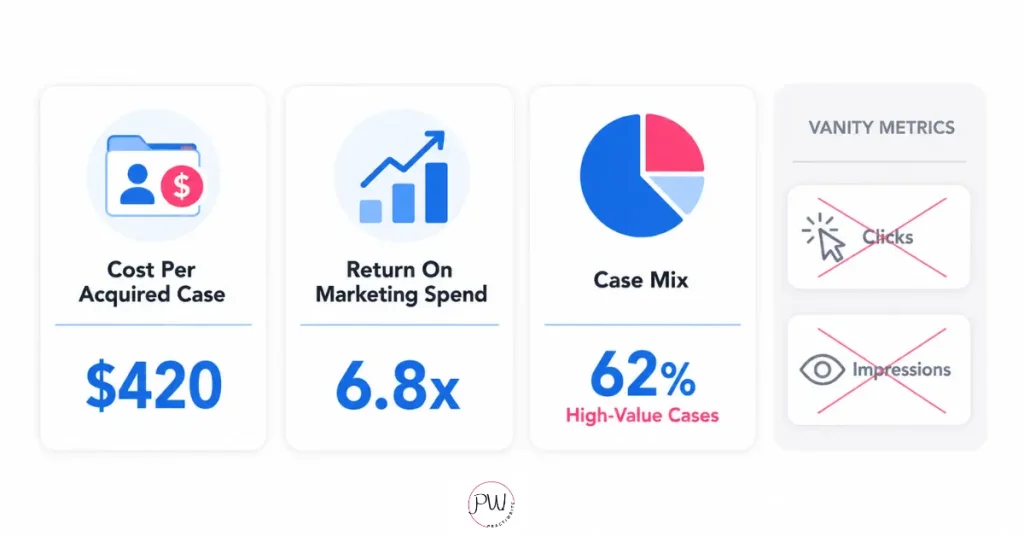
Cut spend that chases vanity metrics. Impressions, clicks, follower growth, and raw call volume feel like progress, but none of them is a booked case. If your agency’s report leads with reach and buries revenue, you’re funding a highlight reel.
Cut discount-driven campaigns. New-patient specials, free-whitening offers, and race-to-the-bottom promotions are volume tools. They train your market to see you as a deal, which is the exact opposite of the fee-for-service positioning you’re paying to build.
Cut anything you can’t tie to production. If a line item can’t show you the cases it produced, it’s not an investment, it’s a subscription.
Would you keep paying a lab you couldn’t confirm ever delivered a crown? Then stop paying for marketing that can’t confirm it delivered a patient.
How Do You Know If Your Marketing Budget Is Working?
A working fee-for-service marketing budget is one you can trace directly from spend to booked case value, measured in cost per acquired case and return on spend, not clicks or calls. If you can’t connect a dollar out to a case in, you’re not measuring, you’re hoping.
Track three numbers and ignore the rest:
- First, cost per acquired case, your total spend divided by the high-value cases it booked.
- Second, return on marketing spend, the production those cases generated against what you paid to get them.
- Third, case mix, whether you’re attracting the implant and cosmetic patients you targeted or drifting back toward low-value volume.
Give it a real window. High-value cases have longer decision cycles than a routine cleaning, so a serious patient might find you in March and book in May. Judge the budget on a rolling 90-day view, not a two-week panic.
The practices that win are the ones that measure patiently and adjust with data, not the ones that yank the budget the first slow week.
How much should a dental practice spend on marketing?
There is no universal figure, and the common 3 to 7 percent of revenue benchmark is built for volume practices. A fee-for-service practice should calculate its budget from case value instead: the production value of a target case, the cost to acquire one such patient, and the number of cases needed to reach a production goal. This method ties spend directly to profitability rather than to an industry average.
Is a fee-for-service marketing budget higher than a PPO practice budget?
Not necessarily higher in total, but different in structure. A fee-for-service budget often supports a higher cost per acquisition because each target case carries greater production value. A practice may spend less overall while allocating more per patient, because it pursues fewer, higher-value cases rather than maximizing patient volume.
What is a good cost per new patient for a fee-for-service dental practice?
The right cost per acquisition depends entirely on case value. A patient worth $4,500 in implant production can justify a far higher acquisition cost than a routine hygiene patient. Rather than targeting a fixed dollar figure, fee-for-service practices should evaluate cost per acquisition as a ratio to case value, aiming for a return that comfortably exceeds the spend.
How much of a marketing budget should go to Google Business Profile and website?
For fee-for-service practices, the Google Business Profile and website deserve first funding priority because they function as a single buying decision. High-value patients research a practice on Google and confirm the choice on its website before booking. Underfunding either half undermines every other channel that drives traffic to them.
How long before a fee-for-service marketing budget shows results?
High-value cases carry longer decision cycles than routine visits, so results are best measured on a rolling 90-day window rather than week to week. A patient considering a five-figure case may research a practice for weeks before booking. Practices that evaluate performance using cost per acquired case and return on spend make better budget decisions than those reacting to short-term swings.
Wrapping Up: Your Budget Should Match The Practice You Actually Built
Here’s the whole thing in one breath. Stop budgeting like the volume practice you’re not.
A fee-for-service marketing budget doesn’t start with a percentage someone else averaged. It starts with the case you want, the cost to land it, and the number you need. Then it funds the channels closest to the booking and cuts everything that just looks busy.
Build it that way and a smaller, sharper number will out-produce every bloated volume budget in your market. You didn’t drop insurance to be busy. You dropped it to be profitable. Your budget should reflect that.
But you can’t build case-value math on a foundation that leaks. If your Google Business Profile is thin or your website reads like everyone else’s, the smartest budget in town still bleeds patients before they ever call.
Schedule your 100% free Dental Practice Roadmap. Your Dental Practice Roadmap is a GBP and website audit that shows you exactly where you stand, what keywords you’re ranking for now, what you should be ranking for, and a step-by-step plan to close those gaps.
No vague recommendations. No fluff. Just a clear picture of what’s broken and what to do about it.
Book your Dental Practice Roadmap and get yours today now.

10+ year content strategist, writer, author, and SEO consultant. I work exclusively with fee-for-service dental practices that want to build value, not volume.