
Most dentists believe their dental Google Business Profile ranking is out of their hands.
They assume the practices at the top of the map pack got there because they’re in a big city, have less competition, or are some specialty that naturally draws attention.
So they conclude there’s no point trying. That belief is wrong, and I’ve got the data to prove it.
I analyzed 2,000 dental Google Business Profiles across all 50 states: a mix of general dentists and specialists, in metros and small towns, from solo offices to multi-location groups.
I measured completeness, reviews, review responses, photos, and engagement.
The question I wanted to answer was simple. Do your circumstances, where you are and what you do, decide how you show up on Google? Or does something you control matter more?
Here’s what I found, up front. Location and specialty don’t determine how a dental practice ranks and performs on Google. Execution does.
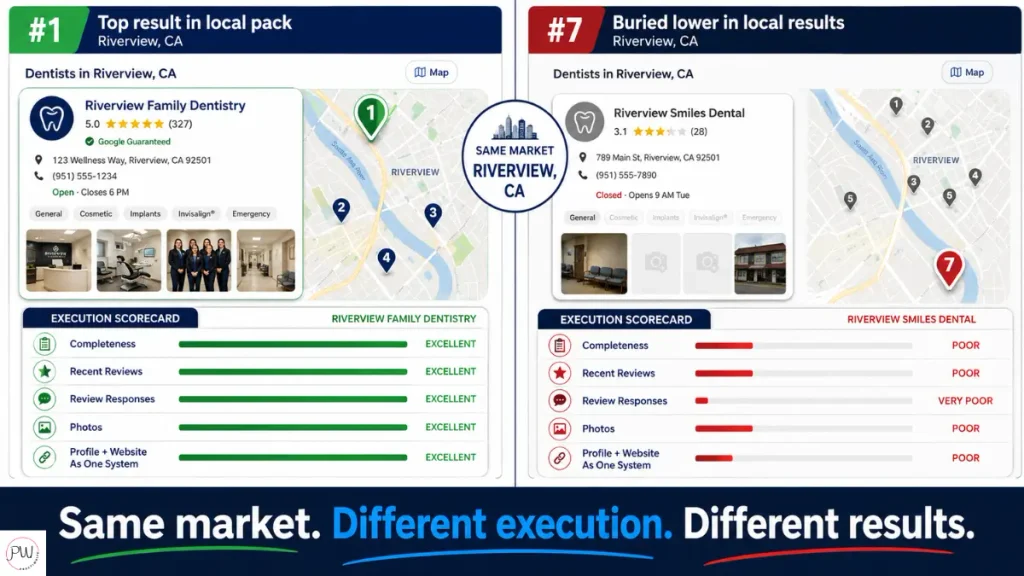
The profiles that won weren’t the ones in the biggest cities or the easiest markets. They were the ones that filled out every field, earned recent reviews, replied to those reviews, and posted real photos.
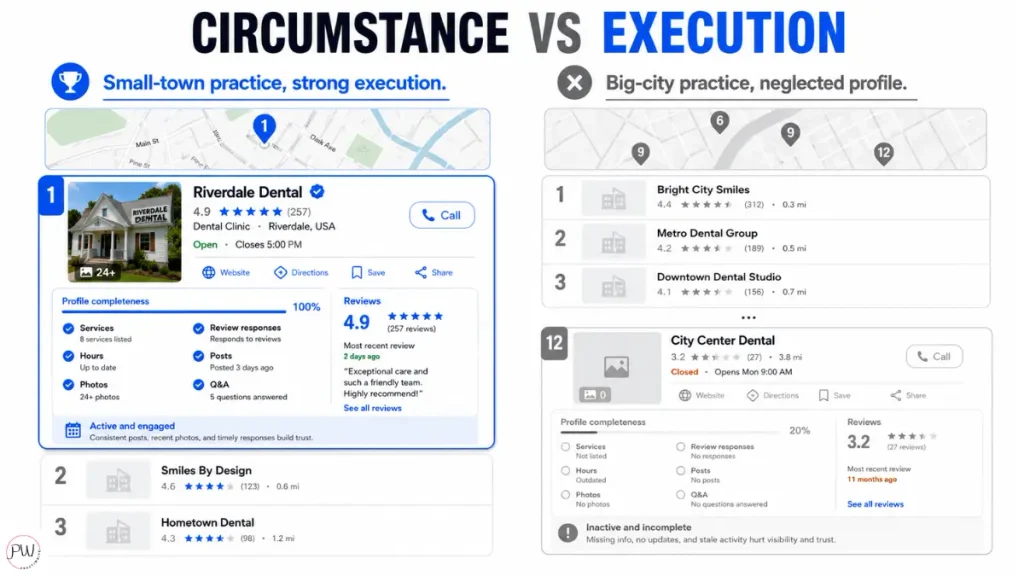
Small-town practices beat metro practices.
Solo dentists beat groups.
The difference was never the zip code. It was the work.
That’s good news, because it means your ranking isn’t a fixed hand you were dealt. It’s a set of choices you control.
Let’s walk through what the data showed, and exactly what separates the dental practices that win on Google from the ones that don’t.
What Did The Dental Google Business Profile Study Measure?
The study was an analysis of 2,000 dental Google Business Profiles across all 50 states, examining the specific factors that drive local ranking and patient engagement. I built the sample to be broad on purpose: general dentists and specialists like orthodontists, pediatric dentists, and oral surgeons; practices in dense metros and rural towns; and everything from solo practitioners to multi-location groups.
Why cast such a wide net? Because a narrow sample can hide the truth. If I only looked at big-city practices, I couldn’t tell whether success came from the city or the execution. By spanning every state, every size, and every specialty, I could separate what actually moves the needle from what only looks like it does. I assessed each profile across five dimensions:
- Profile completeness and accuracy
- Review volume and quality
- Review responsiveness
- Visual content
- And engagement signals
The result is one of the broadest independent looks at how dental practices actually use their Google profiles, and it turned up a pattern that should change how you think about your own.
What Was The Single Biggest Finding?
The single biggest finding was that execution, not circumstance, determines how a dental practice performs on Google. Across 2,000 profiles, the practices that ranked and engaged best weren’t set apart by their location, their market size, or their specialty. They were set apart by how completely and consistently they managed their profile.
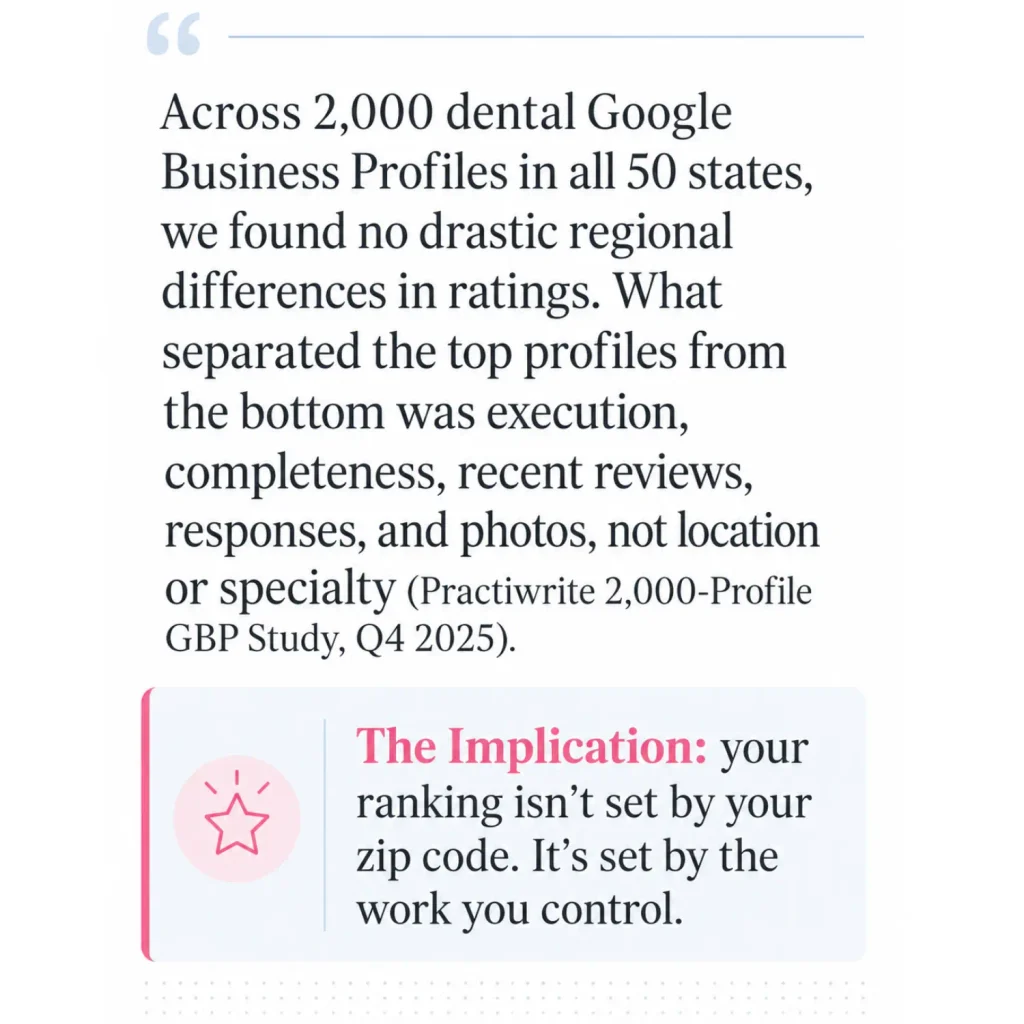
The evidence was everywhere in the data. I found no drastic regional differences in how practices were rated: dental offices in every state showed similarly high satisfaction.
What separated the top profiles from the bottom wasn’t geography, it was
- Whether they’d filled out their information
- Kept earning recent reviews
- Responded to feedback
- And uploaded real photos
A solo practice in a small town that did those things outperformed a big-city group that didn’t.
Sit with that for a second. If ranking were dictated by your market, there’d be nothing to do but envy the practice across town. But if it’s dictated by execution, then every advantage is available to you right now, no move, no rebrand, no bigger city required.
So the real question isn’t ‘is my market too tough?’ It’s ‘am I actually doing the work the winners are doing?’
Why Doesn’t Your Location Or Specialty Decide How You Rank?
Location and specialty influence some raw numbers, like how many reviews you tend to accumulate, but they don’t decide how you rank, because ranking rewards execution factors any practice can control. In plain terms: your circumstances set the starting line, not the finish. Let’s break down both assumptions, because they’re the two excuses that keep good practices invisible.
Does A Bigger City Mean Better Rankings?
No. A bigger city means more potential patients and usually more competition, but it doesn’t hand you a better ranking. My data showed that urban and suburban practices did tend to accumulate more total reviews than rural ones, simply because they have larger patient pools. But raw review count isn’t the same as ranking well in your own market.
Here’s what actually happened. Rural and small-town practices that executed well, complete profiles, steady recent reviews, active responses, ranked at the top of their local results, while plenty of big-city practices with neglected profiles sat buried below their competitors.
You’re not ranking against the entire country. You’re ranking against the other dentists in your area, and most of them aren’t executing.
So does a small market hold you back? Only if you let it become an excuse instead of an opening.
Does Your Specialty Decide Your Visibility?
No. Your specialty affects your patient volume and review patterns, but it doesn’t cap your visibility. We saw high-volume specialties like orthodontics rack up large review counts because patients visit often, while referral-based specialties like oral surgery and endodontics sometimes had under 20 reviews.
That’s a difference in circumstance, not in ceiling.
The revealing part: those lower-volume specialty practices still performed well when they executed, because a smaller set of glowing, recent reviews and a complete, well-photographed profile still signals quality to both patients and Google.
An oral surgeon with 18 heartfelt recent reviews and a fully built profile can absolutely out-earn a distracted generalist with triple the reviews and a dormant profile. The lesson holds across every specialty: execution scales down as well as up.
What Separates A High-Performing Dental Profile From A Low-Performing One?
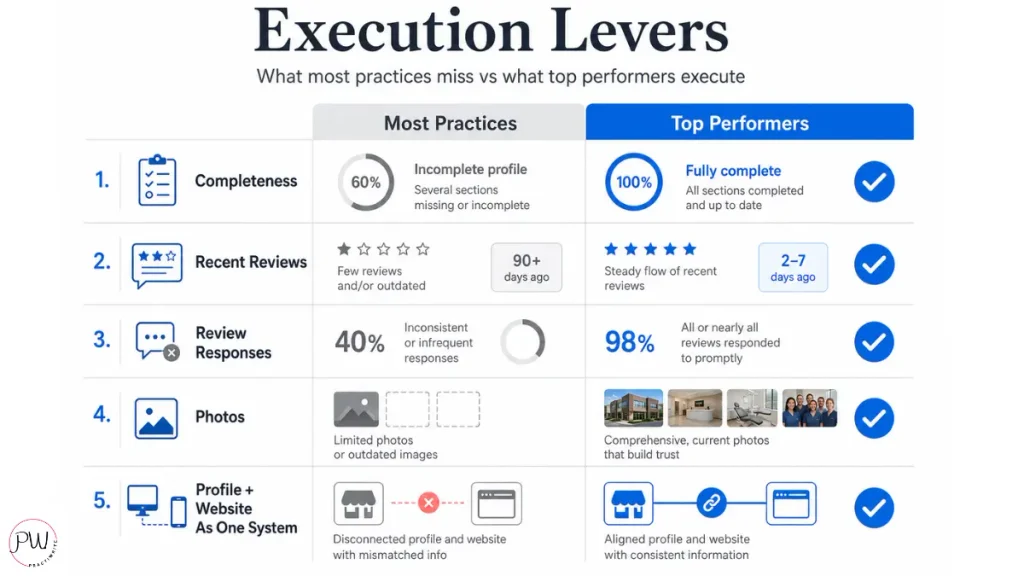
The gap between a high-performing and a low-performing dental profile comes down to five execution levers:
- Completeness
- Reviews
- Review responses
- Photos
- And treating the profile and website as one system
In my study, the top profiles did these consistently and the bottom profiles neglected them. None of the five requires a bigger budget or a better location. They require attention.
Here’s what the data showed on each.
How Complete And Accurate Is The Profile?
Completeness means every available field is filled and kept current, and it was the clearest dividing line in the study. Nearly all practices nailed the basics (address, phone, hours) because Google requires them. The separation happened in the details.
Fewer than half of the practices I analyzed explicitly listed their specific services, like implants, Invisalign, or emergency care, in the services section, leaving easy visibility on the table.
The top profiles filled out everything: services, a real description, attributes, and booking links, and they updated it whenever something changed. The weak ones left fields blank or let details go stale, sometimes still showing a dentist who’d retired or hours that hadn’t been right in a year. Completeness is the definition of low-hanging fruit, because it’s entirely within your control and most of your competitors are ignoring it.
How Strong And Recent Are The Reviews?
Review strength is a combination of volume, rating, and recency, and all three mattered in the data.
Only about one in five practices had 100 or more reviews, while more than 90 percent maintained a rating of at least 4.0 stars and roughly 15 percent held a near-perfect 5.0. But the quiet differentiator was recency. Top-ranked profiles had a steady trickle of new reviews, while underperformers often hadn’t earned one in months or even years.
Recency matters because it signals an active, trusted practice to both patients and Google’s algorithm. A profile that stopped collecting reviews a year ago looks dormant, no matter how good its old rating is.
Would you rather trust your smile to the practice with 200 reviews and nothing since last spring, or the one with 60 and three from last week?
Does The Practice Respond To Its Reviews?
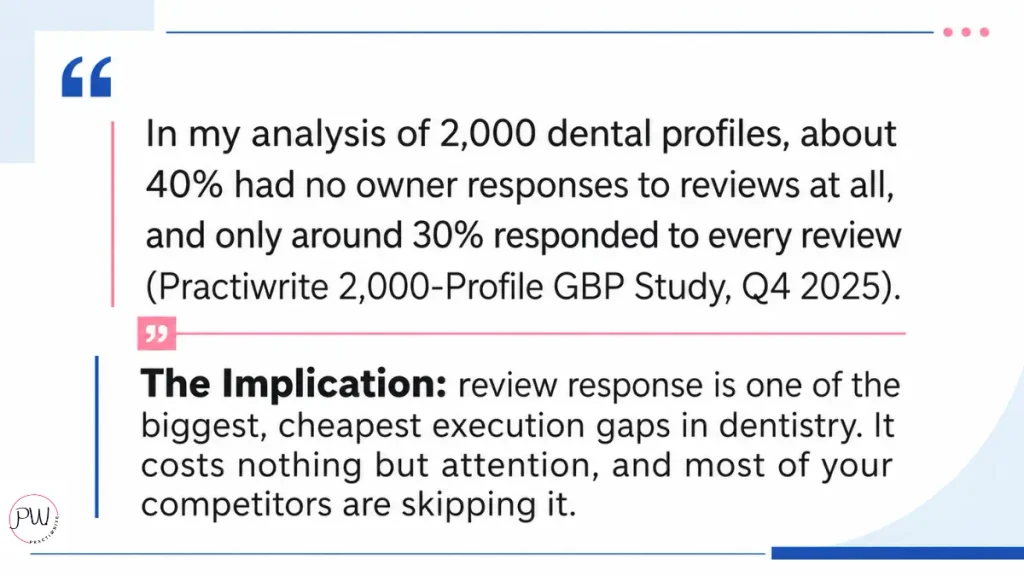
Review responsiveness means the practice publicly replies to the feedback it receives, and it was one of the largest execution gaps I found. About 40 percent of the practices in my study had no owner responses at all, or only a stray reply from years ago. Only around 30 percent responded to every review, and those were overwhelmingly the top performers.
That gap is a gift, because responding is free and most practices don’t do it. A simple, professional reply to every review, gratitude for the good ones and a calm, compliant invitation to resolve the bad ones, tells every future patient reading along that you’re present and you care. Silence tells them the opposite.
Do The Photos Show A Real, Current Practice?
Photo quality means a profile shows enough current, professional images to give patients a real sense of the office, and the study revealed a wide spread. The typical practice had roughly 10 to 15 photos, but the top quartile posted 20 to 30 or more, while the bottom quartile had just one to three. Sometimes it was only an auto-generated street view or an outdated snapshot.
Photos build trust because patients want to see where they’re going before they book. The strongest profiles showed the exterior, the waiting room, the treatment areas, and the team. The weakest left it to chance, and a dark, dated, or random user photo became their first impression. This is another lever fully within your control.
Do The Profile And Website Work As One System?
Treating your profile and website as one system means they reinforce each other in a single patient journey rather than operating in isolation. A patient finds you on Google, judges you by your profile and reviews, then clicks to your site to confirm you’re the right choice. The practices that ranked and converted best had both halves working together.
This is where most agencies quietly fail dentists: they optimize the GBP in a vacuum, or the website in a vacuum, and the two never point at the same patient. A strong profile that clicks through to a weak, generic website loses the patient at the doorstep.
Funded and managed as one system, they compound. Optimized in isolation, they leak.
Why Do Most Dental Practices Get GBP Execution Wrong?
Most practices get GBP execution wrong because they treat the profile as a one-time setup instead of an ongoing system, and because the marketing help they hire often optimizes it in isolation. The study was full of profiles that were clearly built once and abandoned: complete on day one, dormant ever since.
The first failure is set-and-forget. A profile isn’t a directory listing you finish; it’s a channel you maintain. Reviews go stale, photos age out, services change, and a profile that isn’t tended slowly slides down while active competitors climb.
The second failure is fragmentation. The agency that treats your GBP as a silo disconnected from your website, so the two never tell one coherent story.
There’s a third, timelier reason: the tactics are shifting. Google has moved away from the old user Q&A feature, which my study already found most practices ignored, toward an AI-driven experience through Ask Maps and Gemini. That means the execution feeding your visibility now runs through FAQ schema on your site, your profile description, your review responses, your photo captions, and consistent citations across the web.
The practices that keep executing as the mechanics change will pull further ahead of the ones still treating GBP like a set-it-and-forget-it listing. Are you maintaining a living system, or did you build a profile once and walk away?
What Should You Do With These Findings?
What you should do is treat execution as the one variable you fully control and work the five levers the study identified, starting with the gaps most practices ignore. You can’t change your city or your specialty. You can change everything that actually determines how you rank.
Start with completeness, because it’s the fastest win and fewer than half of practices even list their services. Fill every field, then keep it accurate.
Next, build a steady habit of earning recent reviews, not a one-time push but an ongoing trickle, because recency was a clear differentiator.
Then respond to every review, since about 40 percent of practices don’t, which makes it the cheapest way to stand out. Add real, current photos to clear the bar most profiles fall short of. And insist that your profile and website work as one system, not two disconnected projects.
Here’s the mindset the whole study points to. Your competitors are mostly coasting on profiles they set up once and forgot.
That’s not a threat. That’s an opening. Execution is the great equalizer, and it’s sitting right there for any practice willing to do the work most won’t.
What determines dental Google Business Profile ranking?
Dental Google Business Profile ranking is determined primarily by execution factors within a practice’s control rather than by location or specialty. Analysis of 2,000 dental profiles found that the strongest performers shared five traits: a complete and accurate profile, a healthy and recent volume of reviews, consistent responses to those reviews, current and professional photos, and a profile that works together with the practice website. Google’s stated local ranking pillars are relevance, distance, and prominence, and most of what a practice can influence falls under prominence, which these execution factors build.
Does location affect Google Business Profile ranking for dentists?
Location affects which patients see a profile and can influence review volume, since larger markets have bigger patient pools, but it does not determine how well a practice ranks within its own area. A study of 2,000 dental profiles found rural and small-town practices with strong execution routinely outranked big-city practices with neglected profiles. A practice competes against other local providers, most of whom underinvest in their profiles, so execution matters more than market size.
How many reviews does a dental practice need to rank well?
There is no fixed number, because recency and consistency matter alongside volume. In a 2,000-profile analysis, only about one in five dental practices had 100 or more reviews, yet lower-volume practices still performed well when their reviews were recent and their profiles complete. A steady stream of new reviews signals an active, trusted practice, so a smaller but current review base can outperform a larger one that has gone stale.
How often should you update a Google Business Profile?
A Google Business Profile should be treated as an ongoing system rather than a one-time setup, with updates whenever information changes and a regular cadence of new reviews, photos, and responses. Profiles that were built once and abandoned tended to slide in visibility, while those that were actively maintained climbed. A practical rhythm is to respond to reviews weekly, refresh photos periodically, and correct any changed details immediately.
What replaced Google Q&A for dental profiles?
Google has moved away from the older user Q&A feature toward an AI-driven experience delivered through Ask Maps and Gemini. As a result, the information that once lived in Q&A is now better served through FAQ schema on the practice website, the profile description, review responses, photo captions, and consistent business citations across the web. Practices that shift their effort to these areas maintain visibility as the underlying mechanics change.
Wrapping Up: Your Ranking Is A Choice, So Make The One Your Competitors Won’t
Here’s the whole study in one breath. I looked at 2,000 dental Google Business Profiles across all 50 states, and the practices that won weren’t the ones with the best markets, they were the ones with the best execution.
Location and specialty don’t decide your ranking. Completeness, recent reviews, responses, photos, and a profile and website that work as one system do.
Every one of those is a choice, not a circumstance. Your competitors are mostly coasting, and that’s the whole opportunity: out-execute them and you win the map pack in your market, regardless of where that market is.
The catch is that it’s almost impossible to see your own gaps from the inside. You know your practice too well to notice the blank fields, the stale photos, the reviews you never answered, or the disconnect between your profile and your website.
That’s exactly what fresh eyes in an outside audit is for.
Schedule your 100% free Dental Practice Roadmap. Your Dental Practice Roadmap is a GBP and website audit that shows you exactly where you stand, what keywords you’re ranking for now, what you should be ranking for, and a step-by-step plan to close those gaps.
No vague recommendations. No fluff. Just a clear picture of what’s broken and what to do about it.
Book your Dental Practice Roadmap and get yours today now.

10+ year content strategist, writer, author, and SEO consultant. I work exclusively with fee-for-service dental practices that want to build value, not volume.