
A PPO to FFS transition is the move from accepting discounted insurance contracts to setting your own fees and getting paid in full by patients directly.
Most of them fail.
Not because fee-for-service is a bad model, but because dentists treat the switch like flipping a price tag instead of rebuilding a foundation.
Here’s the part nobody tells you. The transition doesn’t fail the day you drop a plan.
It fails months earlier, when you decide to drop the plan with no system in place to replace the patients who walk.
You pull the insurance, your PPO patients leave, and nobody new shows up to fill their chairs.
That’s not a transition. That’s a slow bleed.
The dentists who pull this off aren’t braver or luckier.
They just built the thing that brings in new patients before they ever touched their contracts.
Their Google Business Profile was ready.
Their website actually answered the questions patients ask.
Their team knew how to talk about value instead of stammering through “we’re out-of-network now.”
The order they did things in is the whole story, and it’s the opposite of what most consultants tell you to do.
Let’s break down the real reasons PPO to FFS transitions fail, and the exact sequence that keeps yours from joining the pile.
No theory. No cheerleading about how fee-for-service is the future.
Just the failure points, named plainly, so you can sidestep every one of them.
If you’re staring down a transition right now, or quietly nursing one that’s already starting to wobble, treat this as your map.
Table of Contents
What Does It Actually Mean When a PPO to FFS Transition Fails?
A failed transition isn’t dropping a plan and feeling nervous about it. It’s losing patients faster than you replace them, watching your revenue dip with no recovery, and crawling back to the PPO contracts inside a year.
Most dentists picture failure as some dramatic collapse. It’s quieter than that.
The schedule thins out. Production slips. The panic sets in around month four.
By month eight, you’re calling the insurance rep to get re-credentialed, telling yourself fee-for-service just doesn’t work in your market.
It works fine in your market. What didn’t work was doing it blind.
Here’s the test. A real transition trades volume for value and comes out ahead: fewer patients, higher production per patient, healthier margins.
A failed one trades volume for less volume and calls it a day. If half your schedule walks out the door and nobody new walks in, was that a transition or just a resignation from insurance?
Why Do Most PPO to FFS Transitions Fail?
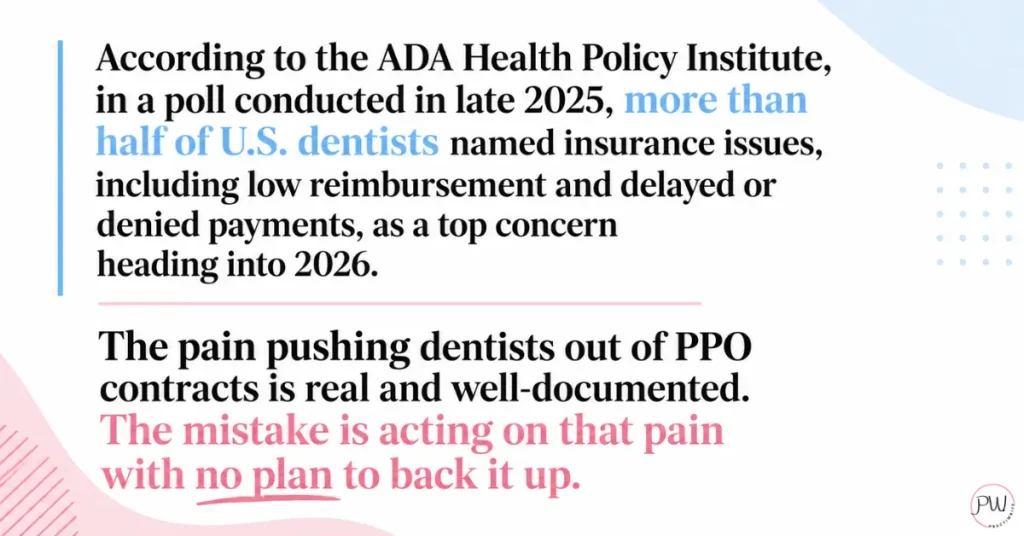
Most PPO to FFS transitions fail because dentists treat the switch as a billing change when it’s actually a patient-acquisition change. Drop the insurance and you lose the insurance company’s referral pipeline.
But if you didn’t build your own pipeline first, you’ve got nothing feeding the schedule.
It usually comes down to four mistakes, and most failed transitions make all four:
- They drop plans before building any way to attract new patients on their own.
- They treat it as a pricing decision instead of a positioning decision.
- They have no plan for telling existing patients what’s changing or why.
- They’ve got a front desk that can’t explain out-of-network value without sounding apologetic.
Each one is fixable. Together, they’re a wrecking ball.
The good news is that fixing them is mostly about sequence, doing the right things in the right order, which is exactly what the rest of this covers.
The insurance network was never your marketing. It just felt like it was. So which of these four is already true in your practice right now?
Why Does Going Fee-For-Service Before Fixing Your Online Presence Backfire?
Going fee-for-service before fixing your online presence backfires because the moment you leave the network, your Google Business Profile and your website become your new front door. Most practices try to walk patients through a door that doesn’t open.
Think about what changes. As a PPO practice, a chunk of your new patients found you through the insurance directory. They picked you because you were in-network and nearby.
Strip that away and patients have to find you the way they find every other local business: by searching, reading reviews, and judging your website in about eight seconds.
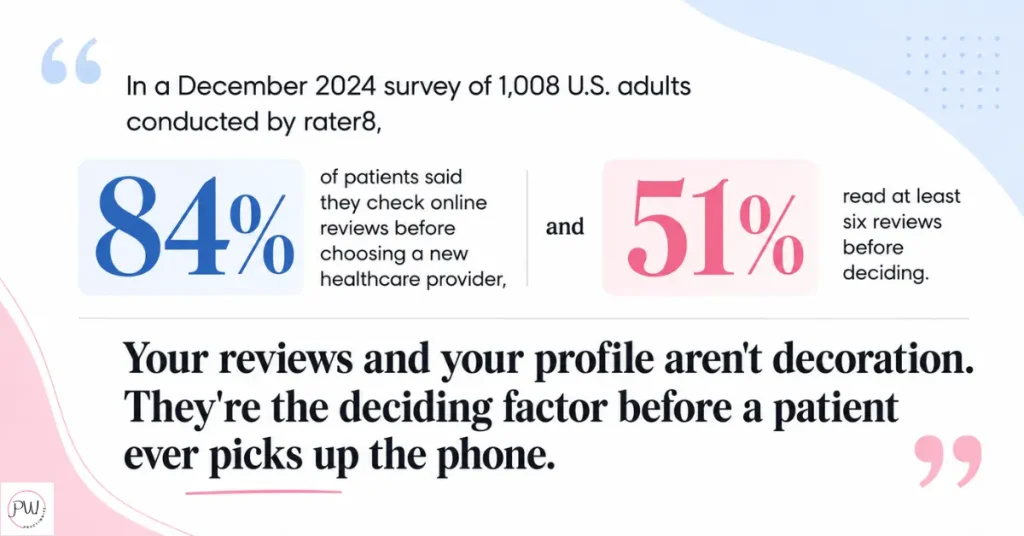
So when your profile is half filled out and your website reads like a brochure from 2014, here’s what happens. The PPO patients leave right on schedule, but the new fee-for-service patients never arrive. They can’t find you, or they do find you and aren’t impressed enough to call. That’s the backfire. You removed the old source of patients without turning on a new one.
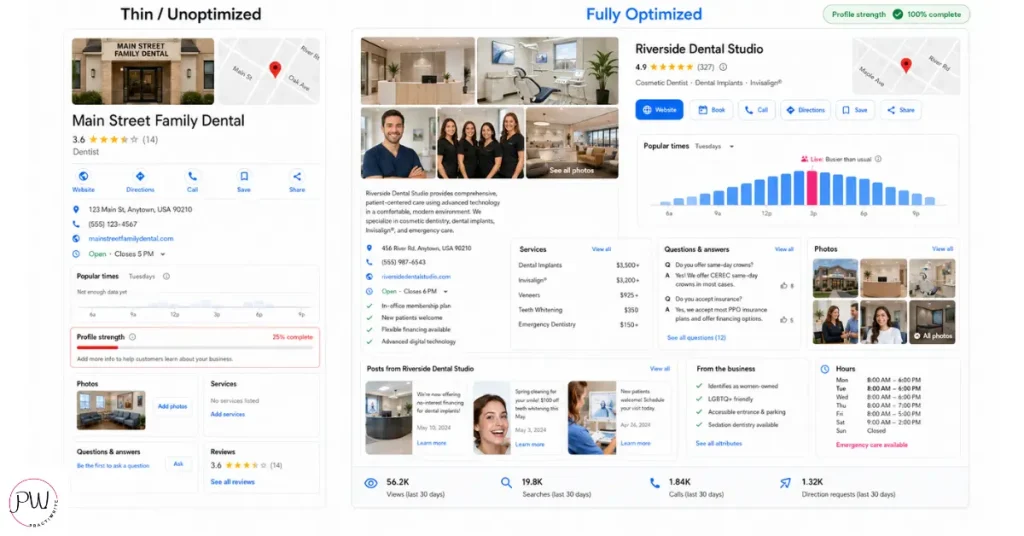
When the insurance directory stops sending patients your way, what’s actually sending them instead? This is why we tell every practice to fix the foundation first. Your profile and your website do the heavy lifting in a fee-for-service model, because they’re carrying the exact load the insurance network used to carry.
Want the full picture of how this foundation works together? Start with our pillar guide on fee-for-service dental marketing.
Is Dropping Your PPO Plans The Same As Becoming a Fee-For-Service Practice?
No. Dropping your PPO plans is an event. Becoming a fee-for-service practice is a system.
The event takes an afternoon and a few certified letters. The system is everything that makes a patient choose to pay your full fee and feel good about it.
This is the confusion that sinks people. They think the hard part is the paperwork to leave the network.
The paperwork is the easy part.
The hard part is building a practice where being out-of-network is a non-issue, because the value is obvious before anyone asks about insurance.
A real fee-for-service practice has answers ready for “why don’t you take my insurance?” It has a patient experience that earns the fee. It has financing options, clear pricing conversations, and a reason to be there that has nothing to do with a network logo in a directory.
Leaving the network is a decision. Being worth it is a build.
Most consultants will happily sell you the exit. Almost nobody makes you do the build first, and that’s backwards. If your only answer to “why should I pay more here?” is “because we left your insurance,” how long do you really think that patient sticks around?
Why Does Your Front Desk Decide Whether the Transition Survives?
Your front desk decides whether the transition survives because they field the “wait, you’re not in my network anymore?” call. That single conversation either keeps the patient or hands them a reason to leave.
You can do everything else right and still lose patients at the desk. When your team sounds apologetic about your fees, patients hear a problem. When your team sounds confident and explains the value, patients hear a practice worth paying for.
Same facts, opposite outcome. Your fees don’t lose patients. Untrained scripts do.
This comes down to hiring and training the right people, which is a whole topic on its own. I break down the hiring side in depth in how to hire dental staff for an FFS practice.
Who’s actually having the hardest conversation in your transition, you or the person answering your phones?
What Does a PPO-to-FFS Transition That Actually Works Look Like?
A PPO to FFS transition that works is sequenced, not sudden. You build the patient-acquisition foundation first, train your team, communicate with patients, and only then start dropping plans, usually one at a time instead of all at once.
Here’s the order that keeps you out of the failure pile:
- Fix the foundation. Get your Google Business Profile fully optimized and your website built to be found and to convert. This is what replaces the insurance referral pipeline.
- Build your value story. Use content, reviews, and clear messaging that answer why you’re worth the full fee before a patient ever asks.
- Prep your team. Train the front desk to handle out-of-network conversations with confidence, not apology.
- Phase the plan drops. Start with your worst-paying plan, watch what happens, adjust, then move to the next. Cold turkey is how you panic. Phased is how you stay in control.
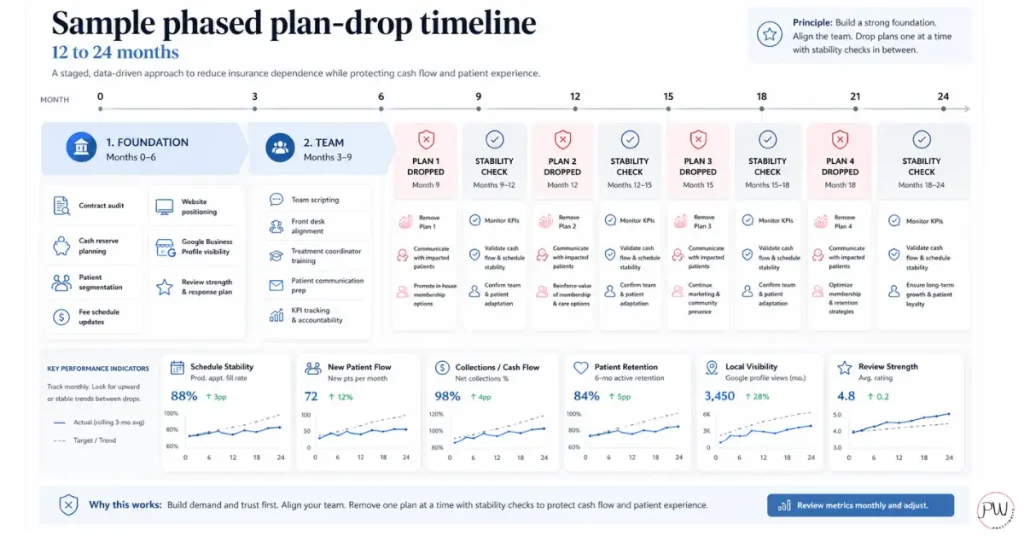
Notice what comes last. The actual plan-dropping, the part everyone thinks is the whole transition, is step four. Get the first three right and step four is almost boring. Skip them and step four is a cliff. Fee-for-service isn’t a leap of faith. It’s a sequence, and a sequence is something you can actually follow.
Wrapping Up: Be The Exception With Your PPO to FFS Transition
PPO to FFS transitions don’t fail because fee-for-service is risky. They fail because dentists drop the insurance before they build the thing that brings patients in without it.
The profile, the website, the value story, the team, the phased plan: that’s the whole difference between a practice that thrives out-of-network and one that quietly re-credentials by spring. So before you touch a single contract, get an honest look at whether your foundation can actually carry the weight.
Schedule your 100% free Dental Practice Roadmap.
Your Dental Practice Roadmap is a GBP and website audit that shows you exactly where you stand, what keywords you’re ranking for now, what you should be ranking for, and a step-by-step plan to close those gaps.
No vague recommendations. No fluff. Just a clear picture of what’s broken and what to do about it.
Book your Dental Practice Roadmap and get yours today now.

10+ year content strategist, writer, author, and SEO consultant. I work exclusively with fee-for-service dental practices that want to build value, not volume.