
Every dentist I talk to asks the same question before they sign anything: how fast will this work?
Fair question. You’re about to spend real money, and your schedule doesn’t care about marketing theory.
Here’s the straight answer. Results from dental marketing show up in three waves.
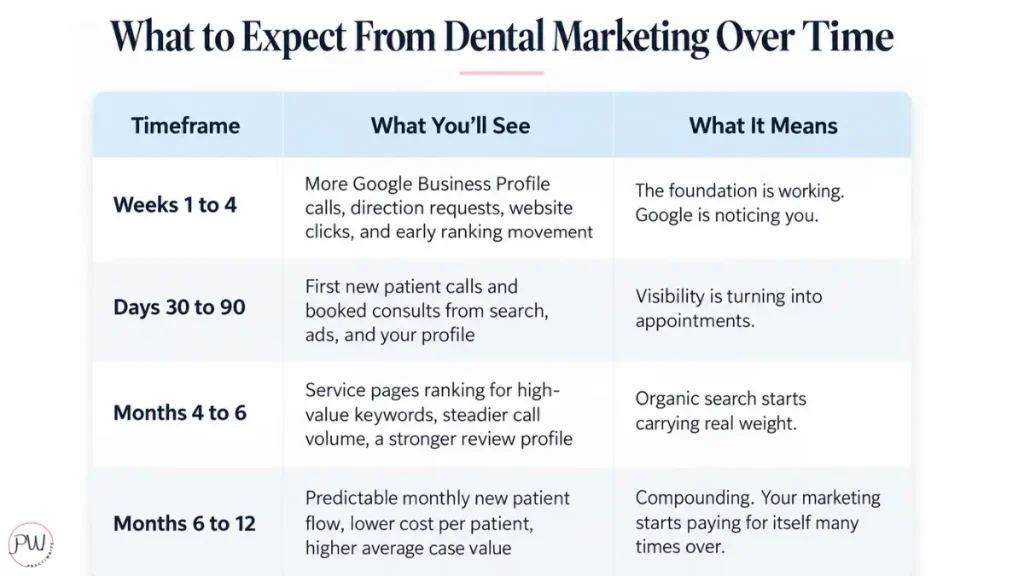
You’ll see leading signals, like more calls, direction requests, and ranking movement, within 2 to 4 weeks. Your first new fee-for-service patients typically book within 30 to 90 days. And the compounding growth, the kind that keeps your chairs full without you babysitting it, builds between months 6 and 12.
That’s the timeline. Anyone promising you more than that, faster than that, is selling something your practice doesn’t need.
Now here’s the part most agencies won’t tell you. Speed is the wrong scoreboard for a fee-for-service practice.
PPO-based practices run on volume, so their marketing “works” the second the schedule looks crowded.
Fee-for-service practices run on quality. Your marketing isn’t trying to fill every slot with whoever calls first. It’s sorting for the patients who value your care and say yes to the treatment plan.
That sorting takes a little longer to show up on your calendar and a lot less time to show up on your P&L.
So the real question isn’t “how fast will I get patients?” It’s “how fast will I get the right patients?”
Those are two very different questions.
One of them gets you a busy schedule.
The other gets you a profitable practice. Let’s talk about the second one.
How Long Does It Take To See Results From Dental Marketing?
Results from dental marketing arrive in three waves: signals, patients, and compounding growth.
Signals show up in 2 to 4 weeks. New patients follow in 30 to 90 days. Compounding growth builds between months 6 and 12.
Each wave depends on the one before it, which is why demanding “where are my new patients?” in week two leads to bad decisions, like firing an agency right before the work pays off or doubling down on one that was never going to deliver.
Here’s what each stage looks like in a fee-for-service practice:
Your starting point shifts this timeline. A practice with a clean Google Business Profile and consistent listings moves faster than one that’s been ignoring its online presence for years.
One practice I worked with had 14 different variations of its name and address floating around the internet. Google couldn’t figure out which one was real, so it didn’t trust any of them. Fixing that came before anything else.
What Counts As A Result For A Fee-For-Service Dental Practice?
For a fee-for-service dental practice, a result is a booked patient who values your care and accepts treatment.
Traffic isn’t a result. Impressions aren’t a result. Likes definitely aren’t a result, unless your landlord started accepting them as rent.
Plenty of agencies report on vanity metrics because those numbers go up easily and look great in a colorful monthly PDF. But a fee-for-service practice needs a different scoreboard. The numbers that actually matter are:
- New patient calls from people in your area who are searching for services you offer
- Booked consults for high-value services like implants, cosmetic work, and full-mouth rehabilitation
- Case acceptance, because a consult that never turns into treatment is just an expensive conversation
- Patient fit, meaning fewer “do you take my insurance?” calls and more “when can I come in?” calls
If your marketing report leads with impressions and buries the phone calls on page six, ask yourself what someone is hoping you won’t notice.
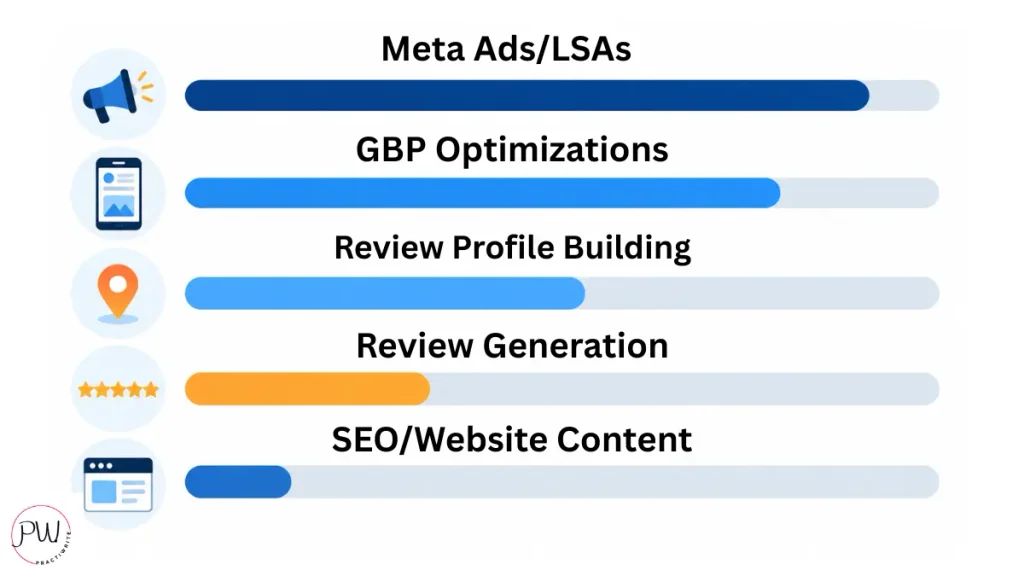
How Fast Does Each Dental Marketing Channel Work?
Each dental marketing channel works on its own clock. Paid channels are the fastest, organic channels are the slowest, and the ones in between depend almost entirely on execution. Knowing which clock you’re watching keeps you from judging a six-month strategy by a six-week standard.
How Fast Does Google Business Profile Optimization Work?
Google Business Profile optimization typically produces measurable movement within 2 to 6 weeks. It’s the fastest organic lever a dental practice has, because Google picks up changes to your categories, services, listing consistency, photos, and posts quickly.
It’s also where patients searching “dentist near me” make their decision, often without ever clicking through to your website. That’s why your profile is usually the first place leading indicators like calls and direction requests start to climb.
How Fast Do Local Service Ads Generate Leads For Dentists?
Local Service Ads can generate leads within days of going live. The catch is getting live.
Google requires screening and verification before your ads run, and how long that takes depends largely on how quickly your paperwork moves. Once you’re approved, you pay per lead instead of per click, which is a much better deal for most practices.
One practice I worked with was spending $3,200 a month on Google Ads and getting 11 new patient calls. After switching to Local Service Ads, they spent $2,400 a month and got 28 new patient calls. Less money, more than double the calls.
That’s not magic. That’s picking the right channel.
How Long Does Dental SEO And Website Content Take To Work?
Dental SEO and website content typically take 3 to 6 months to produce meaningful organic traffic and 6 to 12 months to fully compound. Technical fixes, like repairing indexing errors or merging duplicate pages, can move rankings much faster.
One practice had three separate pages competing for “dental implants.” I merged them into one strong page, and it jumped from page three to the top of page one in less than a month.
New content for high-value services takes longer, because the competition for keywords like “dental implants in [your city]” is heavier. That’s also exactly where fee-for-service case value lives. The slowest channel happens to be the one that builds the most valuable asset you’ll own.
How Long Does It Take To Build A Review Profile That Converts?
A review profile that converts isn’t built once. It’s maintained constantly, because patients only trust recent reviews. A steady review system usually starts improving your profile within the first 30 to 60 days, but the work never really ends.
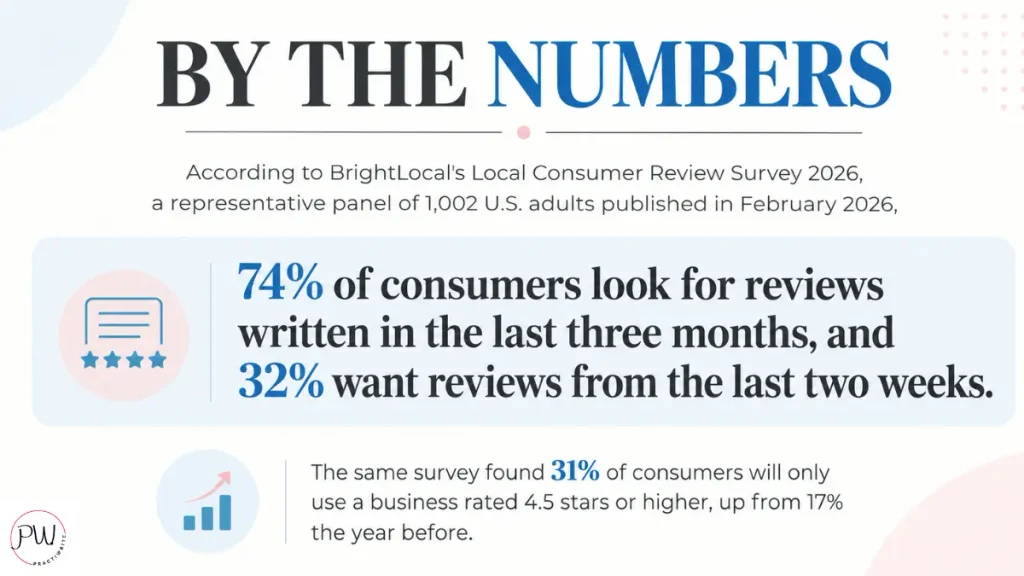
Translation: Your review strategy has a 90-day shelf life. A practice with 200 glowing reviews from 2023 looks, to a patient searching today, like a practice that stopped caring in 2023.
How Fast Do Meta Ads Work For Dental Practices?
Meta Ads can produce leads within the first 1 to 2 weeks, but they work differently than search. Search captures people who are already looking for a dentist. Meta reaches people who aren’t looking yet and gives them a reason to start.
That makes Meta Ads useful for elective and cosmetic services, and less useful if nobody at your front desk follows up quickly. A Meta lead that sits in an inbox for three days isn’t a lead anymore. It’s a missed opportunity with a timestamp.
Why Do Fee-For-Service Practices See Marketing Results On A Different Timeline Than PPO Practices?
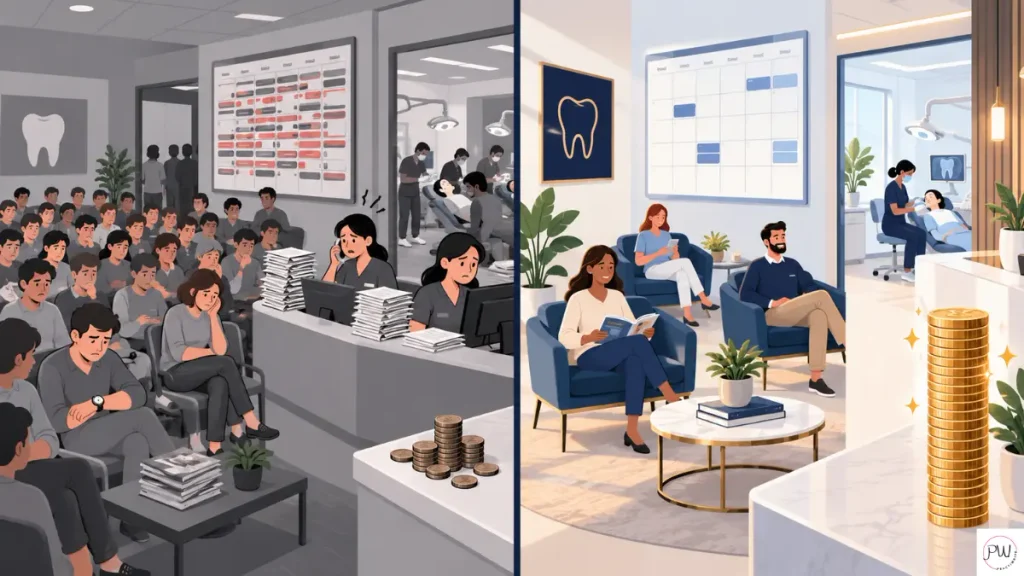
Fee-for-service practices see marketing results on a different timeline because they’re measuring case value, not volume. A PPO-based practice judges its marketing by how full the schedule looks, and that shows up in weeks.
A fee-for-service practice judges its marketing by the quality and value of the cases it accepts, and that takes longer to show up because high-value patients take longer to decide.
A cleaning patient decides in the time it takes to find their insurance card. An implant patient decides after a consult, two conversations with their spouse, and one deep dive into financing options at 11 p.m. The gap between the first phone call and accepted treatment can stretch across weeks.
That doesn’t mean fee-for-service marketing is slower. It means it’s playing a different game. One accepted full-mouth case can outproduce a month of new hygiene patients. A quieter phone isn’t a failure if the right people are the ones calling.
Would you rather have 40 new patients who argue about their copay, or six who say yes to the treatment plan?
Why Do Some Dental Marketing Agencies Promise Results In 30 Days While Others Say 12 Months?
Dental marketing agencies that promise results in 30 days are usually selling volume, and agencies that ask for 12 months of patience are usually selling a long contract. Neither answer fits a fee-for-service practice.
The 30-day promise is the PPO playbook. Flood the phone, fill the schedule, and hope nobody checks whether those patients ever accepted treatment. The 12-month answer is the opposite problem. It gives an agency a full year to deliver very little while you wait politely for the “compounding” to kick in.
The honest answer lives in between. Good dental marketing runs in short, focused cycles, and each cycle produces something you can measure.
You see signals in weeks, patients in months, and compounding growth over the year. Nobody pretends the last part happens overnight, and nobody hides behind it either.
Here’s a simple test for any agency: ask what you should see at day 30, day 90, and day 180. If they can’t answer in specifics, they don’t know either.
What Slows Down Dental Marketing Results?
Dental marketing results slow down because of execution gaps, not because of your location or your market. Your zip code isn’t the problem. What’s been done (or not done) with your online presence is.
The most common gaps are:
- Inconsistent listings. When your name, address, and phone number don’t match across the web, Google stops trusting your information.
- Thin or duplicate service pages. Three weak pages about the same service compete with each other instead of beating your competitors.
- Stale reviews. A profile that hasn’t seen a new review in months tells patients you’re coasting.
- No call tracking. If you can’t tell which calls came from which channel, you can’t tell what’s working.
- A front desk that doesn’t convert. Marketing can make the phone ring. It can’t answer it.
That last one stings, but it matters. You can’t market your way out of a phone that rings to voicemail. The fastest marketing results in the world disappear the moment a high-value caller gets put on hold for four minutes.
Does Waiting To Start Dental Marketing Cost You More Than Starting?
Yes. Waiting to start dental marketing costs more than starting, because every month you wait is a month your competitors spend compounding. The 6 to 12 month growth curve doesn’t start when you feel ready. It starts when you start.
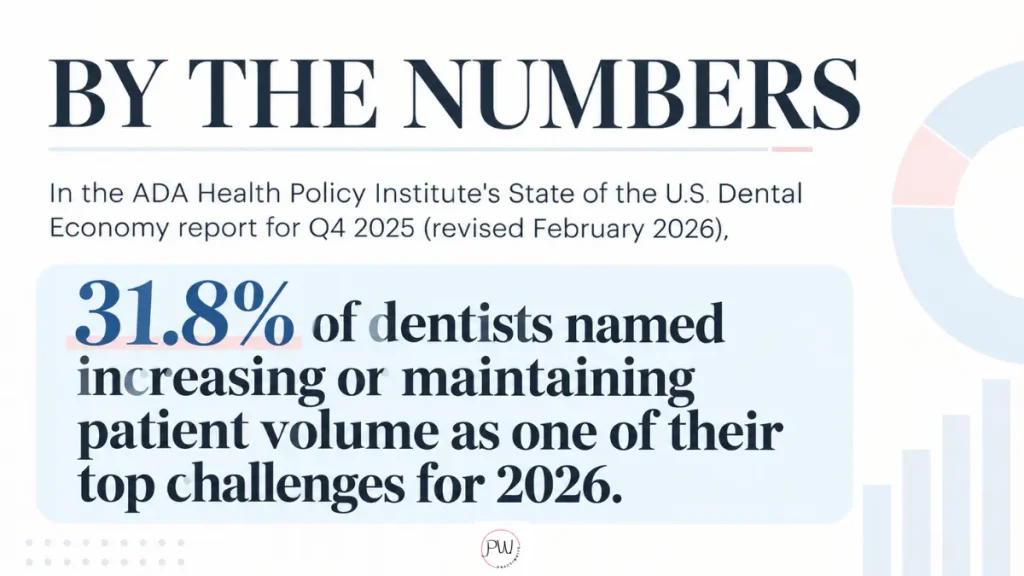
Nearly one in three dentists already expects a patient-flow problem this year. The practices that solve it won’t be the ones that waited for a quieter month to get started.
Waiting for the perfect time to start marketing is a lot like waiting for the perfect time to floss. It never comes, and the results of waiting are predictable.
How Do You Know Your Dental Marketing Is Working Before New Patients Show Up?
You know your dental marketing is working before new patients arrive by tracking leading indicators. These are the early signals that tell you visibility is growing, even before it turns into booked appointments. In the first 30 to 60 days, watch for:
- Google Business Profile calls and direction requests, which show patients are finding you and taking action
- Impressions for your service keywords, which show Google is putting you in front of the right searches
- Ranking movement on high-value terms, like implants, cosmetic dentistry, and your city name
- Website form submissions and click-to-call taps, which show your site is turning visitors into contacts
If none of these move within 60 days, something’s broken. That’s your cue for a hard, specific conversation with whoever’s running your marketing.
Is 90 Days Long Enough To Judge A Dental Marketing Agency?
Ninety days is long enough to judge the direction of a dental marketing campaign, but not its full results. By day 90, a practice should see clear movement in leading indicators, such as Google Business Profile calls and ranking changes, along with initial new patients from faster channels like Local Service Ads. Organic SEO results typically continue building for 6 to 12 months.
Can Dental Marketing Work Faster For An Established Practice Than A New One?
Dental marketing generally works faster for an established practice than a new one. Established practices usually have existing reviews, business listings, and website history that Google already recognizes. A new practice starts without that foundation, so early efforts focus on building trust signals before rankings and patient flow can grow.
Why Does Dental SEO Take Longer Than Paid Ads?
Dental SEO takes longer than paid ads because paid ads buy placement immediately, while SEO earns placement over time. Search engines need time to crawl, evaluate, and trust new or improved content before ranking it. Paid placement stops the moment spending stops, while SEO rankings continue producing patients long after the work is done.
What Should A Dentist Track In The First Month Of A New Marketing Campaign?
In the first month of a new dental marketing campaign, a dentist should track Google Business Profile calls, direction requests, website clicks, impressions for service keywords, and early ranking movement. These leading indicators show whether visibility is improving before new patient bookings begin to increase, which typically happens within 30 to 90 days.
Wrapping Up: What Should You Do Next?
Stop asking how fast your marketing will work and start asking how fast it’s moving you toward the right patients.
Signals come in weeks. Patients come in months. Compounding growth comes to the practices that start, measure the right things, and don’t flinch when a high-value patient takes a few extra weeks to say yes.
The practices that win the next 12 months are the ones that started measuring the right results today. But you can’t measure progress from a starting line you can’t see.
Schedule your 100% free Dental Practice Roadmap. Your Dental Practice Roadmap is a GBP and website audit that shows you exactly where you stand, what keywords you’re ranking for now, what you should be ranking for, and a step-by-step plan to close those gaps.
No vague recommendations. No fluff. Just a clear picture of what’s broken and what to do about it.
Book your Dental Practice Roadmap and get yours today now.

10+ year content strategist, writer, author, and SEO consultant. I work exclusively with fee-for-service dental practices that want to build value, not volume.